Presidential Colloquium Examines Future of Manufacturing in Connecticut

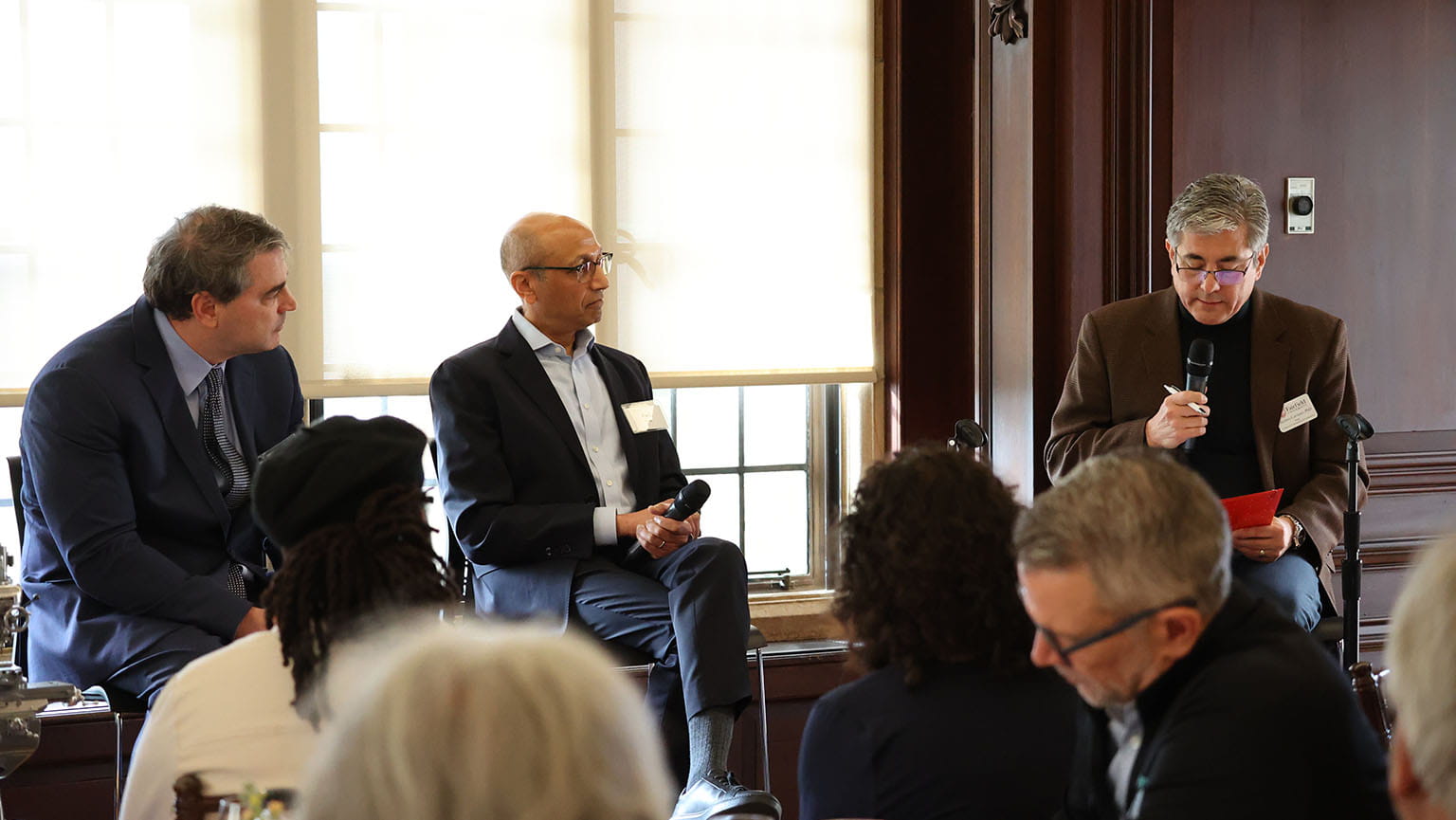
Colloquium speakers sitting at the front of a brightly-lit windowed room while discussing the future of manufacturing in CT.
(l-r) ASML Chief of Staff Andrew Judge, PhD, Connecticut's Chief Manufacturing Officer Kirti Patel, and School of Engineering and Computing Dean Andres Leonardo Carrano, PhD, were panelists at the March 19 Presidential Colloquium.
By Jackie Bertolone

What will it take to sustain and grow manufacturing in Connecticut? That was the question on the minds of business executives, foundation leaders, and community partners as they gathered in Bellarmine Hall on March 19 for a panel discussion hosted by University President Mark R. Nemec, PhD.

Positioning higher education as an engine of change, President Nemec described the modern university as both a civic institution and a driver of economic and industrial competitiveness. Fairfield University, he said, leans fully into its dual role.

He likened today’s surge in AI and digital technologies to a “new Sputnik,” a moment driving broad shifts across industries and institutions, and pointed out that Fairfield is a leader and engaged partner—driven in part by School of Engineering & Computing programs that connect academic inquiry with innovation and workforce development.

School of Engineering & Computing Dean Andres Leonardo Carrano, PhD, who moderated the panel, grounded that vision in a personal story. Trained as a manufacturing engineer, he spoke of his early days on the factory floor and the quiet pride he still feels when passing by the historic Bridgeport milling machine displayed outside Fairfield’s engineering center. It serves, he noted, as a reminder that Connecticut’s story has long been shaped by steel, optics, and precision manufacturing.

Manufacturing Drives Growth and Job Creation

Panelist Kirti Patel, the state’s chief manufacturing officer and deputy commissioner for economic development, reminded the audience of the scope of Connecticut’s long-standing manufacturing identity. Beyond the trees and farms visible from our highways and roads, he said, lies a vibrant manufacturing sector that is the state’s second-largest contributor to GDP. Roughly 4,600 manufacturers generate about $34 billion in output—11 to 12 percent of Connecticut’s GDP—and employ approximately 153,000 people, or 10 percent of the private workforce.

“Connecticut is unique because of its highly specialized supply chain, skilled workforce, deep engineering expertise and talent,” Patel said, “and its strong legacy of innovation combined with high quality standards."

About 80 percent of Connecticut’s manufacturers are small- and medium-sized firms, often family-owned, and deeply rooted in their communities. Together, they produce critical components for submarines, jet engines, surgical devices, electronics, and the sophisticated equipment used in semiconductor production. Through programs such as the Manufacturing Innovation Fund, the state is helping these companies adopt smart, data-driven Industry 4.0 technologies and build the workforce needed to support them.

The state’s workforce demands were brought into focus by Andrew Judge, PhD, chief of staff at ASML and adjunct faculty member in Fairfield’s School of Engineering & Computing. He described the extraordinary precision of ASML’s lithography systems—room-sized machines capable of positioning components with sub-nanometer accuracy to pattern billions of transistors onto a chip. Many of the systems’ critical subsystems, he noted, are engineered and manufactured in Connecticut, underscoring the state’s essential role in the global semiconductor supply chain.

Mechatronics Engineering: Preparing the Next Generation

Meeting these demands requires a new kind of multi-disciplinary engineer, said Dr. Judge as he explained the growing importance of mechatronics—the integration of mechanical, electrical, and software engineering into intelligent, high-precision systems.

“Fairfield University is at the forefront of developing this as a direct, specialized skill,” Dr. Judge said. “This combined discipline sets graduates apart.”

Fairfield’s new BS in Mechatronics Engineering—one of only a handful of such programs in the country—was developed in close collaboration with ASML and aligned with Connecticut’s workforce priorities. The program prepares students to design, integrate, and operate the advanced automated systems “at the heart of Industry 4.0.”

As Dean Carrano noted, the University is responding directly to workforce needs, preparing engineers who will help power the future of manufacturing in Connecticut.

Related Stories