Held in the Diffley Room of Bellarmine Hall, the three-part colloquium was the brainchild of Special Assistant to the President Philip Eliasoph, PhD.
By
Jackie Bertolone
For three mornings this fall, invited business and community leaders met in Bellarmine Hall for a series of working conversations led by University President Mark R. Nemec, PhD, on the challenges and opportunities facing higher education.
The discussions ranged from civic formation to NIL (Name, Image, and Likeness) policy to emerging AI tools, with a focus on how institutions can navigate rapid change with clear values and realistic expectations. Conversations returned repeatedly to the question of how Fairfield University—as a regional anchor—can sustain public trust by preparing students for leadership on campus, in competition, and in the workplace.
Higher Education as a Civic Enterprise
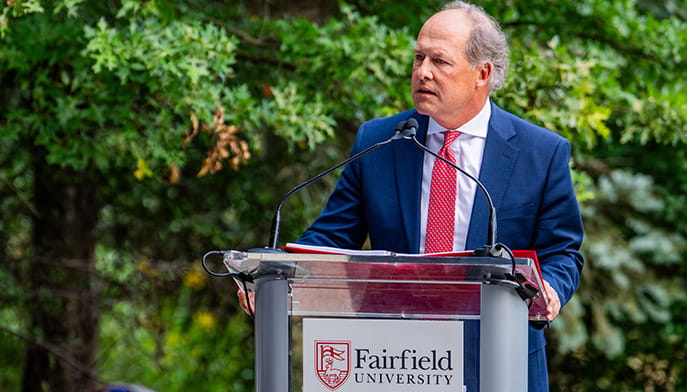
On Sept. 25, Dr. Philip Eliasoph offered opening remarks before President Nemec began the series with a provocation and a promise, reframing the University not as a static institution but as “a living engine of the republic.” He traced a lineage from colonial colleges to the land-grant movement and the GI Bill—periods when higher education widened both access and ambition.
Dr. Nemec situated Fairfield's rising selectivity and yield within a broader sector marked by demographic shifts, urbanization, globalization, and accelerating technological change, then returned to first principles: universities are anchors of democratic life and economic vitality. "Higher education is not simply a private good—it is a civic enterprise, "he said, underscoring Fairfield's regional economic contribution—more than $1.2 billion within Connecticut. He connected that to a deeper vocational claim rooted in Jesuit humanism: forming "productive citizens" who strengthen communities and democratic culture.
Higher education is not simply a private good—it is a civic enterprise."
- Mark R. Nemec, PhD
In his historical sweep, Dr. Nemec reminded the audience that today's tensions—public scrutiny, policy shifts, governance debates—are not unprecedented. What matters, he suggested, is maintaining institutional autonomy with accountability, and aligning growth to mission and public purpose. "Our job as university leaders,” he said, "is not to manage the moment," but to be several steps ahead of the present moment.
NIL and the Changing Landscape of College Athletics
The second colloquium on Oct. 23 turned to athletics and NIL policy, with a candid assessment from Athletics leadership and coaches about competitiveness, integrity, and formation. "In times of massive disruption‚ there also exists incredible opportunity," said Paul Schlickmann, VP for Athletics, describing how Fairfield has opted into the new model and is investing strategically while ensuring that the Stags’ student-athlete experience remains transformational, not transactional.
"We're competing, but we're competing with integrity—forming people, not just chasing wins," noted President Nemec.
Women's basketball head coach Carly Thibault-DuDonis described a values-first approach that has made Fairfield nationally relevant: a team-centered style, a tiered and stable NIL model to support retention, and recruiting that prioritizes culture and long-term development alongside competitiveness. "We can be one of the best teams in the country and still be true to who we are," she emphasized, noting recent players’ decisions to remain at Fairfield—valuing fit and formation over higher-dollar offers elsewhere.
Men's basketball head coach Chris Casey outlined the realities of the current marketplace—agents in recruiting, portal volatility, and the need to retain players. He reaffirmed Fairfield's path: recruit families who value education, community, and post-graduation opportunities, and use NIL pragmatically to support a traditional, developmental model. "We want as many ‘normal’ situations as possible," he said, "and we'll retain by coaching, culture, and appropriate NIL."
Artificial Intelligence on College Campuses
The closing session on Nov. 20 centered on AI, less as a hype cycle and more as a human question. President Nemec urged principled ambition anchored in human flourishing: set ethical parameters, build literacy, and prepare students and faculty to use AI responsibly.
Featured panelists for the discussion on AI included Gregg Caruso, PhD, director of Fairfield's Patrick J. Waide Center for Applied Ethics, alongside CEO of the Business-Higher Education Forum Kristen Fox and University Trustee Hugh Davis '95.
Fairfield's AI framework focuses on five areas: teaching and learning, organizational maturity, data governance, workforce development, and human flourishing—reflecting an approach that treats AI both as a tool and as part of the environment in which students are formed. “For us, AI is as much a spiritual and philosophical question as it is an organizational one,” said Dr. Nemec. “We ask not only what it can do, but whether it can be wise, creative, and just—and we remember it will only be so to the extent that we are.”
“The internet changed where we work,” offered panelist Hugh Davis ‘95, an entrepreneur and University Trustee. “AI is changing how we work—and what skills define a leader.”
Panelist Kristen Fox, CEO of the Business-Higher Education Forum, stressed that while enterprise adoption is uneven, individual experimentation is widespread and valuable. Graduates with AI fluency, she noted, are landing roles with higher salaries. Both panelists agreed that the durable competencies to cultivate across disciplines are critical thinking, communication, data literacy, and ethical discernment.
In summary, Dr. Nemec noted that within Fairfield’s primary arenas—classroom, competition, and innovation—our charge is the same: to act with clarity, form persons for others, and stay ahead of the curve. The premise, he said, is straightforward: institutions thrive when they align mission with measurable outcomes and lead change without losing their compass. The task is to plan continually, even as the terrain is shifting. The Colloquium Series will return for invited guests with new conversation topics this spring.