Business and economic leaders point to creative and critical thinkers as essential partners to artificial intelligence.
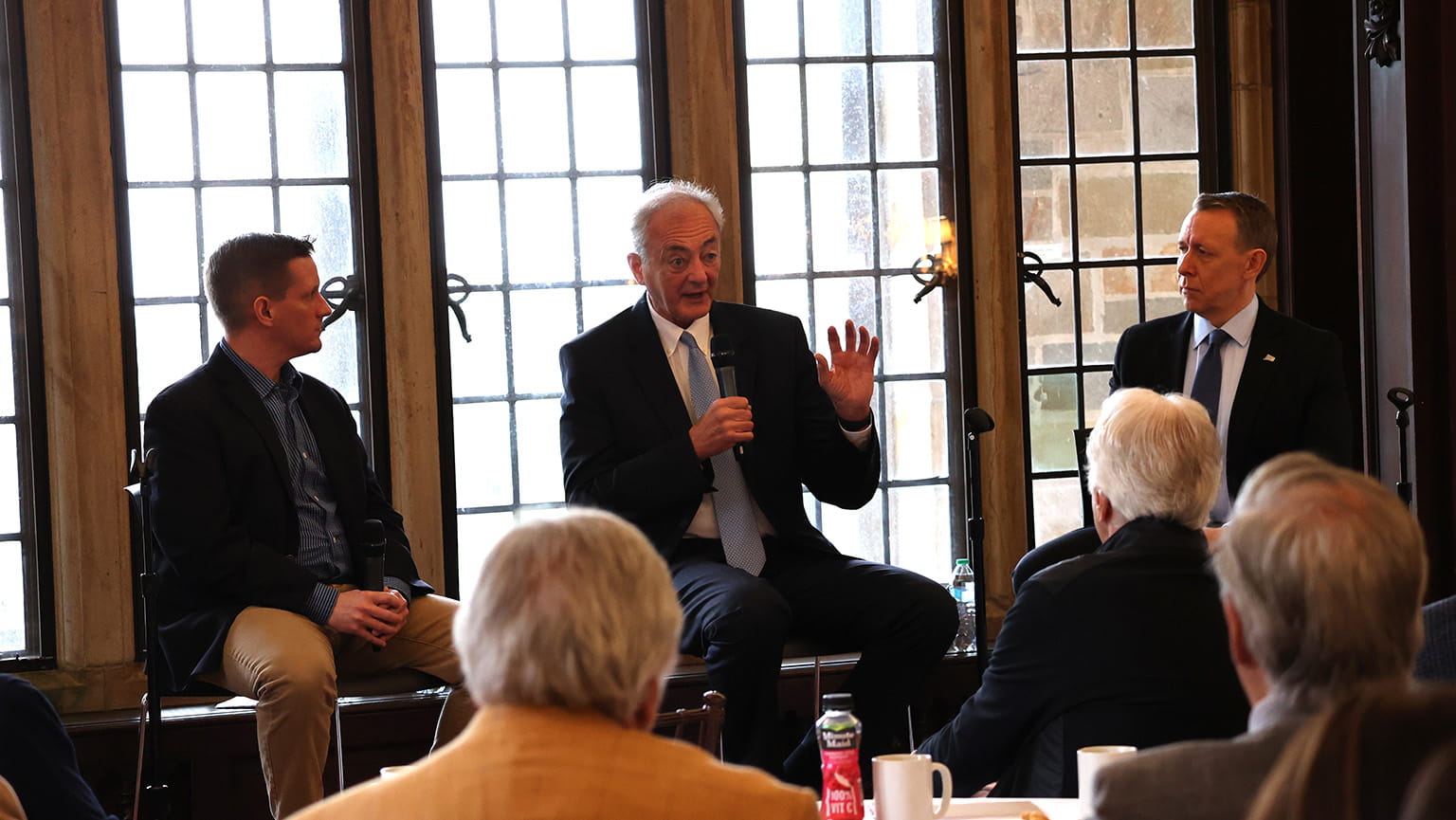
At the final Presidential Colloquium of the spring semester, academic and business leaders explored the future of work, technology, and economic growth in Connecticut. As the panel addressed topics from demographics to manufacturing and global trade, one message was clear: in an age of artificial intelligence, the humanities and the liberal arts are not optional—they are foundational.
The Power of Multimodal Thinking
John Bourdeaux, president and CEO of AdvanceCT, observed that as AI becomes more capable, broad human judgment and creativity become more—not less—valuable.
“What we need in the workforce is people who know how to think in different modalities, which is what a liberal arts education provides,” he said.
Students who can move between data, ethics, and human communication will be best positioned to thrive alongside emerging technologies.
Bourdeaux offered a memorable image: “Sometimes a physics problem needs a poet’s eye. That multimodal thinking is exactly what makes college graduates indispensable partners to AI, not competitors with it.”
AI can automate pattern recognition and routine analysis, he noted, but only humans can frame the right questions and weigh values.
AI as a Tool—Not a Substitute—for Inquiry
Tom Murray, PhD, associate professor in the Charles F. Dolan School of Business, described how AI is already changing teaching and learning at Fairfield. Not long ago, he said, many conversations focused on keeping AI out of the classroom. Now the discussion is how to bring AI in thoughtfully.
“We’re changing how we teach to integrate AI, but the core hasn’t changed: students still have to think rigorously, make arguments, and communicate clearly,” Murray said.
AI may help students organize information, but liberal arts skills—close reading, critical thinking, and sustained writing—remain foundational.
No More “Rifle Shots”—The Interdisciplinary Edge
From the industry side, John Traynor, president of Cambridge Trust Wealth Management, described how AI is raising expectations for new hires. Tasks he once handed to interns—like creating research outlines—can now be generated in seconds by AI tools. That reality, he said, means employers need graduates who can work at a higher level: interpreting, critiquing, and improving what AI produces.
As an undergraduate, Traynor admitted, he didn’t see the value in liberal arts majors. Today, his view has changed. “You just can’t be a rifle shot anymore,” he said. “The people who will succeed with AI are the ones with broad backgrounds—those who’ve learned to think across disciplines.”
The panelists agreed that the humanities and the liberal arts are central to preparing graduates who can use tools wisely, lead teams, and think bigger.
In closing, Dr. Nemec remarked, “We are forming students animated by our Jesuit Catholic mission so they leave Fairfield with a sense of hope and a sense of efficacy—confident not only that they can navigate a changing world, but that they can help shape it in service of the greater good.”