Fairfield biology students and professors are taking on cancer, climate change, and wildlife conservation.
At Fairfield University’s John Charles Meditz College of Arts and Sciences, biology research begins with urgent questions—and leads to meaningful action. From species facing extinction and ecosystems under stress to diseases demanding new treatments, students and professors are applying science where it matters most.
In Research...
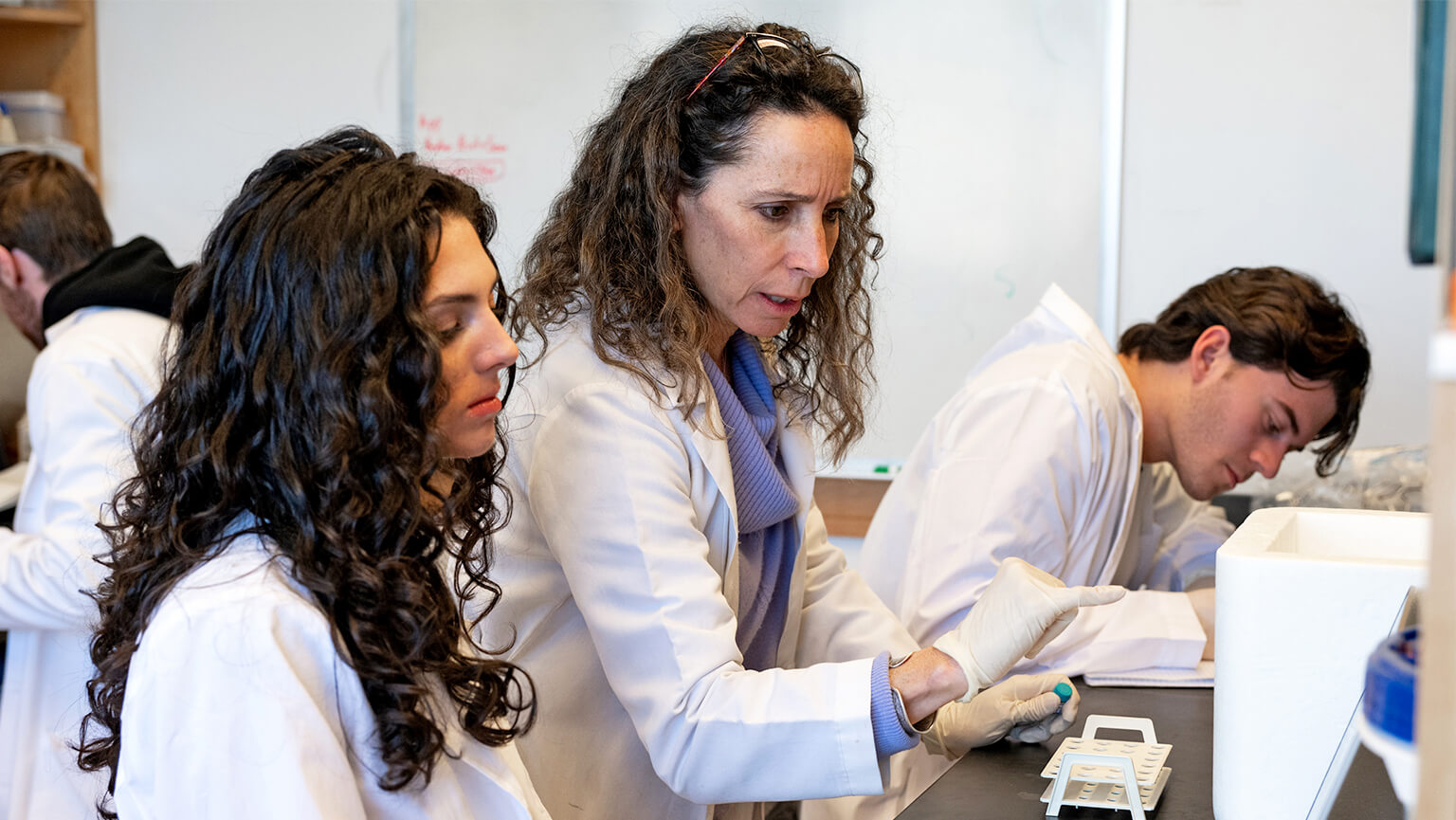
...supported by external grants and alumni donors, students are working with Shelley Phelan, PhD, professor of biology and director of the Science Institute, to answer the question: Can natural plant-derived compounds help combat breast cancer?
“I have focused my work on breast cancer for many years, as it is one of the most prevalent forms of cancer in the U.S. and has benefited from various types of treatments,” said Dr. Phelan. “But tumors of the breast have a lot of heterogeneity—meaning not all cancer cells behave the same way, even within a single tumor—making treatment difficult. Some cells can develop resistance to drugs, leading to tumor regrowth.”
Dr. Phelan’s lab previously focused on understanding the altered biology of breast cancer cells and the mechanisms of traditional chemotherapy drugs. Concerned about the toxicity of conventional treatments—and encouraged by research showing the cancer-preventive effects of certain natural compounds—she began investigating whether those same compounds might also help treat breast cancer. Her work now centers on olive leaves and pomegranate seeds, which have a long history of human consumption and known health benefits.
“The Mediterranean diet, rich in olive oil, has been associated with lower risk of many cancers,” Dr. Phelan explained. Her lab studies oleuropein from olive leaves and punicic acid from pomegranate seeds.
Working alongside Dr. Phelan, biology majors Jenna Walsh ’27, Katie Tirino ’27, Samantha Diiorio ’26, Giovanna Kalin ’26, and Adam Vaz ’26 are studying how these natural compounds affect different types of breast cancer cells—from slower-growing forms to more aggressive cancers. Their early findings suggest that oleuropein targets cancer cells more effectively than healthy breast cells, pointing to its potential as a more precise treatment.
"Both of these cancer cell types were much more susceptible to oleuropein than normal breast cells," Dr. Phelan said, "suggesting that it may have important cancer specificity." The lab has also found that punicic acid can be effective at even lower doses in certain cancer cells.
For Vaz, the project holds deep personal meaning. "As a cancer survivor, I know how damaging treatments like chemotherapy can be," he said. Working in Dr. Phelan's lab, the alternatives he is helping to explore could one day offer patients safer, more targeted options.
In the Lab...
...of professor of biology Shannon Gerry, PhD, the question is: how do rising ocean temperatures affect fish movement and muscle function? As climate change warms coastal waters, species such as cunner and black sea bass—both common to Long Island Sound—are forced to migrate north, potentially disrupting food webs and altering predator-prey relationships.
"Long Island Sound is warming faster than much of the northwest Atlantic Ocean,” Dr. Gerry said, making it ideal for studying climate change in real time.
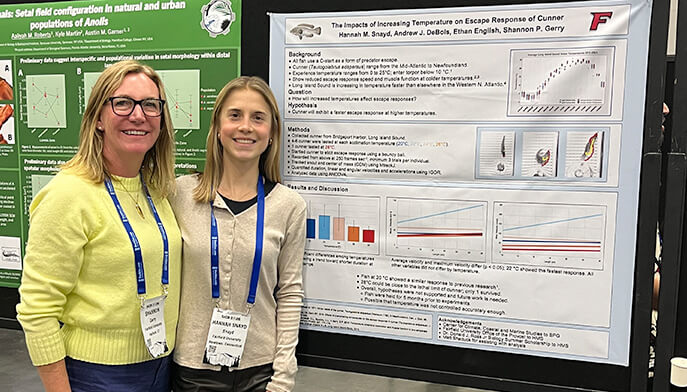
Dr. Gerry and students Hannah Snayd ’27 and Matt Shattuck ’28 are studying what’s known as the “C-start” escape response—a lightning-fast movement fish use to evade predators and occasionally to capture prey. The entire response is completed in roughly 100 milliseconds, so the research relies on high-speed cameras to capture every detail.
After collecting fish from Bridgeport Harbor and transporting them to a 200-gallon tank in the campus lab, the researchers acclimate the fish to different water temperatures before filming them under a simulated predator threat. Students then study the footage, frame by frame, to measure how quickly and powerfully each fish moves—key indicators of its ability to survive in warming waters.
Their findings reveal a concerning pattern. While escape performance improves slightly as temperatures rise, it drops significantly at a critical threshold. “Ecologically, 28 degrees Celcius may be close to the lethal limit for cunner,” Dr. Gerry said.
“This leads us to conclude that as temperatures continue to rise, at a certain point the Long Island Sound will no longer be viable for the cunner to live,” noted Snayd, who presented the research at the Society for Integrative and Comparative Biology Annual Meeting in Portland, Oregon, this winter. “Further migration of cunner to colder waters would have significant impacts on the whole ecosystem.”