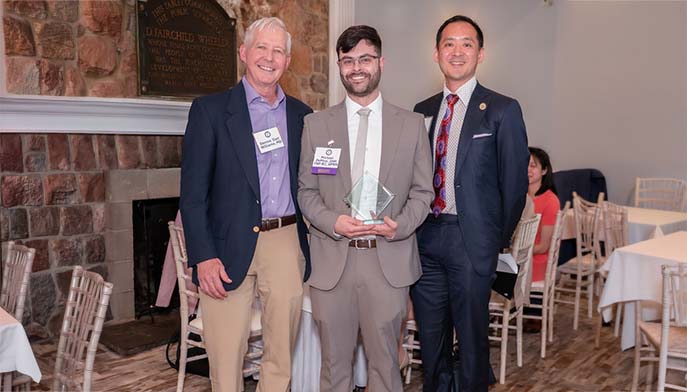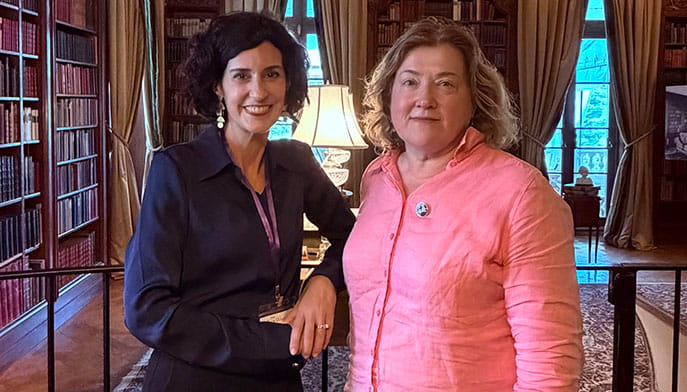
For the first time in four decades, Edith Wharton scholars, readers, and enthusiasts gathered at The Mount in Lenox, Massachusetts, for a landmark international summit dedicated to the celebrated American author. The Mount is Wharton’s historic estate, which she designed and built in 1902. Emily Orlando, PhD, professor of English and Corrigan Chair in the Humanities and Social Sciences, co-led the summit.
Held June 3-6, the Edith Wharton Summit brought together approximately 90 participants from across the United States, Canada, France, Norway, England, Scotland, Kenya, and beyond. The event was organized by Dr. Orlando and Dr. Laura Rattray of the University of Glasgow at the invitation of, and with meaningful administrative support from, The Mount.
“It was a rare thing to have unlimited access to the house in which she wrote The House of Mirth and Ethan Frome (and numerous other works) and gathered material for her novella Summer,” Dr. Orlando said.
"Being able to hold the event in Wharton’s home made for an unforgettable experience," said Dr. Rattray. "It was a privilege and a pleasure for us to bring everyone together for the first formal in-person international gathering of Wharton scholars and enthusiasts for a decade."
The three-day summit featured scholarly presentations, tours of the estate and gardens, social events, and immersive experiences that allowed attendees rare access to the home Wharton designed and built based on the principles laid out in her first book, The Decoration of Houses.
During the event, Dr. Orlando chaired panels exploring Wharton's connections to architecture, archaeology, and popular culture, bringing together experts in fields ranging from literary studies to art history and design. Among the presenters was Fairfield’s Marice Rose ‘92, PhD, professor and chair of the Dept. of Visual and Performing Arts, who drew on her experience working with the Cesnola galleries at the Metropolitan Museum of Art to offer a new interpretation of a pivotal scene in Wharton's Pulitzer Prize-winning novel, The Age of Innocence.
The summit also celebrated the contributions of pioneering Wharton scholars Drs. Irene Goldman-Price and Alan Price, whose decades of research and advocacy helped restore attention to both Wharton's literary legacy and The Mount itself.