AI Showcase Inspires Discourse on Teaching, Learning, and Research

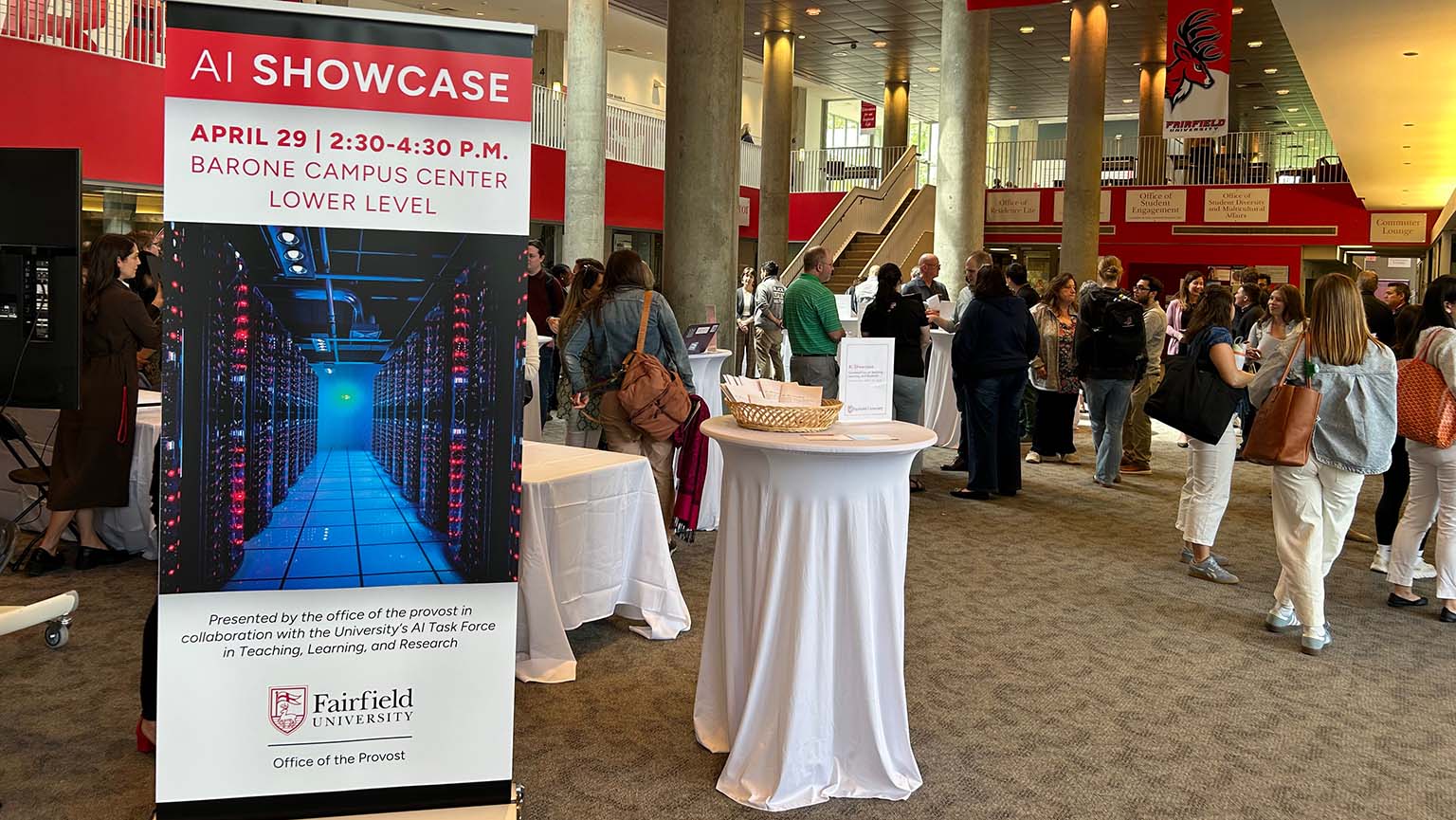
A crowd of people surrounding a large banner, indicating a gathering or event, with expressions of enthusiasm and engagement.
By Jeannine Graf

Toward the conclusion of the spring 2026 semester, faculty members from across Fairfield University’s five schools gathered in the Barone Campus Center to share the innovative and intellectually rigorous ways they’ve thought about, discussed with students, and implemented coursework made possible by emerging technologies over the past year.

Representing fields of study from the arts and sciences, education and human development, nursing and health studies, engineering, and business, more than 20 presenters showcased discipline-informed examples of ways in which artificial intelligence is being framed, used, or limited within courses or fields of study at Fairfield.

Scores of students, staff, and faculty members browsed presentation tables at the informal, drop-in event to ask questions and connect with colleagues. "The breadth of approaches represented across disciplines was exciting to see," said Christine Rodriguez, PhD, who teaches biology and serves as associate director of the Center for Academic Excellence.

"Faculty are engaging AI in ways that remain grounded in the disciplinary expertise, professional judgment, and authentic practices of their fields. Some are integrating AI directly into learning experiences, while others are designing AI-supported role-play conversations or establishing thoughtful boundaries around its use."

Live, Adaptive Case Studies

Yifeng Fan, PhD, an associate professor of management in the Charles F. Dolan School of Business, demonstrated how he uses AI to generate live, adaptive case studies that evolve through multiple rounds of class discussion and decision-making. Dr. Fan’s students choose from AI-generated options, prompting the AI to create dynamic cases focused on business decisions, ethical dilemmas, and evolving contexts—offering a temporal dimension and interactivity that traditional static cases can’t provide.
Improving Calculation Competency

Among those representing the Marion Peckham Egan School of Nursing and Health Sciences, assistant professor of the practice Christina Aloi DNP’18, CRNA, APRN, CHSE, in Fairfield, Conn., and instructor of the practice Carolyn Altuna, RN, CRNA, in Austin, Texas, co-presented a project designed to help students in the DNP Nurse Anesthesia program build confidence in their math skills and improve calculation competency. Dr. Aloi explained that nurse anesthetists routinely make calculations that affect patient safety—for example, when determining infusion rates or drug dosage based on a patient’s weight.

Using a series of anesthesia-specific medication calculation modules, Altuna, who attended the AI Showcase virtually, described how the project invited students to view video demonstrations and then complete an AI-guided conversation that functioned as a pharmacology tutor—posing questions, providing immediate feedback, and identifying errors in students’ reasoning in real time.

Data Gathering and Analysis

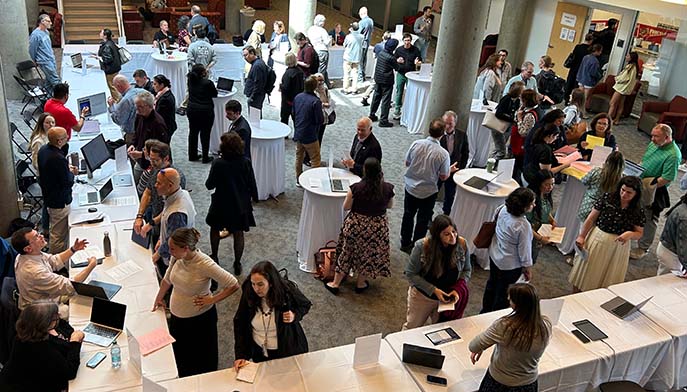
Overhead view of a busy indoor networking event, with people gathered around tables and white cocktail roundtables in a lobby.

To illustrate how AI can support complex administrative and evaluative work without replacing professional judgment, Associate Dean Joshua Elliott, EdD, an assistant professor of the practice in the School of Education and Human Development, shared a project titled “Using AI as a Critical Friend in Accreditation Work.”

Dr. Elliott’s work illustrated ways in which AI tools can be responsibly used in the accreditation process to identify missing components, summarize historical feedback, and support brainstorming and review.

Examining the Boundaries of AI Use

Both Mary Laughlin, PhD, an assistant professor of the practice in English in the John Charles Meditz College of Arts and Sciences, and Haolin Tang, PhD, an assistant professor of the practice in the School of Engineering and Computer Science, presented projects that clearly distinguish when generative AI is permitted in their classrooms and when it is intentionally limited. In his first-year programming course, Dr. Tang described how students use AI for debugging and concept clarification, but not for completing foundational assignments.

Dr. Laughlin’s project presented a reframing of AI policy in first-year writing to center it around writer responsibility and accuracy rather than detection. She shared two policies—one governing attribution and sources and one governing generative AI use—and explained the pedagogical rationale underlying their design.

While the full range of projects varied widely in scope and discipline, a common theme emerged throughout the afternoon: through ongoing experimentation, dialogue, and collaboration, faculty members across campus are engaging with AI as a tool to advance learning and prepare students for careers.

"Together, the presented examples show how faculty are accompanying students as they navigate an evolving technological landscape," noted Dr. Rodriguez. "In doing so, they help students develop the discernment to use AI thoughtfully while remaining connected to the knowledge, skills, and professional responsibilities that define their disciplines." 

Learn more about artificial intelligence initiatives at Fairfield University at fairfield.edu/ai.

Related Stories