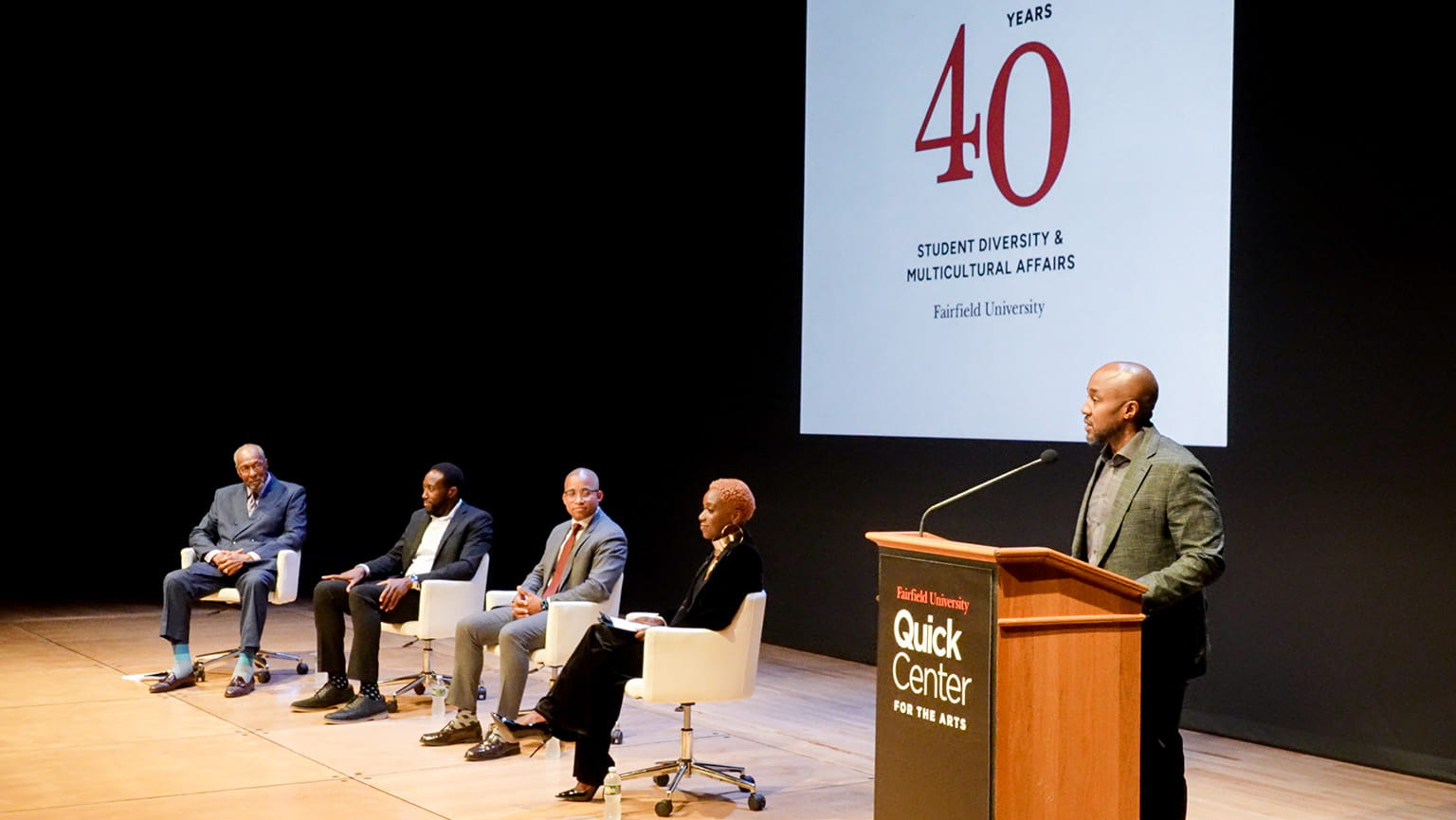
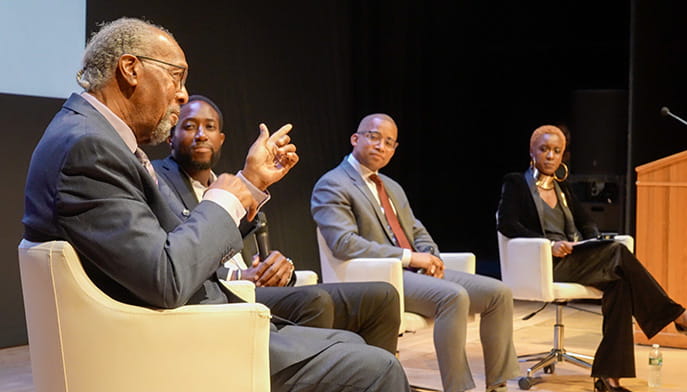
On Sept. 14, Fairfield University’s Office of Student Diversity & Multicultural Affairs (SDMA) celebrated its 40th anniversary with a live podcast at the Regina A. Quick Center for the Arts. Don Sawyer III, PhD, vice president for access, belonging, and community engagement, offered opening remarks before past and present SDMA leaders reflected on the office’s history, its influence on generations of students, and its future.
Moderated by Yolehema Felican ’12, current SDMA director and the first Fairfield alumna to serve in the position, the live podcast featured Larry Mazon, founding director of institutional diversity initiatives (1983-2010); William Johnson, PhD, associate vice president of student life and dean of students; and Pejay Lucky, associate dean of student success at Fairfield Bellarmine. Both Johnson and Lucky previously served as SDMA directors.
A Legacy of Advocacy and Opportunity
Reflecting on SDMA’s beginnings, Mazon credited early student advocates who brought their concerns and ideas to University administrators. These conversations helped lay the foundation for the office and its work.
“That, for me, was the foundation. It was students who initiated it,” Mazon said.
Four decades later, SDMA continues to advocate for students, connect them with resources, and create opportunities to build community and find their place at Fairfield. Working with student organizations, faculty, and other University offices, SDMA also supports initiatives designed to support student success at Farifield, including the Academic Immersion Program.
For Lucky, the work often came down to individual relationships. He recalled helping students navigate challenges ranging from housing insecurity to discrimination and personal difficulties. One particularly memorable moment involved helping a student tie his tie for a formal event. Years later, that student was working on Wall Street.
“Moments matter,” Lucky said.
Creating “Brave Spaces”
The discussion also explored how universities can support students through difficult experiences while encouraging them to speak up for themselves and others.
“I know a lot of people say ‘safe spaces,’ but I think we have to create ‘brave spaces’ as well,” Dr. Saywer said. He emphasized that a university cannot guarantee that students will never encounter harm or conflict. It can, however, commit to listening and responding when those situations occur.
Dr. Johnson described the work of SDMA as an expression of Fairfield’s Jesuit mission, while Mazon emphasized the shared responsibility of creating an inclusive community. He encouraged students to think critically about contemporary challenges while remaining grounded in human dignity and compassion, and urged them to advocate for themselves and others, hold the institution accountable, and continue challenging leadership to do more.
Looking Toward the Next 40 Years
Looking forward, panelists considered how SDMA’s role might evolve alongside technology, higher education, and the broader understanding of diversity, equity, and inclusion. Dr. Johnson cautioned that while artificial intelligence and other digital tools offer new resources, they can also contribute to isolation, making face-to-face connection increasingly important.
Panelists also identified scholarships and expanded educational pathways as priorities for the future, along with the continued importance of building a community where all students feel supported, connected, and empowered to succeed.