How many college courses could you ace simply by submitting the assignments to ChatGPT? When Philip Maymin, PhD, associate professor of analytics, poses that question to students, most estimate about 80 percent.
Their responses raise larger questions about teaching and learning in the age of artificial intelligence. "What is it that humans can add over and above?" asked Dr. Maymin, who holds the Stephen and Camille Schramm Chair in Analytics in the Charles F. Dolan School of Business, "How do we elevate what we teach?"
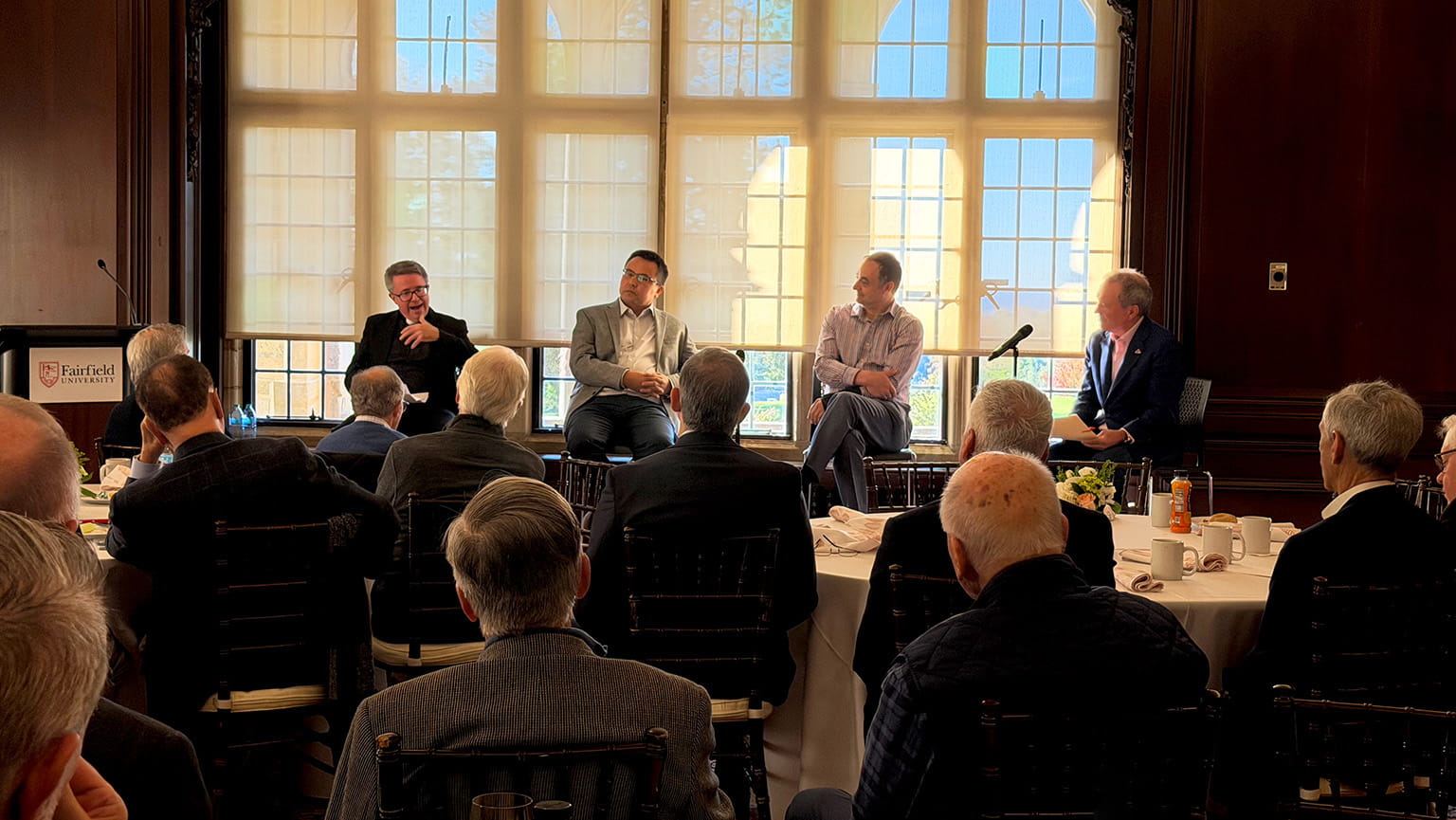
These were among the questions explored at Fairfield University's Presidential Colloquium, "The Moral Dimension of AI," held October 22.
President Mark R. Nemec, PhD, opened the colloquium by recalling his experience as a graduate student in the early 1990s, when he helped develop ways to teach students to use the internet. Within a year, the students were teaching their professors.
Today, universities face a similar challenge in preparing students for a world shaped by AI. Dr. Nemec emphasized the importance of equipping faculty to teach future generations of "AI natives," while remaining true to Fairfield's Jesuit Catholic mission.
Moderator Chris Hamer, professor of the practice in management and director of the AI at Fairfield initiative, explored some of the ethical questions surrounding the technology: Who is responsible when AI causes harm? Who benefits from the technology? And how does AI affect our understanding of what it means to be human?
"Organizations don't get to outsource their conscience to software," Hamer said. "Someone must own the decision."
Technology, Ethics, and Human Formation
Dr. Maymin described how students are already using AI to create books, artwork, and films. The approach that he and Christopher Huntley, associate professor of analytics and director of the Entrepreneurship Center, take in the intro graduate course they co-teach rests on a simple principle: Human + AI > AI.
He cautioned that relying on AI to do our thinking can make us less thoughtful. Used intentionally, however, the technology can encourage mindfulness, introduce new perspectives, and deepen understanding.
Sidike Paheding, PhD, associate professor and chair of the Computer Science Dept. in the School of Engineering and Computing, discussed the ethical responsibilities of AI developers—from selecting training data to designing the algorithms that shape outcomes.
Drawing on his research supported by the National Science Foundation, NASA Connecticut Space Grant Consortium (CTSGC), USGS and Connecticut Tech Talent Accelerator (TTA) Pilot Grants, Dr. Paheding explained how errors in AI systems designed to identify hazardous conditions could create serious risks to human safety and the environment.
"The intelligence should serve the wisdom," he cautioned.
Rev. Paul Rourke, S.J., vice president for mission and ministry, brought the conversation back to the dignity of the human person. He said he encourages students to use the principles of Ignatian pedagogy to reflect on whether AI is strengthening their abilities or allowing them to bypass important parts of their education.
"What is this doing to me?" he asked. "What is it doing to society?"
The panelists debated whether AI development should be slowed to allow for greater ethical oversight. Dr. Maymin cautioned that delaying innovation could postpone lifesaving medical advances, while Fr. Rourke questioned who should determine the pace of technological change.
"Who decides whether to go fast or to go slower?" he asked. "Is it just a handful of people ... or is it the rest of society?"
Beyond the Technology
Audience questions turned to the arts, including whether artificial intelligence could create works comparable to those of Bach or Mozart. Dr. Maymin suggested that AI opens new opportunities for creative expression, even for those without formal artistic training.
Fr. Rourke offered another perspective, noting that art is also about the relationship between the artist and the audience. "It's not all about the product itself," he said. "It's about the communication of two souls."
The same principle, he suggested, applies to education. A student's development cannot be measured solely by academic accomplishments or professional success.
"Ultimately, it's what kind of person you're becoming."