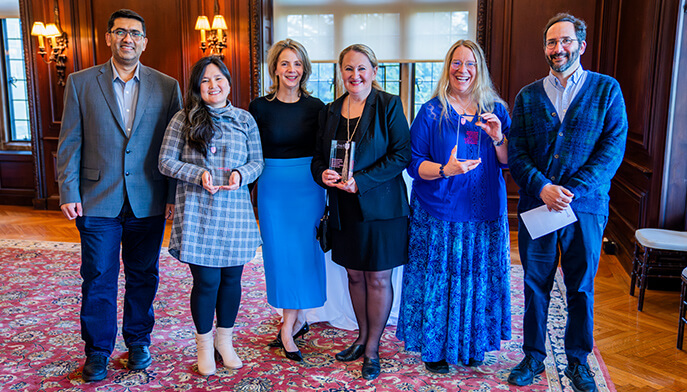
The rotating annual residency connected online doctoral students with researchers, policymakers, and community health leaders in Texas.
First- and second-year Doctor of Public Health (DrPH) students in Fairfield University’s Marion Peckham Egan School of Nursing and Health Studies gathered in Austin, Texas, for the program’s annual residency, which rotates between Washington, D.C.; Austin, Texas; and Fairfield, Conn.
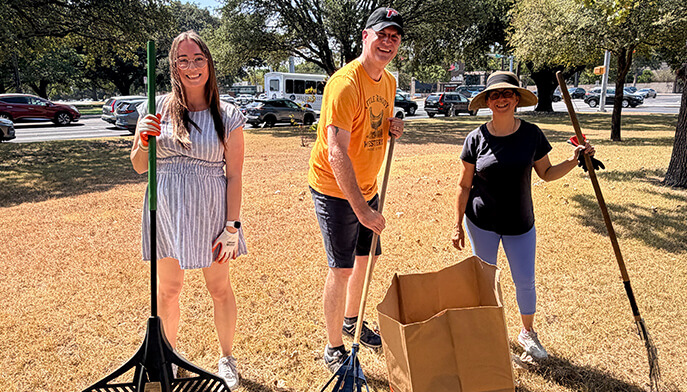
Over three days, students engaged with researchers, practitioners, policymakers, and community-oriented public health leaders from organizations including the Texas Health Institute, UTHealth School of Public Health, and Austin Public Health. Students also spent an afternoon at the Austin Child Guidance Center completing a community service project, helping to beautify the center’s healing garden.
The residency was led by Anthony Santella, DrPH, MPH, MCHES, CPH, director of the DrPH program and professor of public health, with assistance from Kate Plourde, DrPH, MPH, assistant professor of public health.
Translating Evidence into Practice
The residency was designed to support students’ academic and professional development as they prepare for dissertation research and careers in academia, practice, and policy. Through presentations, case studies, and community-engaged learning, students examined how evidence is generated, translated, implemented, and evaluated in real-world settings.
For second-year DrPH student Dipika Khushalani, one key takeaway was the importance of collaboration across sectors. “Moving from evidence to action requires collaboration, trust, and shared power across systems,” she said.
The learning experience, Khushalani observed, reinforced the importance of cross-sector collaboration in public health. Students saw how public health agencies, healthcare organizations, non-profits, academic institutions, and community partners can work together to address complex challenges and build stronger, more equitable systems of care.
Leadership Rooted in Mission
The Austin residency also reflected Fairfield’s Jesuit mission by emphasizing ethical leadership, community engagement, and a commitment to justice. Students explored how public health leaders can center community voice, build trust, and respond to inequities, even in resource-constrained or politically complex environments.
Second-year DrPH student Gianne Gerena said the experience reinforced the notion that leadership is a human-centered practice. “Public health leadership is fundamentally relational and involves empathy, respect, and transparency,” she said. “It is not simply about making decisions or exercising authority; it is about creating conditions where other people can contribute, challenge assumptions, grow, and succeed.”
The residency also challenged students to consider how communities can help define both public health problems and solutions. “The residency expanded my understanding of equity-focused leadership,” said first-year DrPH student Kim Connolly. “Meaningful engagement requires more than inviting familiar supporters to the table. It also requires including people who may disagree, challenge assumptions, or identify weaknesses in a proposed approach.”
“Leadership requires persistence, careful coalition-building, and a willingness to keep community impact at the center of the work,” Connolly added.