Learning With AI

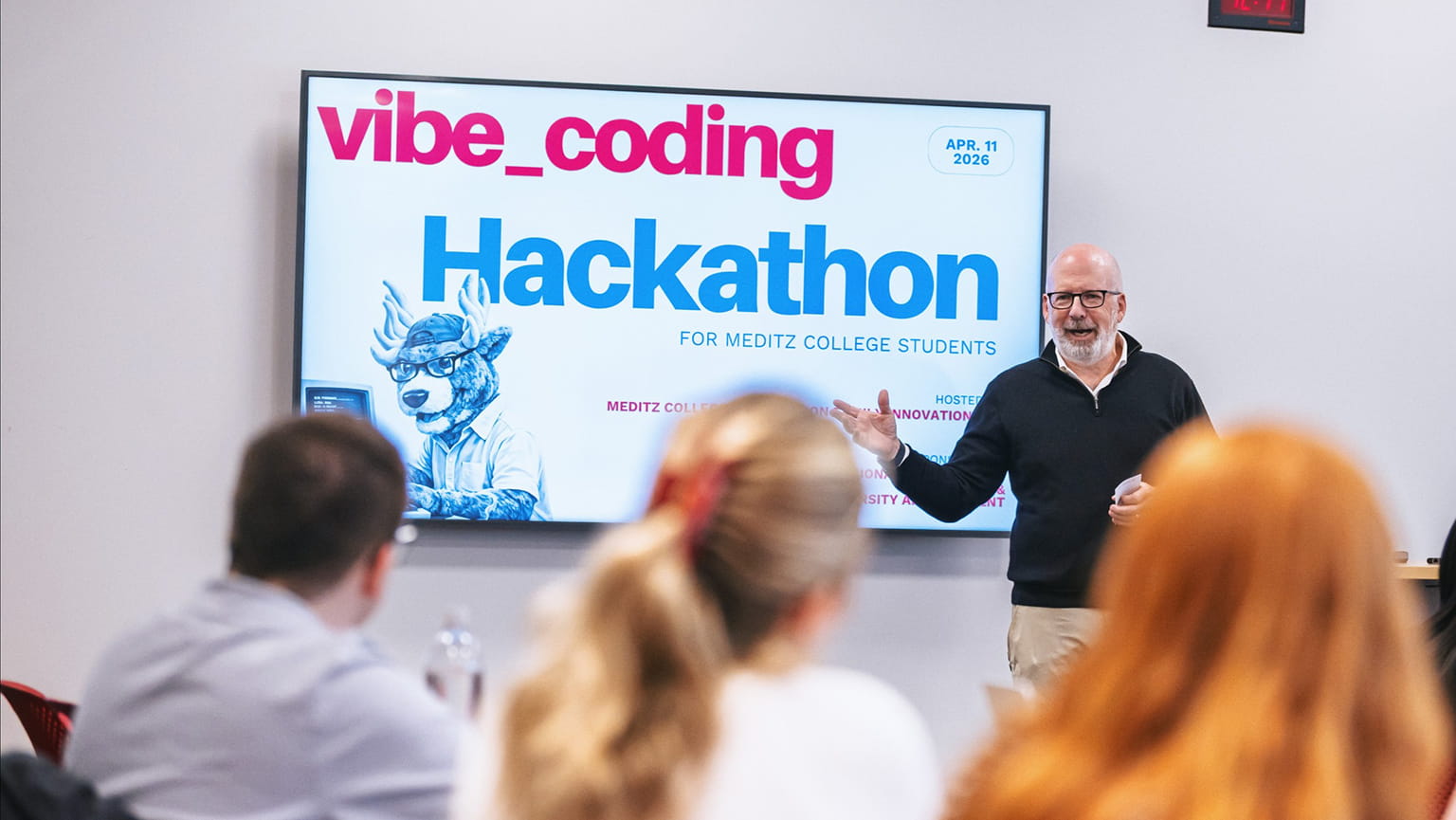
A smiling instructor presents a “vibe_coding Hackathon” screen to seated college students in a classroom, creating an upbeat, collaborative learning mood.
Fairfield Meditz hosted its first-ever Vibe Coding Hackathon, bringing together students from across disciplines to engage with artificial intelligence through a liberal arts lens.
By Sara Colabella ’08, MA’11, EdD’26

Artificial intelligence is often framed in extremes.

It is either the technology that will revolutionize education and work or the tool that will replace critical thinking and creativity. At Fairfield Meditz, faculty and students are exploring a more nuanced reality: AI is neither a shortcut nor a substitute for learning; it is a tool that requires thoughtful engagement, ethical consideration, and human judgment.

“The age of AI promises us more of everything. Meditz College exists for the harder work: not having more, but being more—and knowing the difference,” said Dean Richard Greenwald, PhD.

Across disciplines, Meditz faculty are asking important questions about how AI can enhance learning without diminishing students’ critical thinking and intellectual engagement. Their work recognizes a new reality: today’s students will enter a world in which AI is commonplace, making AI literacy as essential as digital literacy became a generation ago.

In the Biology Department, Christine Rodriguez, PhD, assistant professor of the practice, is using AI to bring clinical reasoning into introductory microbiology through an initiative called The Patient Project: Exploring AI Conversations with Disciplinary Context. Using a Blackboard-embedded AI tool that builds individualized patient scenarios, students practice how to interpret symptoms, explain infections, and respond to patient questions in a guided, reflective environment. With an emphasis on participation and iterative learning, Dr. Rodriguez’s program helps strengthen communication skills and reduce anxiety around clinical decision-making, while encouraging students to thoughtfully consider the ethical use of AI in healthcare settings.
M. Covadonga Arango Martín, instructor of the practice in modern languages and literatures, uses AI to help students create and critique learning activities, encouraging them to evaluate information rather than accept it at face value. Jay Rozgonyi, associate vice provost for pedagogical innovation and effectiveness, uses AI-powered historical simulations in his film courses to help students better understand the social context surrounding 1920s silent films. In journalism courses, Associate Professor Lei “Tommy” Xie, PhD, has created an AI-driven interview environment that challenges students to ask precise, evidence-based questions while investigating a fictional controversy.

Last spring, students participated in Fairfield Meditz’s first-ever Vibe Coding Hackathon, designed to introduce liberal arts students to AI-assisted software development. Unlike traditional coding competitions that often favor experienced programmers, the event emphasized creativity, communication, and problem-solving.

Participants used AI tools to transform ideas into working prototypes, despite many having little or no coding experience. The resulting projects addressed issues ranging from nonprofit management and career readiness to habit formation and dementia care. More importantly, the hackathon demonstrated that technology development is becoming increasingly accessible to people whose strengths lie outside computer science.

“What this program demonstrated is that the traditional prerequisite for building software—knowing how to write code—is no longer the barrier it once was,” said Dr. Xie. “The new prerequisites are compassion, creativity, critical thinking, domain expertise, and the judgment to direct AI responsibly.”

Related Stories