Where Research Takes Root: The Library's Role in Academic Research

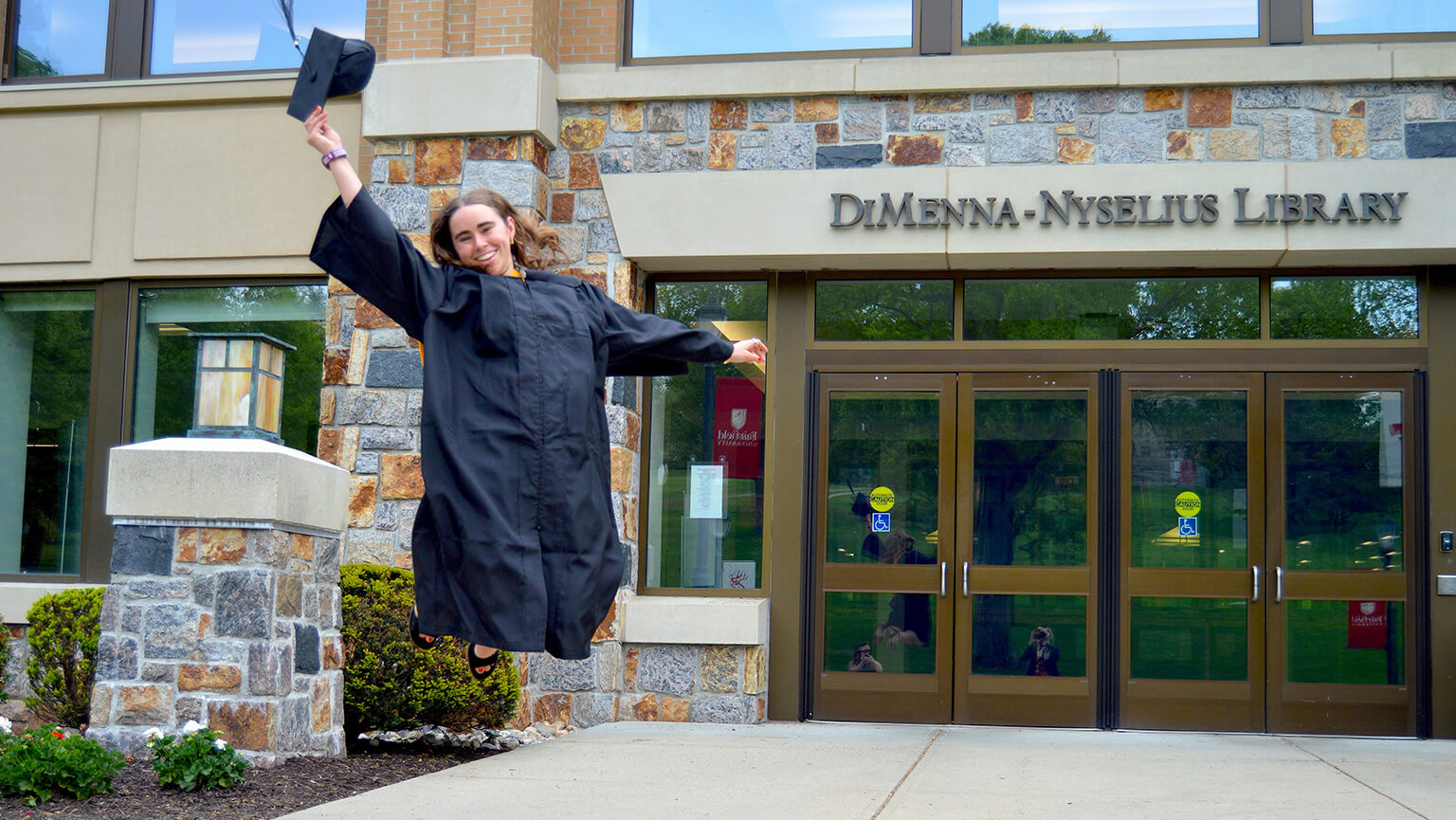
Recent Fairfield Meditz alumna Mia Swenson ’26 in a black gown leaps with one arm raised outside DiMenna-Nyselius Library, celebrating graduation with joyful energy.
Mia Swenson ’26 celebrates outside the DiMenna Nyselius Library, which was central to her academic journey and success.
By Brad Thomas
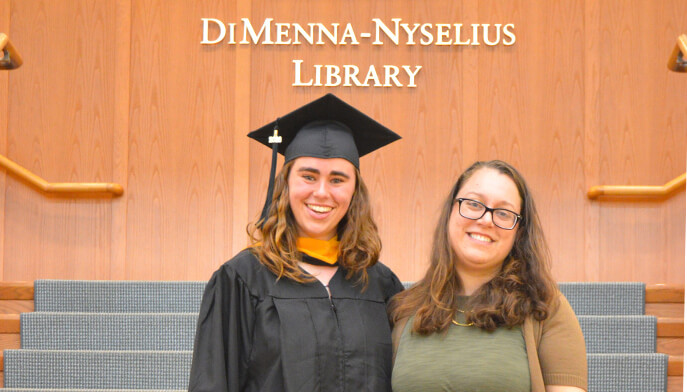
Mia Swenson ’26 in cap and gown poses with head of library beneath the DiMenna-Nyselius Library sign, sharing a warm, proud moment.
Swenson with Lisa Thornell, head of library outreach and communications.

Recent Fairfield Meditz alumna Mia Swenson ’26 credits the DiMenna-Nyselius Library with helping her build a strong foundation for doctoral study.

Mia Swenson ’26, a graduate of Fairfield University’s Meditz College of Arts and Sciences, has taken an impressive next step in her academic journey. A psychology major with a concentration in behavioral neuroscience and a minor in mathematics, Swenson is now pursuing a PhD in clinical psychology—a rare direct path from undergraduate study, made even more notable by her research record of two publications and a third in progress.

At Fairfield, Swenson balanced a wide range of campus roles, including several tied closely to the DiMenna-Nyselius Library: Science Center tutor, library assistant, and Student Library Advisory Board member. Along with many hours spent studying in the stacks, those experiences introduced her to the librarians, services, and research tools that would become central to her academic success.

“Fairfield has an extensive collection of databases and other electronic resources,” Swenson said. “That access to scholarly materials really helped me succeed in my research projects."
Library Resources that Support Student Research

Swenson first explored the library website late in her first year, when she was booking a study room for finals. What began as a practical task quickly became a discovery of the library’s broader academic support.

“I began playing around on the library homepage and was like, ‘What are all these resources?’ That’s when I discovered research and citation guides,” she recalled.

Those tools became increasingly important as Swenson’s research projects grew in size and scope. She relied on Fairfield’s collection of scholarly databases and full-text journals, as well as its citation guides and interlibrary loan services.

“I used all of those library resources to discover and download articles and to cite them properly,” she said.

A Student Perspective on Library Engagement

Swenson’s connection to the library deepened through her work as a library assistant and her involvement with the Library Advisory Board. In her library role, she supported programming and student engagement initiatives, including the therapy dogs program, reading challenges, and Stags Share Stories.

That behind-the-scenes experience helped her better understand the people and services that make academic research and success possible.

Moreover, Swenson came to appreciate the personal support embedded withing those services—from research guides expertly curated by librarians to rare book deliveries by interlibrary loan staff.

“They just want to help you succeed,” she said of the library staff.

As Swenson begins her doctoral studies at Texas Tech University, her Fairfield experience offers a strong example of how libraries can support student achievement. By providing access, guidance, space, and community, they help students not only complete assignments but also grow into confident researchers.

Related Stories