The Patrick J. Waide Center for Applied Ethics integrates course work for students, scholarly research, and community and public events such as this one.
On Valentine’s Day in 2016, one of Google’s self-driving cars crashed into a bus in Mountain View, California. Nobody was hurt, but the car was damaged, and for the first time, the California tech giant admitted in an accident report that clearly, Google had to “bear some responsibility” for what happened. They promised to update the software.
But just a few months later in May, a Tesla model S in autopilot mode collided with a truck that the Tesla’s sensors had not spotted, leading to the death of the driver. This time however, Tesla, in “a carefully worded statement,” expressed sympathy for the customer’s family but emphasized that the customer is always in control. They also promised to update their equipment after the accident.
So where does the responsibility lie? With the robotic cars, guided by the software that needs to be updated and revised on occasion, or with some human being who may not have their hands on the wheel, or even be in the car at the time, but is in some way the owner?
This example is drawn from a 2017 paper by Sven Nyholm, PhD, professor of the ethics of artificial intelligence at Ludwig Maximillian University of Munich, which asks “how to allocate responsibility when automated technologies or robots harm or kill human beings.”
Dr. Nyholm will be the first of four speakers this fall in the Patrick J. Waide Center for Applied Ethics series of lectures, most of which are free and available to screen online. His talk, “The Ethics of Artificial Intelligence,” will occur on zoom on Wed., Sept. 23 at 4 p.m. Dr. Nyholm will address questions of how AI reshapes classic philosophical questions about responsibility, now that we have entered an age of robots, and in particular, AI assisted weaponry that is making wartime decisions about targets independent of a deliberate and intentional targeting by a human officer.
More information about the talk and the link to the live zoom session will be available at fairfield.edu/arts-and-minds.
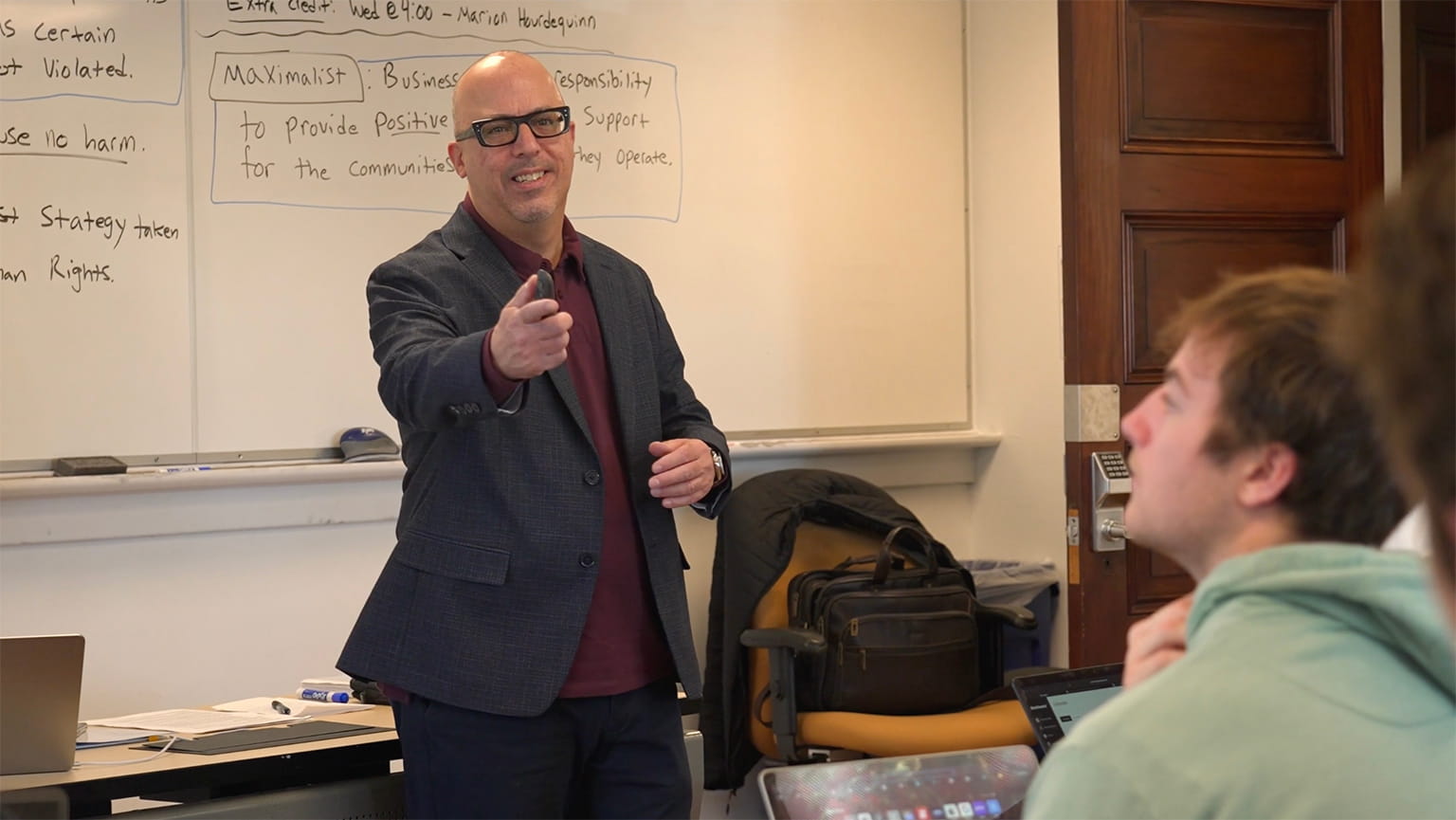
The Waide Center lecture series is curated by Gregg Caruso, PhD, the director of the Waide Center and professor of ethics and management in the Charles F. Dolan School of Business at Fairfield University. In addition to developing integrated courses for students, the Waide Center brings international scholars of standing to Fairfield for conversation on how ethical questions intersect with business, government, healthcare, engineering, and other fields.
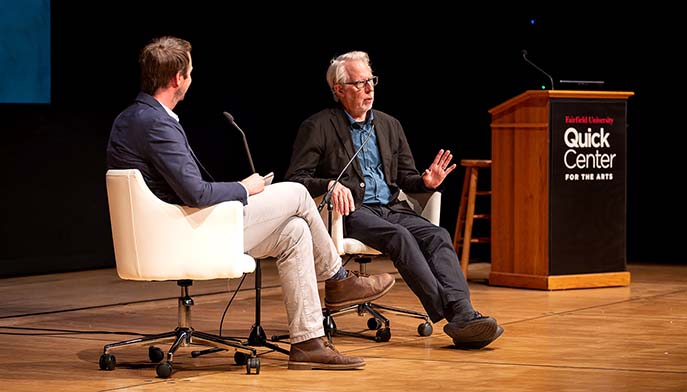
Founded in 2018, and endowed by former Trustee Patrick J. Waide Jr. ’59, the Center integrates course work for students, scholarly research, and community and public events such as this one.
Join the Conversation
One Tues., Oct. 6, the Center will join the Philip I. Eliasoph Open VISIONS Forum in presenting a live event with ethicist Kwame Anthony Appiah, PhD, at 7:30 p.m. in the Kelley Theatre in the Regina A. Quick Center for the Arts. Dr. Appiah is the author of Cosmopolitanism: Ethics in a World of Strangers and Captive Gods: Religion and the Rise of Social Science, among other titles. He teaches law and philosophy at New York University.
On Wed., Oct. 28 at 4 p.m., Andrew Hoffman, PhD, Holcim Professor at the University of Michigan’s Ross School of Business will present “Business School and the Noble Purpose of Market,” exploring how modern business schools reinforce outdated shareholder-focused capitalism, worsening global challenges like inequality and climate change. His talk will be available at fairfield.edu/arts-and-minds.
Then on Wed., Nov. 18 at 4 p.m., Abraham Singer, PhD, associate professor of management at Loyola University Chicago will speak on “An Ethical Framework for the Gambling Industry.” That talk can be found at fairfield.edu/arts-and-minds.
Incidentally, Nyholm’s paper, cited above, reviews different models of agency – where some agency is attributed to solely one party, and sometimes to multiple parties – and concludes that “for robots and automated systems that are meant to drive us around or help us fight wars, what is desirable is to have machines that collaborate with us, that defer to us, and whose performance is supervised and managed by human beings.”