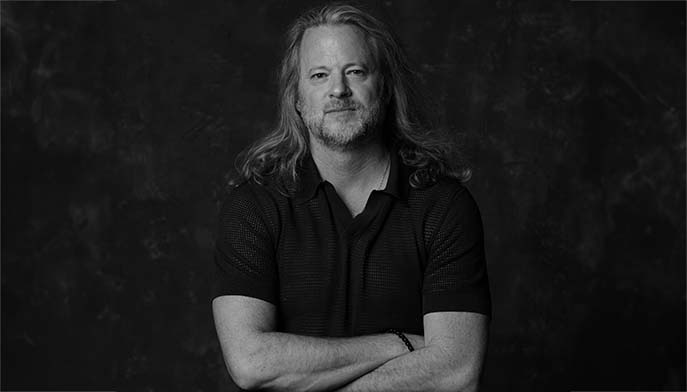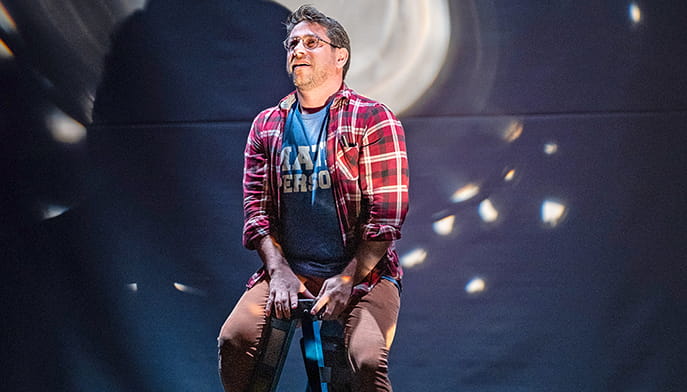
Jared Mezzocchi ’07—a two-time Obie Award-winning director and multi-media artist best known for his groundbreaking work at the intersection of theatre and film—credits his time at Fairfield University as the foundation for his continued success.
“It gave me the awareness of why, right now, I want to participate in this dialogue in the American theatre,” Mezzocchi said. “I had very one-on-one relationships with faculty, and they helped me to understand the catapult I was building toward my career.”
The theatre and film major vividly remembers how the Fairfield community responded after the untimely passing of his father during his sophomore year.
“Both departments came to the funeral and heard my eulogy for my dad, and both told me I should turn it into a piece of theatre or a piece of film,” he shared. “Everything felt messy at that moment with the grief of it all, and I remember asking, well, what if it’s both? What if we do something where I use both theatre and film on the same platform?”
The first step came in his junior year: a short piece chronicling the history of theatre.
“I got everybody to give me their TVs from their townhouses and I stacked a three-by-three grid of tube televisions and connected them to nine DVD players. I was printing DVDs in the Media Lab, trying to get the time codes correct so that when someone threw a ball and it left one frame, it would be caught in another.”
Little did he know that experiment would become the foundation of a career built on bringing together stage and screen.
“I still have that recording, and sometimes I watch it and realize everything I did in that piece, I’m still working through in my career—trying to create interactivity.”
His senior year, his exploration of grief and his father’s death culminated in The One Stoplight in Hollis, a two-act play where he continued his experiment across performance mediums. The work earned him a place in Brooklyn College’s MFA program.
“At Brooklyn College, I knew what I was wrestling with—all the questions—because of what Fairfield gave me,” he said. “I walked in with a depth of information that a 21-year-old at the time wouldn’t typically be walking into grad school with.”