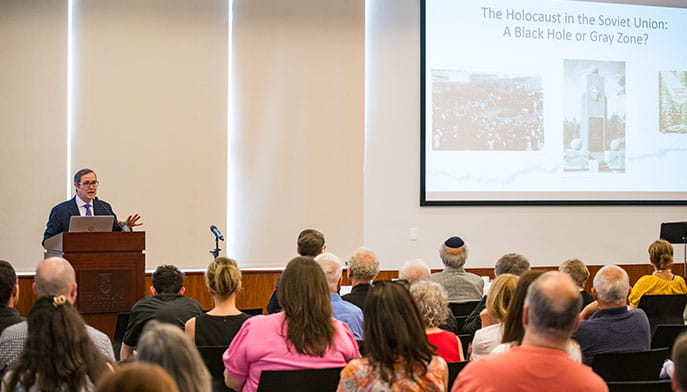
Fairfield University’s annual Holocaust Remembrance Ceremony on April 16, unfolded as a solemn and reflective gathering, weaving together scholarship, prayer, music, and collective memory to honor the six million Jews murdered during the Holocaust, along with the millions of others persecuted by the Nazi regime.
The ceremony began with a musical prelude by Daniel Horstmann, setting a contemplative tone for the program. Professor of Religious Studies and Director of the Bennett Center for Judaic Studies Yaron Ayalon, PhD, offered welcoming remarks and later introduced the keynote speaker, alongside an opening prayer delivered with Rev. John Savard, S.J. Together, their words framed the event as both an academic and moral act of remembrance.
The central address was delivered by Shay Pilnik, PhD, director of the Emil A. and Jenny Fish Center for Holocaust and Genocide Studies. Drawing from his recent scholarship and his book The Ravine of Memory: Babyn Yar between the Holocaust and the Great Patriotic War, Dr. Pilnik guided the audience through the historical tragedy of Babyn Yar—a ravine near Kyiv where tens of thousands of Jews were massacred in 1941.
Rather than focusing solely on the atrocity itself, Dr. Pilnik emphasized what he called the “second murder:” the systematic erasure of memory under Soviet rule. He explained how, after World War II, the Soviet regime suppressed acknowledgment of the Holocaust as a uniquely Jewish tragedy, instead folding it into a broader narrative of wartime suffering. Victims were anonymized as “peaceful Soviet citizens,” and sites like Babyn Yar were left unmarked—or even physically erased.
Dr. Pilnik underscored the moral weight of remembrance with a striking reframing: the Holocaust, he said, should be understood not as the murder of six million Jews, but as “the murder of one Jew, six million times.” Through this lens, he brought attention to the individuality of each life lost, including children like those killed at Babyn Yar.
He also highlighted acts of cultural resistance within the Soviet Union, particularly the 1961 poem “Babi Yar” by Yevgeny Yevtushenko, which challenged state-imposed silence. Though cautiously permitted by authorities, such works represented a turning point—what Pilnik described as “permitted dissent”—which helped reopen suppressed conversations about the Holocaust.
Following the lecture, the ceremony transitioned into collective remembrance. Memorial candles were lit in honor of the six million, accompanied by a moving reflection on the lives that were lost—not only who they were, but who they might have become: writers, teachers, parents, and leaders.
The ceremony continued with the recitation of the traditional Jewish prayer for the dead, the Kaddish, led by Jewish Chaplain Rabbi James Prosnit, followed by a reading by Associate Professor of History Patricia Behre, PhD, on the famous words from Martin Niemöller’s reflection on silence during persecution: “Then they came for me, and there was no one left to speak out for me.”
“A Prayer of Resolve,” by Rabbi David Katz and read by Provost Christine Siegel, PhD, called for a world rooted in justice, protection for the vulnerable, and a shared commitment to preventing future atrocities. Vice President for Mission and Ministry, Rev. Paul Rourke, S.J., concluded the program with a closing prayer, offering words of reflection that urged those present to become agents of peace, reconciliation, and moral courage in the face of suffering and injustice.
The event was sponsored by the Bennett Center for Judaic Studies, Campus Ministry, and the Jewish Federation of Fairfield County.
View the full Holocaust Remembrance Ceremony on vimeo.com.