Cyndi Adams MA’23: Challenging Misconceptions of Dyslexia

By Sara Colabella ’08, MA’11
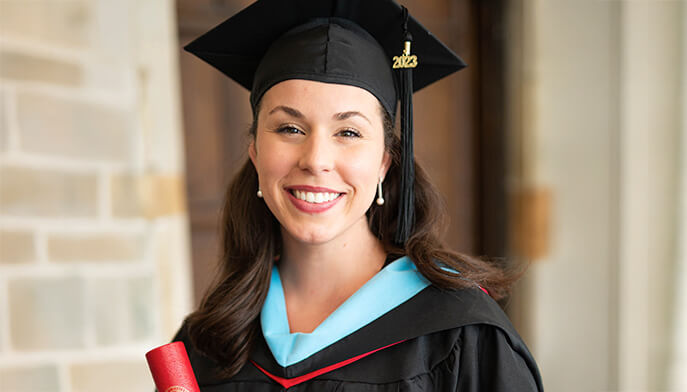
Cyndi Adams MA’23 in a graduation gown and cap proudly holds her diploma, celebrating her academic achievement.
Cyndi Adams MA’23 earned her master’s degree from Fairfield’s School of Education and Human Development.

For educator Cyndi Adams MA’23, the decision to pursue a master’s degree in remedial reading and language arts at Fairfield traces back to a pivotal moment early in her career.

As a first-grade teacher in New Haven Public Schools, “I had a passion for teaching reading to young children,” she said, “but I realized the knowledge and skills I had been equipped with in my undergraduate program and in-service professional learning didn’t reflect current research and effective practices around how children learn to read.”

She enrolled in the School of Education and Human Development’s graduate program as a way to learn how to better help her students and to earn specialized literacy education credentials. Her advanced studies gave Adams the confidence to advocate for implementing research-and evidence-based practices; she graduated with a strengthened belief that all students can learn to read with the right instruction.

Adams holds a Wilson Dyslexia Practitioner (Level 1) Certification and currently works as a teaching and learning specialist at Cooperative Education Services, one of Connecticut’s six regional educational service centers. There, she provides professional development, coaching, and consultation to schools in Fairfield County and across the state. “I collaborate with district and school leaders, teachers, and instructional staff to strengthen literacy practices and ensure all educators have the tools to teach reading effectively,” she said.

She also leads regional councils that provide critical state updates and works with the Connecticut State Department of Education to strengthen literacy initiatives and legislative mandates. Serving on committees within the state’s Office of Dyslexia and Reading Disabilities has taught her a lot about how statewide systems collaborate and how research, advocacy, and policy help to shape the support that students and teachers receive. “My role,” she said, “often involves bringing the perspectives of teachers who are doing this work every day—and making sure their experiences, challenges, and successes are part of the conversation.”
Inspired by the national non-profit StoryCorps project, which records and shares stories of everyday Americans, Adams launched the Voices of Dyslexia storytelling project to amplify the lived experiences of individuals and families impacted by dyslexia. Partnering with the Office of Dyslexia and Reading Disabilities, she recorded, edited, and produced eight interviews. “It was deeply moving to listen to these experiences firsthand and to have the responsibility of preserving and sharing them in a way that would leave a lasting impact,” she said.

Across the narratives, a common theme emerged: dyslexia is often misunderstood and enduring myths continue to shape how individuals with dyslexia experience school and the world around them.

By sharing personal perspectives through the Voices of Dyslexia project, Adams aims to challenge misconceptions and affirm that people with dyslexia are resilient, hardworking, creative, and intelligent. “People with dyslexia,” she noted, “often describe it as an advantage. The way their brains are wired can heighten creative skills such as visual-spatial processing and problem-solving.”

When asked what advice she would share with educators to better support students with reading difficulties, Adams offered, “Stay curious and keep learning.” She stressed that understanding how reading develops and what research tells us about effective instruction can make a big difference for students.

Adams’ favorite part of her work is witnessing moments when learning clicks—both for students discovering their own capacity and for the teachers helping to make it possible. “Getting to witness the moment when a student realizes they can make sense of the world around them through reading and writing is pure magic,” she said. “Equally powerful is empowering teachers to be part of those moments and to see the impact of their work in real time.”

Related Stories