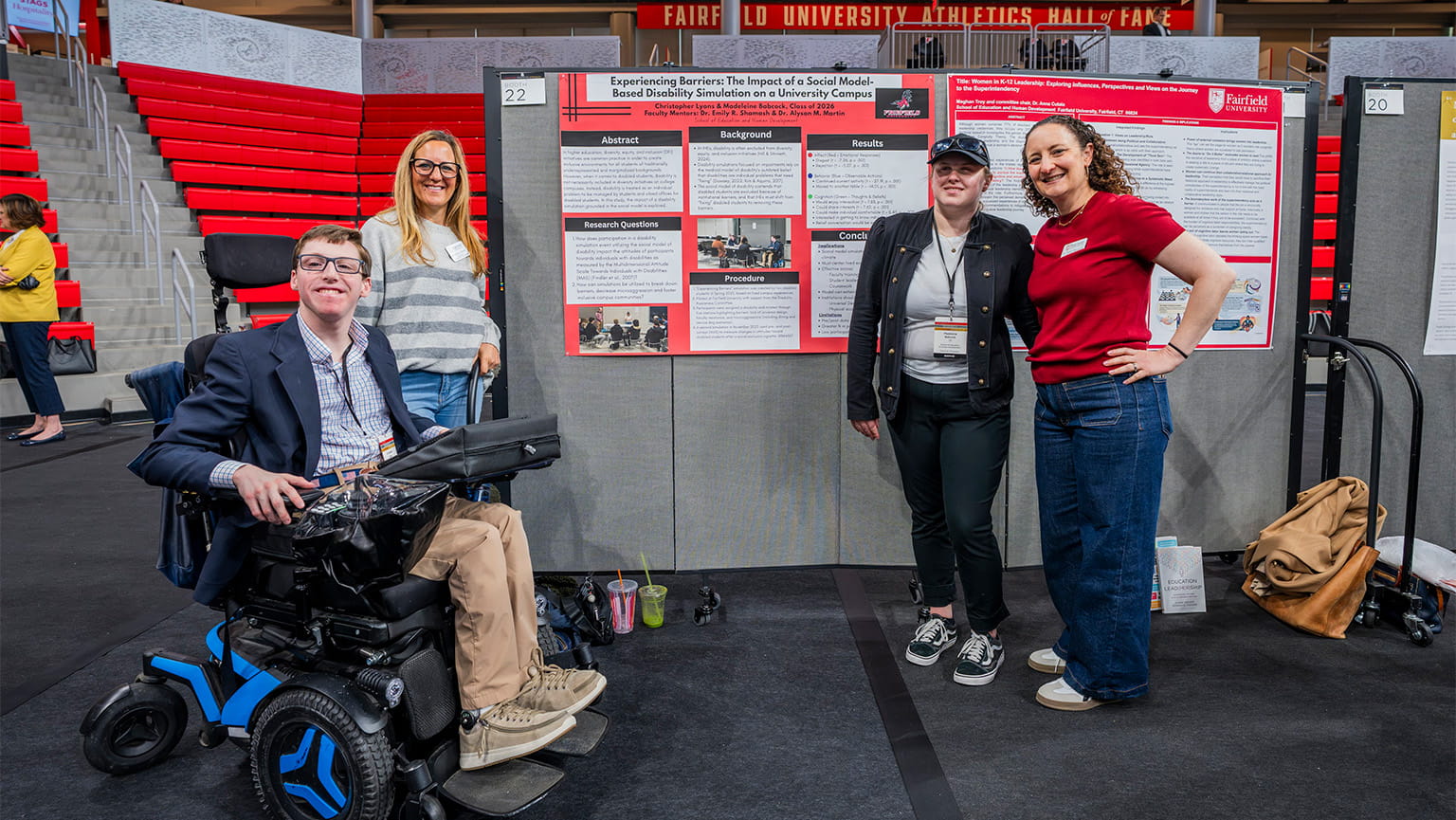
For students Christopher Lyons and Madeline Bobcock, disability advocacy is about more than awareness, it’s about helping others understand the social and institutional barriers disabled students face every day. Through the “Experiencing Barriers” simulation, the pair created an immersive learning experience designed to challenge perceptions and encourage meaningful change across campus.
Developed last spring, the simulation invited members of the Fairfield University community to step into scenarios based on real experiences shared by disabled students. The simulation featured five interactive stations that students rotated through, each designed to highlight common academic and social barriers students may encounter. Each of the participants were assigned a disability and then rotated through the stations. At the classroom station, participants experienced how inaccessible teaching practices, such as not verbally describing images on PowerPoint slides or relying solely on pop quizzes, which can create challenges for students with disabilities.
Another station focused on accommodation meetings, where participants encountered resistance students sometimes face when requesting academic accommodations. Additional stations explored social barriers, including microaggressions, dining hall interactions, and interactions with service dogs.
To better understand the impact of the experience, Lyons and Bobcock later conducted pre- and post-surveys with participants. Their findings revealed shifts in attitudes following the simulation. Their quantitative results showed significant positive changes in attitudes, including less avoidance of situations involving individuals with disabilities and a greater interest in engaging with people with disabilities.
One participant reflected, “I learned about more barriers to access within the classroom environment and emotions that can arise from lack of respect and accommodations.” Another wrote, “I learned that sometimes people with disabilities don’t get treated fairly even though they have a legal right to be treated the same.”
One interaction through a participant’s impact statement, however, stood out most to Lyons and Bobcock. The participant shared that the experience changed their perspective on disability.
Beyond awareness, Lyons and Bobcock hope the simulation inspires action, particularly around universal design for learning, an educational approach that creates flexible and accessible learning environments for all students. They also emphasized the importance of disability allyship among students, sharing that advocacy often begins with recognizing and addressing unintentional ableism.
“Disability allyship doesn’t just mean treating disabled people equitably,” they explained. “It also requires helping others see where they may unintentionally be falling short in their interactions with disabled people.”