On Thursday, Sept. 10, 2026, Fairfield University officially dedicated the bronze Holocaust memorial sculpture She Wouldn’t Take Off Her Boots by artist Victoria Milstein, before kicking off the 2026-27 Philip I. Eliasoph Open VISIONS Forum with a lecture by Ambassador Deborah Lipstadt, former special envoy to monitor and combat antisemitism.
She Wouldn’t Take Off Her Boots
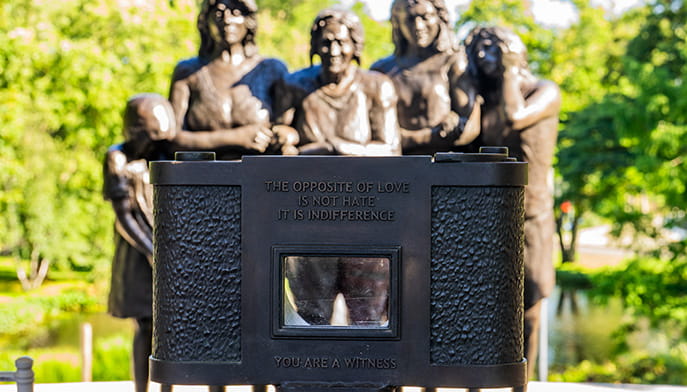
Sited between the Charles F. Dolan School of Business and Bellarmine Pond, the sculpture She Wouldn’t Take Off Her Boots honors and depicts five Jewish women who stood in the face of ultimate terror during the Holocaust and refused to comply.
Facing the figures of the memorial stands a bronze camera, symbolizing the Nazi photographer’s lens through which the victims’ last moments were documented. The area surrounding the sculpture features interconnected pathways, which evoke Jewish symbols of strength and unity.
A Testament and a Teacher
At the dedication ceremony, a crowd of community members, University leadership, and legislators—including U.S. Senator Richard Blumenthal, who shared a personal note about his father who fled Nazi Germany as a teen—assembled to honor the historic moment for Fairfield as the sculpture took its place in the Fairfield University Art Museum collection.
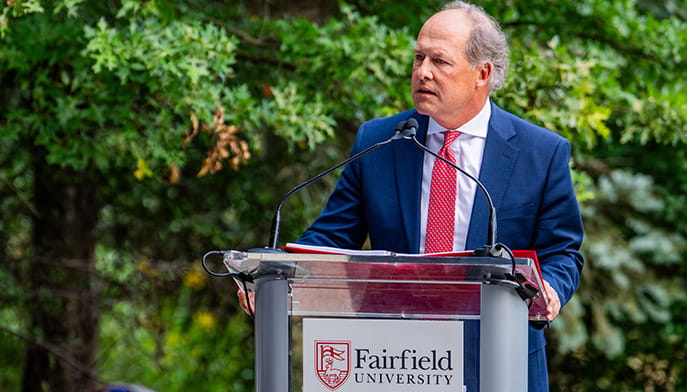
Vice President for Mission and Ministry Rev. Paul Rourke, S.J., Museum Executive Director Carey Mack Weber, and University President Mark R. Nemec, PhD, welcomed attendees and reflected on the significance of the sculpture’s presence on Fairfield’s Main Campus.
Fr. Rourke cited Elie Wiesel’s 1983 Commencement remarks at Fairfield, quoting “beautiful things happen when Catholics and Jews work together,” reminding the audience that we are “brothers in faith and in dignity.”
The memorial “stands as a testament and as a teacher for the campus community,” said Dr. Nemec, with Weber noting that it will serve as a site for “teaching the history of art, the Holocaust, and genocide studies for visitors of all ages.”
Fairfield University is now the nation’s second site for this powerful sculpture, after the first installation in LeBauer Park in Greensboro, N.C., in 2023. Milstein was in attendance and shared that a third sculpture was recently commissioned, to be installed in Nassau County, N.Y.
The sculpture on Fairfield’s campus is a gift of Paul F. Burger and Shoah Memorial of Fairfield, Connecticut, in remembrance of the women and children, and all victims of the atrocities of the Holocaust.
Art, Memory, History
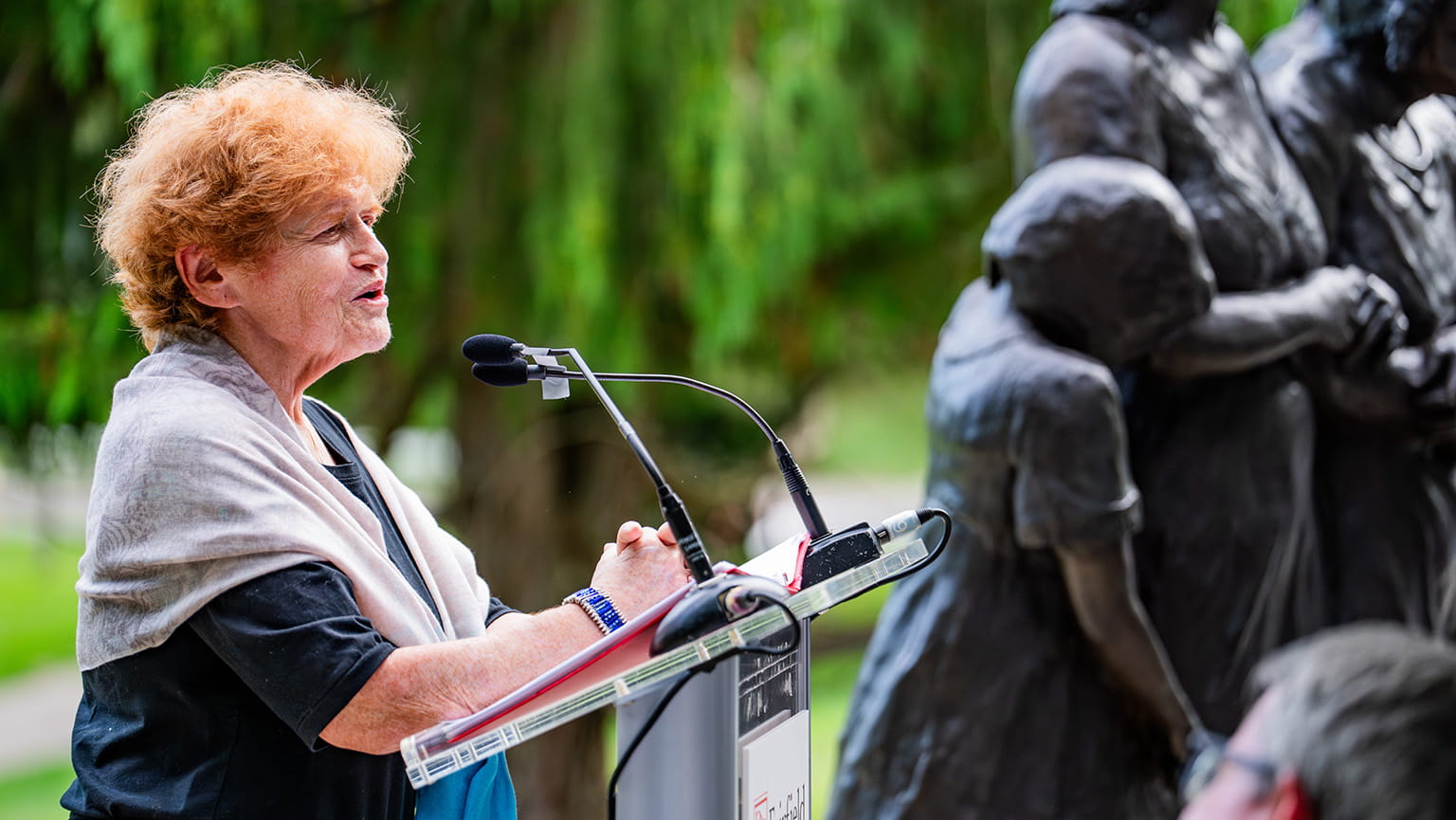
Following the dedication and reception, Ambassador Deborah Lipstadt opened the 2026-27 Philip I. Eliasoph Open VISIONS Forum season with a lecture titled “Art, Memory, History: The Holocaust and Its Lessons for Our Moment.”
Deborah E. Lipstadt was confirmed by the U.S. Senate as the special envoy to monitor and combat antisemitism, with the rank of ambassador. Serving from 2022 to 2025, Ambassador Lipstadt led efforts to advance U.S. foreign policy to counter antisemitism throughout the world.
In her talk, she reflected on two main questions: What is antisemitism and what is the threat of antisemitism? “I don’t see it solely as a threat against Jews, but as the tip of the spear to a much greater threat—a threat to democracy,” she said.
The evening concluded with a panel discussion featuring Ambassador Lipstadt, Bennett Center for Judaic Studies Director Yaron Ayalon, PhD, Carl and Dorothy Bennett Professor Emerita of Judaic Studies Ellen M. Umansky, PhD, and Special Assistant to the President for Arts and Culture Philip Eliasoph, PhD.