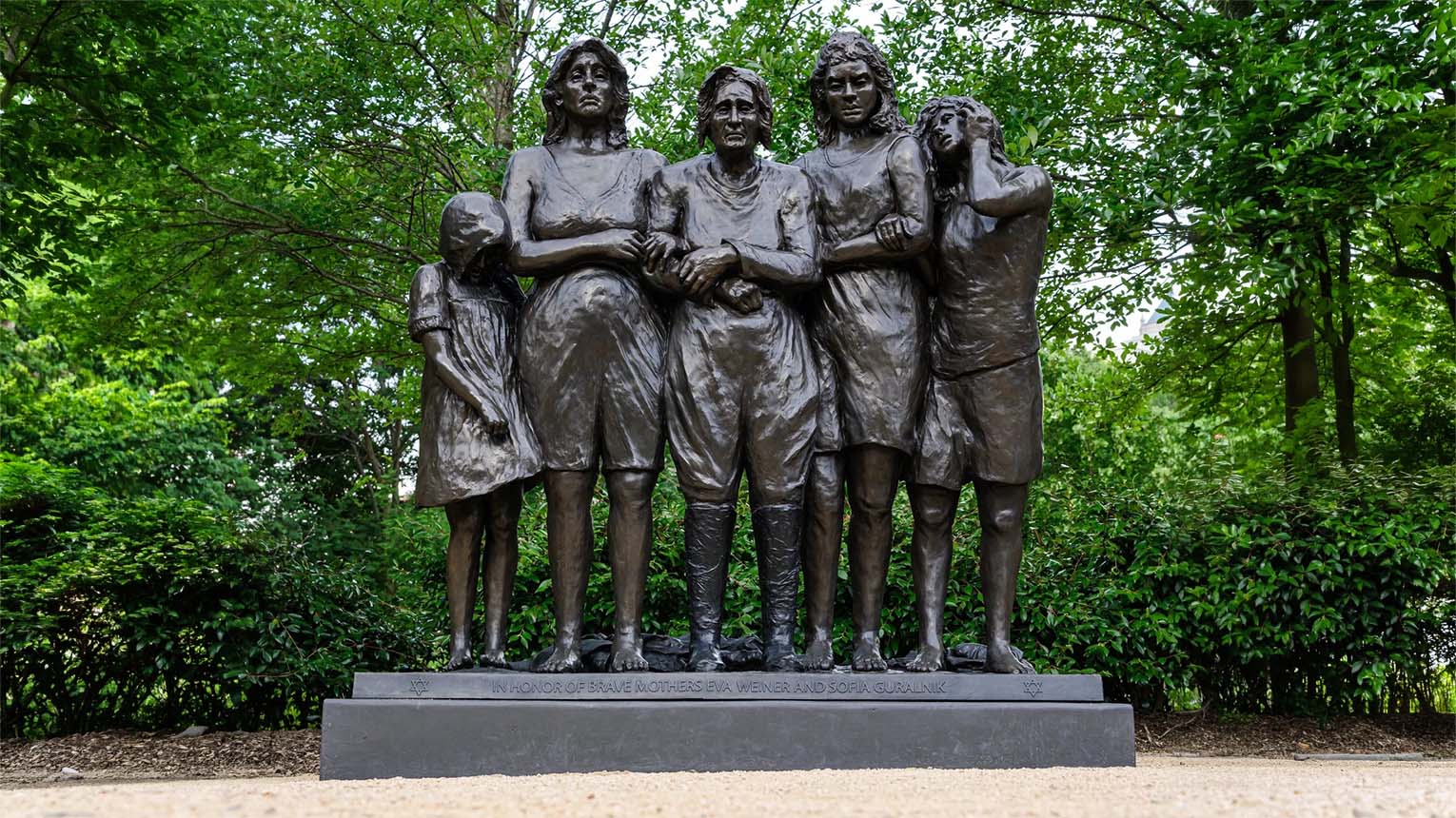
Fairfield University prepares to become the nation’s second site for Victoria Milstein’s powerful Holocaust memorial sculpture, after the first installation in LeBauer Park in Greensboro, NC, in 2023.
Victoria Milstein, "She Wouldn't Take Off Her Boots", 2023, bronze. Greensboro, NC
Fairfield University prepares to become the nation’s second site for Victoria Milstein’s powerful Holocaust memorial sculpture, after the first installation in LeBauer Park in Greensboro, NC, in 2023.
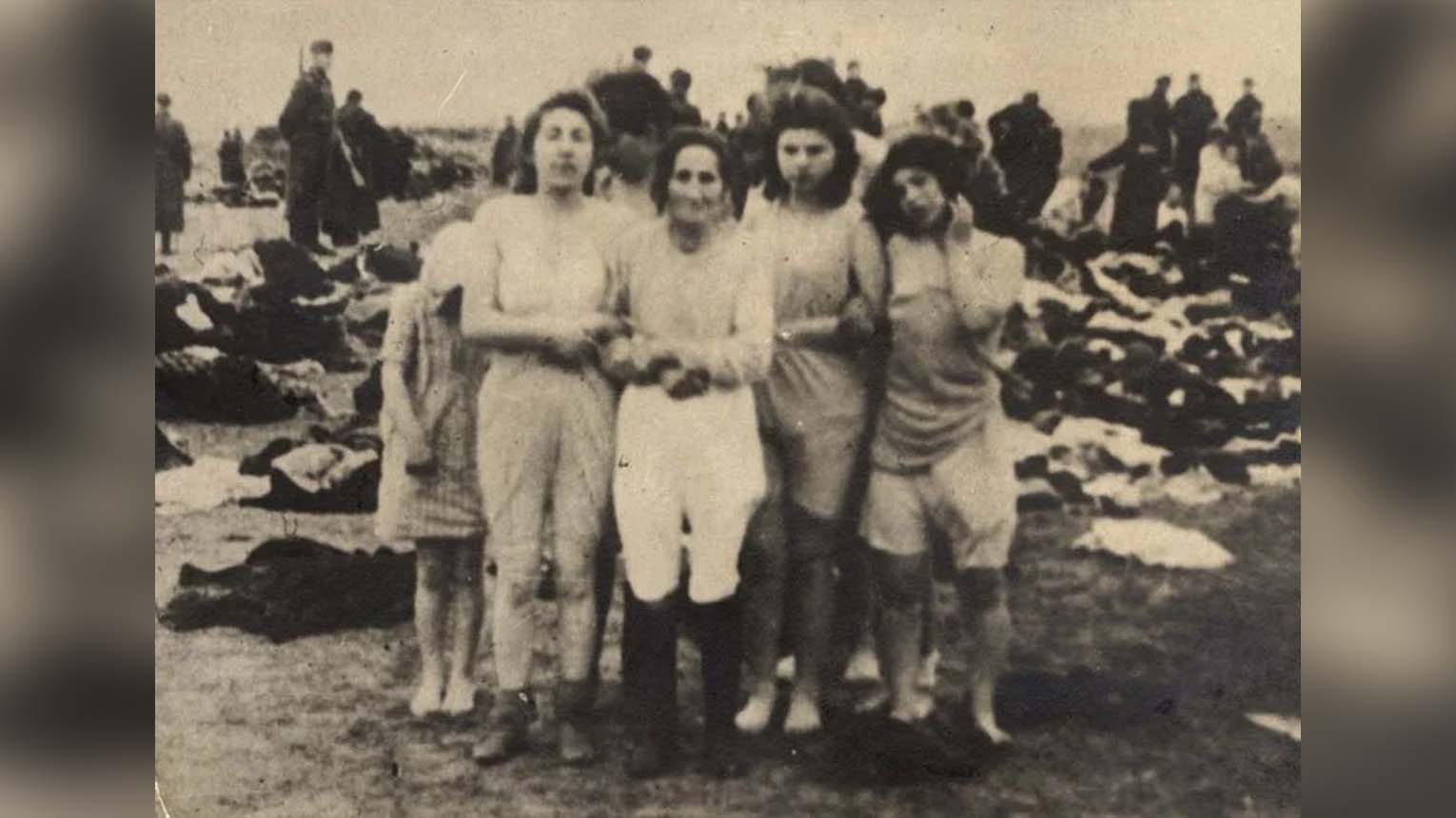
In Liepāja, Latvia, on December 15, 1941, thousands of Jewish women and children were taken to the women’s prison. From there, in the freezing cold, they were marched to a nearby beach called Skede, forced to strip to their underclothes, taken to the edge of a trench, and shot dead in groups of ten. Many of the victims were photographed in their final moments by a Nazi photographer. One such photograph serves as the basis for Victoria Milstein’s monument, She Wouldn’t Take Off Her Boots.
September 11, 2026 - Onward
Fairfield University Art Museum
Sited between the Dolan School of Business and Bellarmine Pond.
Gift of Paul F. Burger and Shoah Memorial Fairfield Connecticut
In remembrance of the women and children, and all victims of the atrocities of the Holocaust.
The photograph of the Liepaja massacre, upon which the monument "She Wouldn't Take Off Her Boots" is based. Some historical sources identify these women as: (From right to left) Emma Epstein, Maya Epstein or Naomi Yankelowtiz, Miriam Parve, Roas Epstein or Frume Purve, and Sorella (Sarah) Epstein, 10 years old. Photo Credit: Yad Vashem
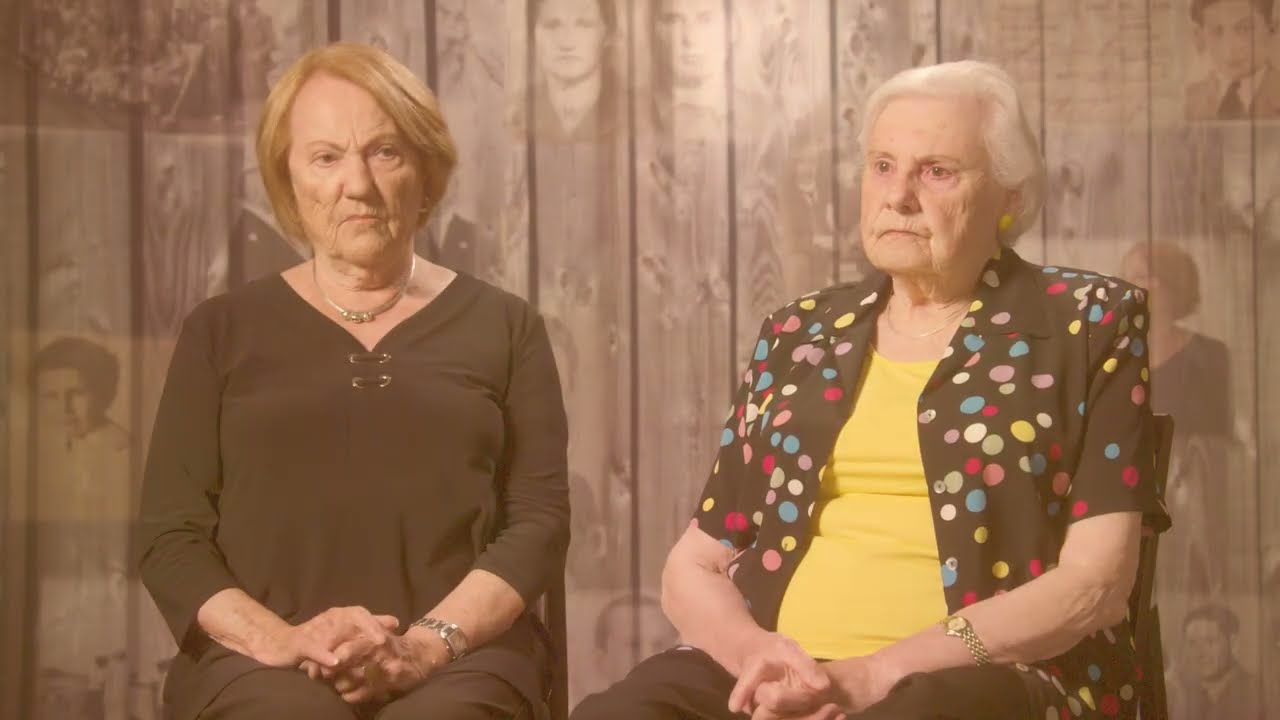
As the artist explains her work, “Standing arm-in-arm are five women in their last act, looking straight at us today, with grace, humanity, and defiance. The older woman, asked to strip, stands in the center with her boots on as she clutches onto the arms of generations of women in her family.
The two figures at the end of the grouping bring us physically into the sculpture, revealing an emotional narrative of their impending death. With a snap of the camera, we almost can’t comprehend the innocence that we see. One sees the subtle emotions of fear, disbelief, terror, and even hope. The youngest, with her head bent, clutches her fists, communicating the human horror of the Holocaust and reminding us of the several million children that were exterminated.”
At the heart of the memorial stands a bronze camera, symbolizing the Nazi photographer’s lens through which the victims’ last moments were documented. By interacting with the camera’s lens, viewers become witnesses, observing the stark contrast to the photographer’s original intent. This immersive experience creates a deep, personal connection with the history and lessons of the Holocaust.
The PBS documentary on Victoria Milstein’s sculpture
Our Audio Guide and Verbal Descriptions of select objects for visitors with low vision, can be accessed on the Bloomberg Connects app or at this link.
The Holocaust was unprecedented, total, and systematic genocide perpetrated by Nazi Germany and its collaborators. Their aim: to annihilate the Jewish people. The primary motivation was the Nazis' antisemitic racist ideology.
During the start of World War II, on September first, nineteen thirty-nine, the Germans implemented a new policy toward the Jews. After the conquest of Poland, the Jews of Eastern Europe were concentrated in ghettos. The Jews of Western Europe were registered and dispossessed of their property. North African Jews faced similar antisemitic racial legislation, and Jews in Southeastern European countries were drafted into forced labor by collaborationist governments. Tens of thousands of Jews perished while in the forced labor camps. There was no escape for those the Nazis deemed unworthy.
Murderers were not content with destroying the communities. They tracked down each hidden Jew and hunted down each fugitive. The crime of being a Jew was so great that every single one had to be put to death. All were meant to suffer and die with no reprieve, no hope, no possible amnesty, nor chance for alleviation. By nineteen forty-five, nearly six million Jews had been murdered.
A civilization that had flourished for close to two thousand years was no more. The survivors, dazed, emaciated, bereaved beyond measure, gathered the remnants of their vitality and the remaining sparks of their humanity and rebuilt. They turned to rebuilding new families forever under the shadow of those absent, new life stories forever warped by the wounds, new communities forever haunted by the loss. World War II transformed the face of Europe and the entire world and resulted in the killing of millions of civilians of different nationalities.
The Righteous Among Nations are non-Jews who took great risks to save Jews during the Holocaust and are honored by Yad Vashem. The Righteous came from different nations, religions, and walks of life. What they had in common was that they protected their Jewish neighbors at a time when hostility and indifference prevailed.
The Righteous showed extraordinary courage during a time when many collaborated with the perpetrators. They saw Jews as human beings in need of help instead of with indifference or hostility. Many felt it was their obligation to help save Jews from certain death. Most rescuers began their journey as bystanders.
Many stood by while Jews were stripped of their rights and their property confiscated. But all found a moment when they could no longer watch and needed to act. For some, it was the moment a Jewish neighbor or friend asked for help. In an instant decision, the bystander was overtaken with the human instinct to help save another.
Small gestures were huge. Some hid someone during a raid, provided shelter for a day until other arrangements could be made, and even hiding someone for months or years. In addition to hiding, two other ways the Righteous helped save Jews were providing false papers and identities and smuggling Jews out to escape.
The Righteous took great risks to themselves and their families. In many countries, getting caught harboring a Jew meant incarceration at a concentration camp or death.In Latvia on Monday, Dec. 15, 1941, thousands of Jewish women and children were taken to the women’s prison in Liepāja. From there, in the freezing cold, they were marched to a nearby beach called Skede, forced to strip to their underclothes, taken to the edge of a trench, and shot dead in groups of ten. Many of the victims were photographed in their final moments by a Nazi photographer. One such photograph serves as the basis for the Women of the Shoah monument “She Wouldn’t Take Off Her Boots.”
We see the strength and the humility of generations of Jewish women from Liepaja, moments before they were murdered by Nazis in 1941. They stand in their innocence; their only crime was that they were Jews. The photo I used as a basis for the monument was taken by a Nazi photographer to document the victories of the Nazi regime as propaganda for its German citizens. My hope is that each time one views the monument from that perspective, one becomes witness to exactly the opposite of what the Nazi photographer intended to document.
Standing arm-in-arm are five women in their last act, looking straight at us today, with grace, humanity, and defiance. The older woman, asked to strip, stands in the center with her boots on as she clutches onto the arms of generations of women in her family. The two figures at the end of the grouping bring us physically into the sculpture, revealing an emotional narrative of their impending death. With a snap of the camera, we almost can’t comprehend the innocence that we see. One sees the subtle emotions of fear, disbelief, terror, and even hope. The youngest, with her head bent, clutches her fists, communicating the human horror of the Holocaust and reminding us of the several million children who were exterminated.
I was very influenced by Rodin’s sculpture of “The Burghers of Calais,” where each figure communicates the emotional journey of their impending death. When I first saw the photograph, I saw my sisters, Jewish women, and it changed me forever. You can’t un-see what you have seen.
Victoria Milstein
Monument Artist
Events listed below with a location are live, in-person programs. When possible, those events will also be streamed and the recordings posted to our YouTube channel.
Kelley Theatre, Quick Center for the Arts
Tickets available through the Quick Center Box Office: quickboxoffice@fairfield.edu or 203-254-4010
Please check back in fall 2026 for information on K-12 tours as well as guided visits for visitors of all ages.
Dawn to dusk.
Bellarmine Hall Galleries and Walsh Gallery Hours
Tuesday-Saturday, 11 a.m. – 4 p.m.
Thursday until 8 p.m.
We are closed for national and university holidays and during inclement weather.
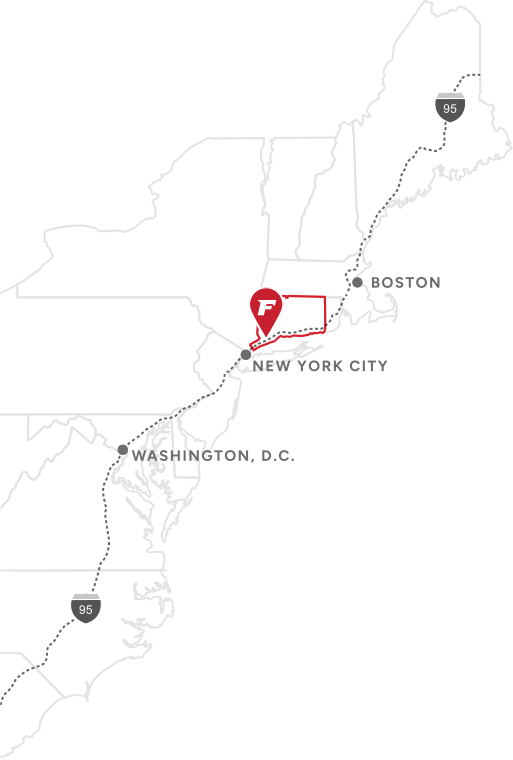
For GPS please use the following address:
200 Barlow Road, Fairfield, CT, 06824.
Free parking, including handicap parking, is available in front of the Dolan School of Business.
Free parking is available at the lot in front of the Quick Center, including handicap parking. Museum visitors may park in any available spot that is not marked reserved, handicap accessible only, or for service vehicles.
The monument and the museum are open to the public and admission is free.
Take Metro-North, New Haven Line, to Fairfield Station.
Approximately 70 minutes from Grand Central Station.
(800) 638-7646
1073 North Benson Road
Fairfield, CT 06824
(203) 254-4046
museum@fairfield.edu
Enjoy free admission every day—no reservations required.
Before you arrive, be sure to check current hours for the Bellarmine Hall and Walsh Galleries to make the most of your visit.