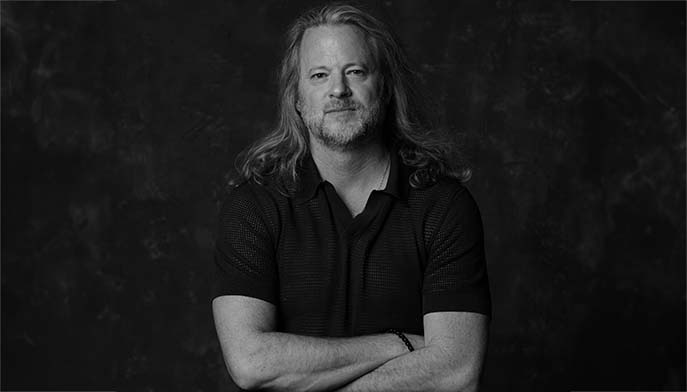
James Baldwin’s life and work came into focus at Fairfield University on October 5 through the Fairfield MFA Creative Writing’s Inspired Writers Series. The event brought Nicholas Boggs to campus to discuss his New York Times bestselling biography, Baldwin: A Love Story.
The first major biography of Baldwin in more than three decades, the book has received numerous honors, including the National Book Critics Circle’s John Leonard Prize and the ALA Stonewall Book Award in Nonfiction. The event was sponsored by the John Charles Meditz College of Arts and Sciences’ MFA in Creative Writing program and the Arts Institute.
“Nick was incredibly generous and thoughtful, offering insight not only into Baldwin, but also into the approach he took to writing his biography—which made it such an astounding read,” said Phil Klay, professor of religious studies and director of the MFA in Creative Writing program.
The Inspired Writers Series brings nationally recognized authors to campus to explore craft, culture, and the role of literature in public life. Hosted by Klay, who was recently named president and chair of the Board of Trustees of PEN America, the evening’s discussion of Baldwin connected to broader questions about a writer’s role in engaging with culture, politics, and free expression.
Love as a Lens on Baldwin’s Life and Work
At the center of Boggs’s biography is the idea of love: not simply romantic love, but love as a force that shaped Baldwin’s relationships, writing, and understanding of America. Boggs explained that Baldwin’s novels, from Go Tell It on the Mountain to Giovanni’s Room and Another Country, can fundamentally be understood as love stories. Even his political writing, including The Fire Next Time, was rooted in a belief that Americans needed to find a way toward one another.
Boggs also reflected on the challenge of writing Baldwin’s story himself, describing biography as “a construction” and “a living, breathing project.” By acknowledging his own perspective as a biographer, he challenged the idea that an artist’s life can be captured in a completely objective account. That perspective also allowed him to explore Baldwin beyond his familiar image as a civil rights icon and examine the experiences and relationships that shaped him as an artist.
Boggs challenged the idea that Baldwin’s writing declined as he became more politically engaged. Rather than viewing art and politics as separate paths, Baldwin remained an artist at his core. His experiences with racism, sexuality, religion, and political activism informed the subjects and perspectives he brought to his work. That connection between art and politics was also reflected in Baldwin’s complicated relationship with America. Although he spent periods of his life abroad, he kept returning to the U.S. and engaging with its political and social struggles.
An Enduring Legacy of Love and Connection
Boggs described Baldwin as having “an impossible love for America,” a country that celebrated him but continued to confront him with both racism and homophobia. Boggs explained that this relationship with America was marked by both profound love and deep disappointment, a tension that shaped his work and his role as a writer and critic.
For Boggs, Baldwin’s genius was not simply his ability to write but his “ability to connect with people” and to “challenge others to love better.” His relationships with teachers, mentors, friends, collaborators, and romantic partners shaped his development as an artist. Baldwin challenged readers to confront difficult truths while also asking them to consider what it means to love, understand, and accept one another.
Decades after Baldwin’s death, those questions about identity, race, sexuality, politics, and human connection continue to engage new generations of readers and writers. As Boggs reflected, Baldwin believed that “a great artist is not judged in his time”—a sentiment that speaks to the enduring relevance of his work and the continued discovery of his ideas by new generations.