James Welling: Cento opened to the public on Thursday, Sept. 24 at the Fairfield University Art Museum’s Walsh Gallery in the Regina A. Quick Center for the Arts.
The second of two exhibitions to open on campus this fall, James Welling: Cento focuses on more than 60 recent works by contemporary photographer James Welling (American, born 1951) in the first American presentation of this body of work. From the artist’s Cento and Personae series, these photographs of ancient sites in Italy and Greece, as well as antiquities found in museums around the world such as the Louvre and the Met, were subjected to digital and painterly alteration by the artist to achieve transformative effects.
The photographs are exhibited alongside a selection from the Museum’s extensive historic plaster cast collection of Greek and Roman sculpture.
Revitalizing Ancient Objects
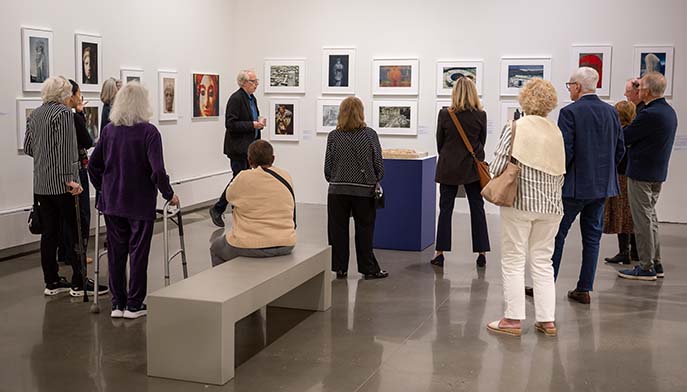
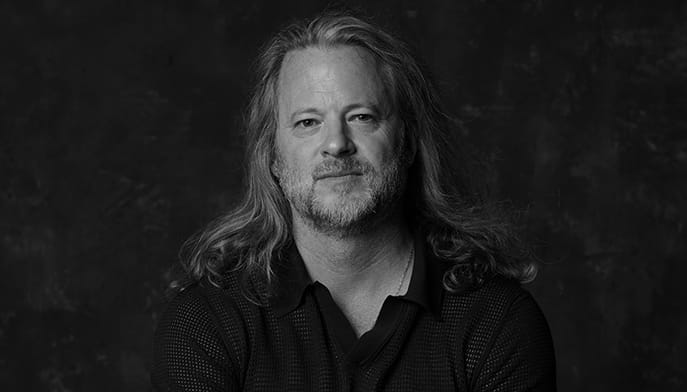
Welling, a self-taught photographer who never studied the art formally, gave the opening night lecture. He described his work in the show—which include pieces made with a laser printer and oil paint—as a “revitalization of the objects” in his photographs and spoke about how his final product helps to “reanimate the sculptures” pictured.
“I’m very interested in the phenomenon of color,” Welling said, noting the bright colors that once covered the sculptures of antiquity. Today, we think of, and see, these sculptures as pristine white stone.
Welling begins his work on some of the photographs by cleaning up the background in photoshop, then adding fine washes of color digitally before going in with oil paints. On others, he digitally adds features from other works, combining, for example, ancient sculpture with the eyes of a Renaissance painting or even the eyes of someone he knows personally.
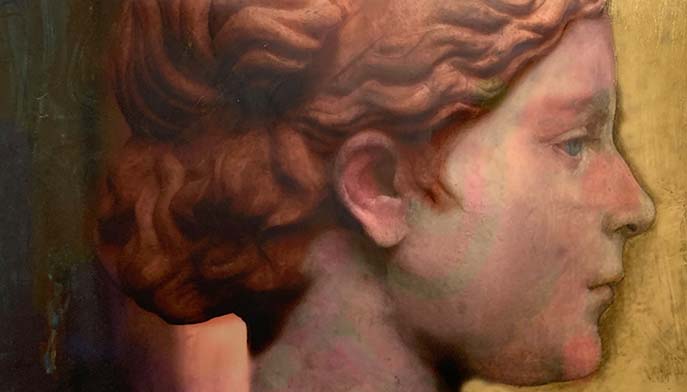
An example he shared from the exhibition was the photograph Apollo. In it, the head and hair are from a sculpture, with a face by Leonardo DaVinci layered over the sculpture’s face.
Unique Portraits
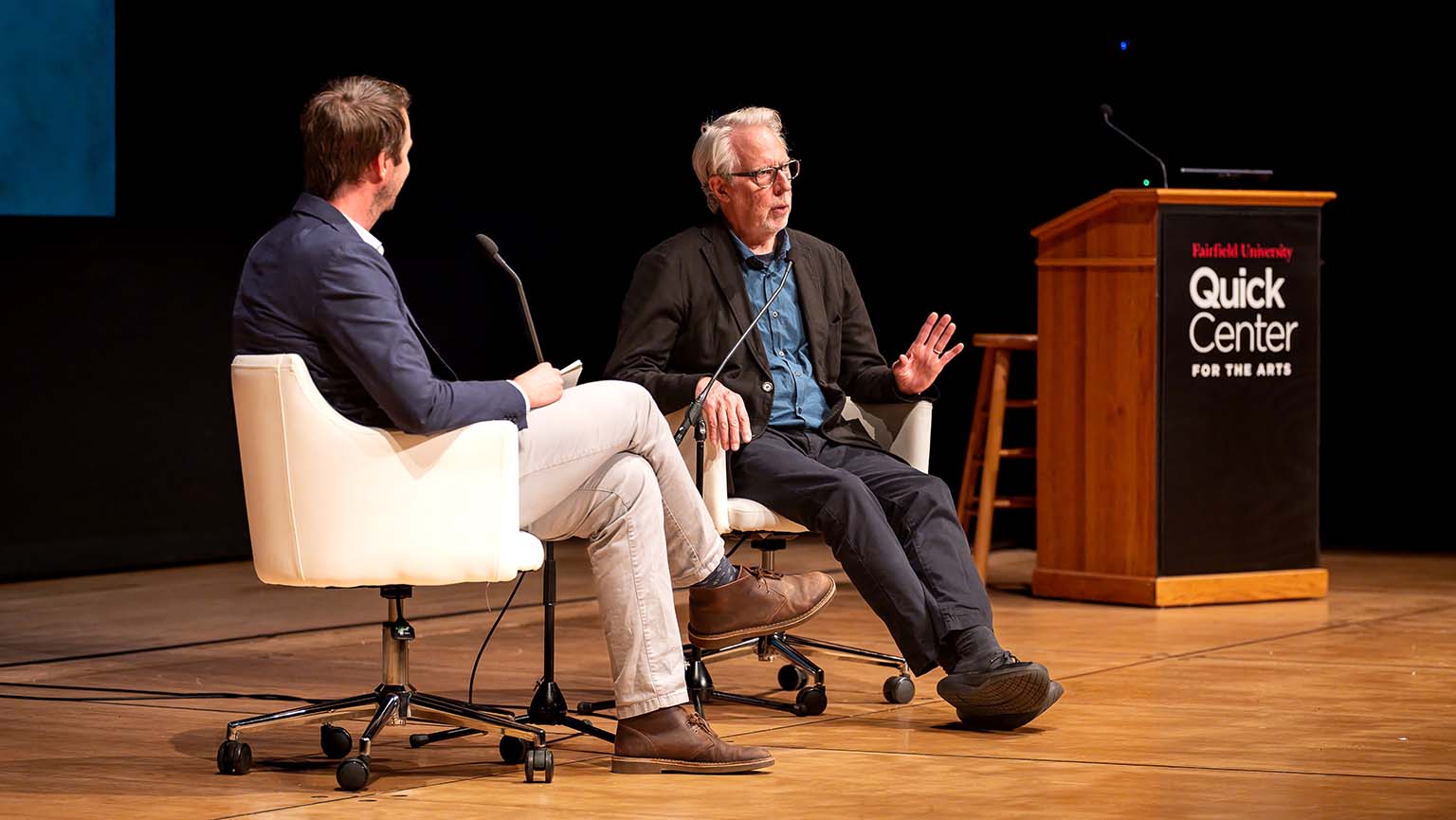
Following his lecture, Welling was joined onstage by Andrew Ward, PhD, assistant professor of art history & visual culture, for a conversation and Q&A session with the audience.
An audience member asked about Welling’s unique style and his creative process, specifically as a “revival and rebirth, versus creating an entirely new being via his photography.”
“In the museum, I’m trying to solve the problem of how to make a portrait, in a unique way,” said Welling, who then shared that his work is actually a little bit of both—revival and rebirth—and that his final pieces allow viewers to “go directly to these people, these objects, as if you can feel them.”
Welling will return to campus for a series of gallery talks in the Walsh Gallery later this semester.
Learn more about the exhibition and upcoming free public programming.