Veteran journalists visited students in the John Charles Meditz College of Arts and Sciences to share tips on storytelling, tenacity, and developing sources.
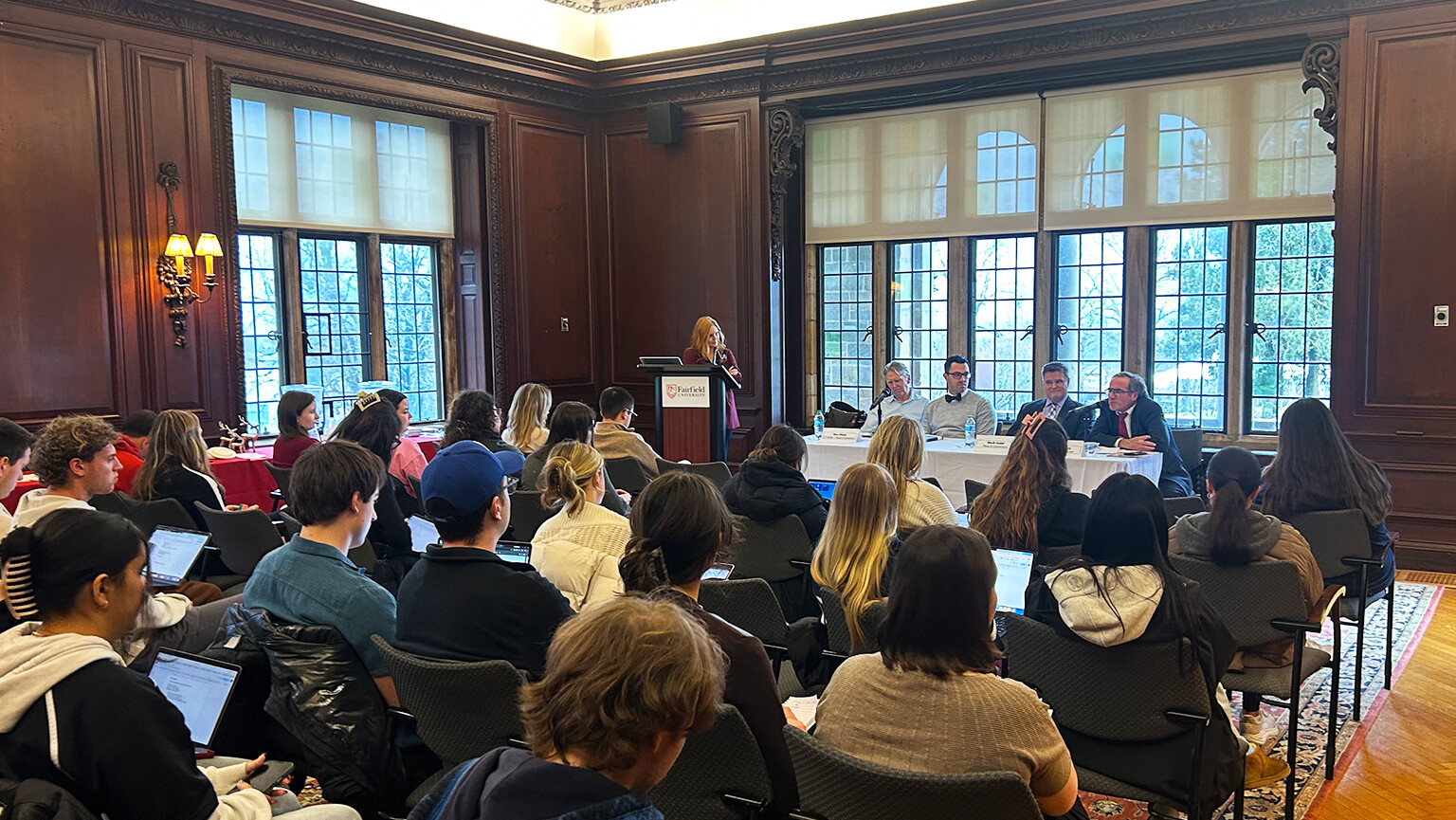
Meditz College students got a behind‑the‑scenes look at political reporting during a panel discussion hosted by the Master of Public Administration (MPA) program. Four veteran journalists shared insights into how they find stories, cultivate sources, and hold public officials accountable in a fast‑paced news environment.
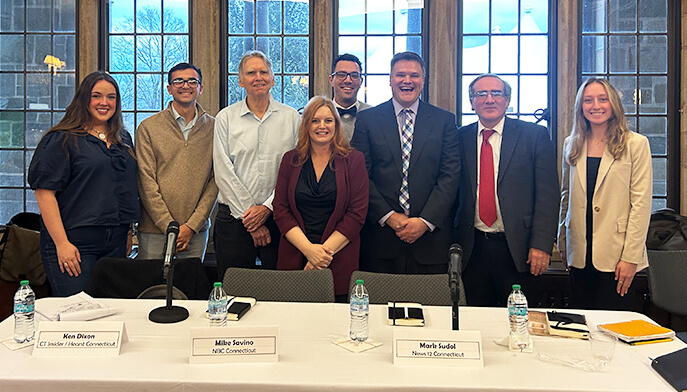
Moderated by Fairfield Meditz’s Gayle Alberda, PhD, associate professor of politics and director of the MPA program, the panel featured Chris Keating (The Hartford Courant), Ken Dixon (CT Insider/Hearst Connecticut), Mike Savino (NBC Connecticut), and Mark Sudol (News 12 Connecticut).
“The goal is to pull back that curtain,” Dr. Alberda told the panelists, inviting them to discuss how they report on politics and policy.
The Realities of Reporting
Chris Keating opened with a candid look at the demands of political reporting and the persistence required to succeed. He underscored the importance of maintaining neutrality when covering politics. “If you’re super ideological, you shouldn’t get into it,” he said, explaining that reporters must be able to engage with people across the political spectrum.
Mark Sudol described the unpredictable nature of broadcast news, recalling how his team once went to cover a plane crash, only to pivot to a U.S. Postal Service story. He highlighted News 12’s political show and the value of in-depth interviews that allow reporters to ask tough questions and hold public officials accountable.
Mike Savino emphasized adaptability across media. Originally drawn to journalism by a love of sports, “I wanted to cover the Red Sox,” he said, but “when I graduated, the industry was changing very rapidly, and they weren’t really hiring sports reporters.” He got his start as a print reporter covering local meetings, which taught him that strong storytelling translates across platforms: “If you know how to tell a story, you can figure out how to tell it in the medium that you’re [working in].”
Ken Dixon focused on building trust with sources. “Trust is built over time, and it starts with spelling their name right,” he said.
Verifying Information and Building Sources
The importance of verifying information and vetting sources in political reporting was a central theme. Keating advised students, “If you’re not sure whether it’s true or not, just don’t print it.” Savino echoed that mindset, stressing the need to double-check everything, especially when documents and PDFs can be AI‑generated.