On Tuesday, Oct. 21, the Fairfield University Art Museum hosted a faculty roundtable on incarceration in the United States at the Dolan School of Business Event Hall. The event was part of the programming around the museum’s exhibitions, Stitching Time: The Social Justice Collaboration Quilts Project and Give Me Life: CPA Prison Arts Program, on view in the Walsh Gallery at the Regina A. Quick Center for the Arts through Dec. 13.
Eighty attendees filled the Event Hall, many from local community organizations that serve and support current or formerly incarcerated individuals, particularly as they are transitioning back home.
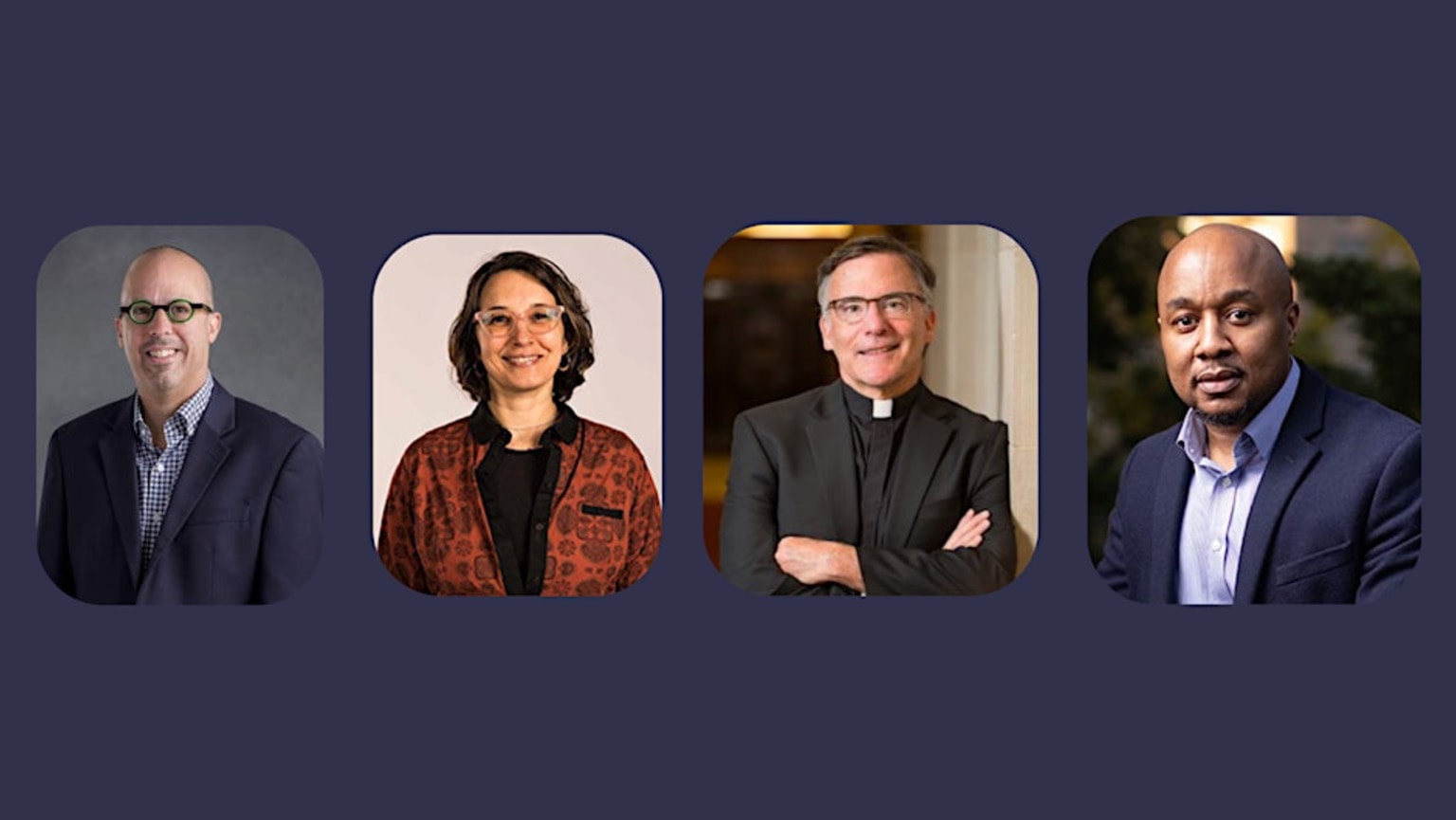
Michelle DiMarzo ’07, PhD, the museum’s curator of education and academic engagement, introduced the panel of speakers which included Sonya Huber, PhD, professor of English and editor of the Dogwood literary journal; Don C. Sawyer III, PhD, vice president of diversity, inclusion, and belonging, and an associate professor in the Department of Sociology and Anthropology; Gifton Bagalloo, a formerly incarcerated student in Dr. Sawyer’s Second Chance Education Alliance classes; Rev. Kevin O’Brien, S.J., vice provost and executive director of Fairfield Bellarmine; and Gregg Caruso, PhD, director of the Patrick J. Waide Center for Applied Ethics and a professor of ethics and management.
The evening’s dialogue began with how and why each of the panelists found themselves involved in the conversation on incarceration, before moving on to the many issues with the current criminal justice system in the United States and the types of programs and ideas that are currently working to shift the narrative.
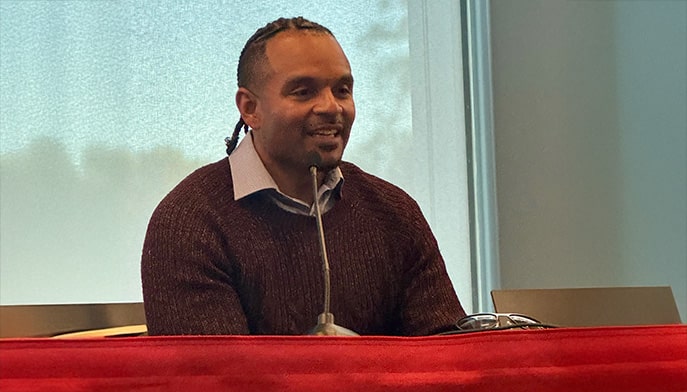
Bagalloo spoke about how the U.S. prison system is not currently designed to support reentry. “When [prison] funding gets pulled,” he said, “it’s from the programs that help people.”
An audience member shared her experience as a pen pal with women in the York Correctional Institution in Niantic, Conn. She mentioned that “the prospect of being released was terrifying” for these women. “I would hope that release would be something to look forward to,” she said, lamenting the lack support systems to help them get back on their feet.
Dr. Caruso shared that “70 percent of prisoners will be re-arrested within the first five years out,” citing that lack of systems to support rehabilitation, education, and reintegration as one of the root causes.
He also called attention to the outsized scope of incarceration in the United States compared to other nations, noting that while the U.S. is home to only 4.4 percent of the world’s population, it houses 20 percent of the world’s prison population—the largest rate known to civilization. “For every 100,000 citizens in the United States, 531 people are imprisoned,” he said, “compared to less than 60 people per 100,000 in countries like Denmark, Norway, and Sweden.”
Other statistics highlighted the recent drastic increase in women who are currently in prison. “In 1980, 26,000 women were incarcerated,” said Dr. Caruso. “In 2025, 191,000 women are incarcerated,” a more than 623-percent increase. Additionally, he pointed out, “70 percent of all women incarcerated in the United States are mothers.”
Asked how any single person can help address a social justice issue of this scale, Dr. Sawyer reminded attendees that “we are not separate. We are all connected through this fragile thread of humanity.” Those in prison could include any of us, he said, if we had made a different decision or if our life circumstances hadn’t given us the opportunity to take the paths that we did.
“Educate yourself on what’s happening,” recommended Dr. Sawyer. “Don’t take it at face value: do your own research and then ask yourself, ‘What can I do within my sphere of influence?’”
Dr. Sawyer is currently building a program at Fairfield that will provide both education for individuals currently incarcerated as well as reentry support following release. A recent information session drew wide faculty interest and more information on the program is expected to be shared in the coming months.
“We are so grateful to the faculty panelists who collaborated with the museum to present the enlightening roundtable conversation on incarceration, in conjunction with our current exhibitions,” said Carey Mack Weber, the museum's Frank and Clara Meditz Executive Director. “It was exciting to see how the program that evening resonated with the audience, and we were so pleased to be able to provide a platform for the community to hear from Dr. Don Sawyer about Fairfield University’s new initiative on prison education and reentry.”