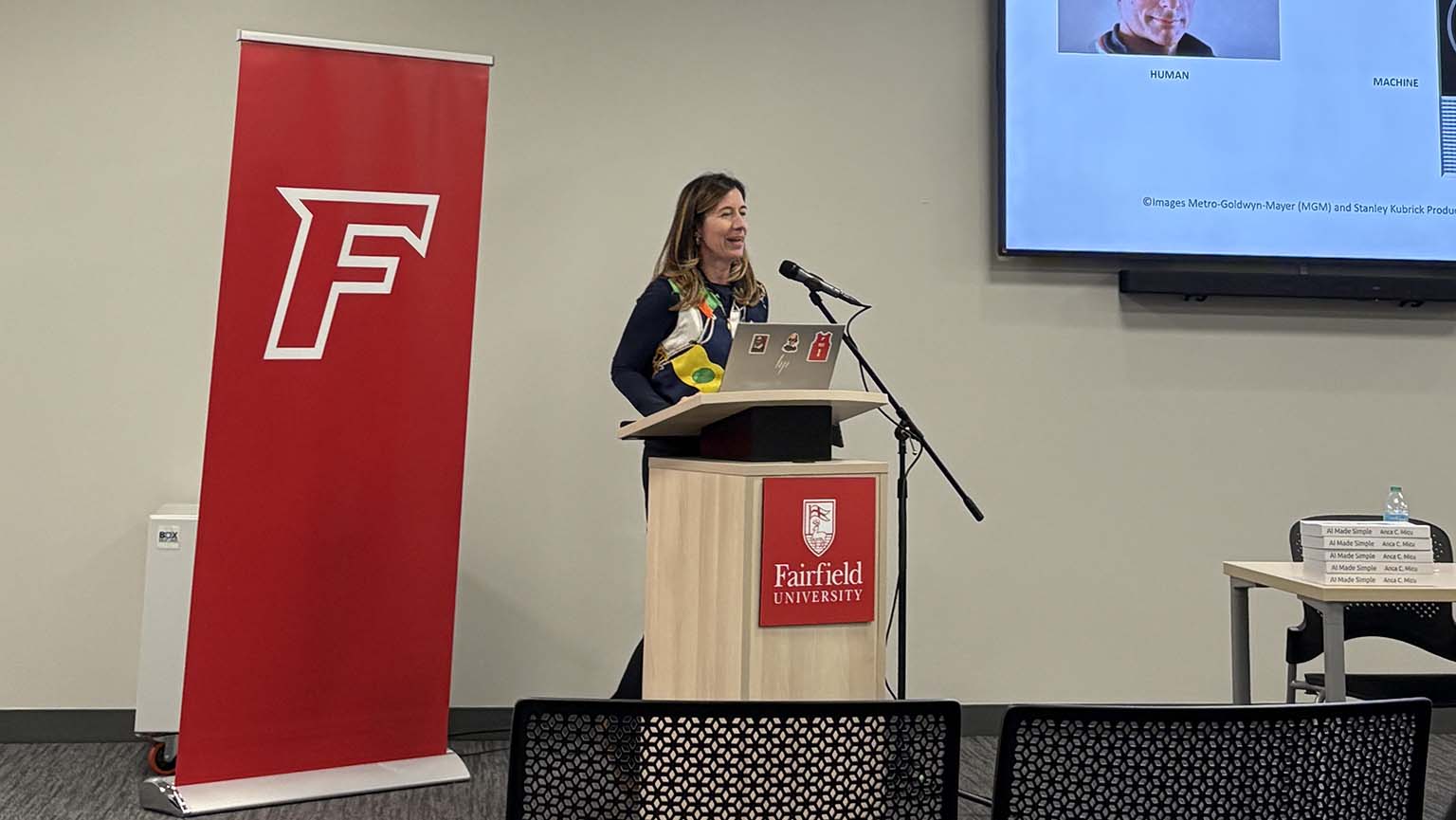
Fairfield University’s final Campus Connect event of the fall 2025 semester brought together two faculty experts—Anca Micu, PhD, senior associate dean of the Charles F. Dolan School of Business, and Tommy Xie, PhD, associate professor of English and director of the Digital Journalism program in the John Charles Meditz College of Arts and Sciences—for an engaging conversation on the rapidly evolving world of artificial intelligence.
Held at the Fairfield University Store’s Second Story on Nov. 13, “AI Unpacked: Understanding the Technology Transforming Our World” drew students, faculty, staff, and community members eager to better understand how AI works—what it can and cannot do, and how it is reshaping daily life, business, creativity, and ethics.
Dr. Xie opened the event by distinguishing AI from generative AI (GenAI)—reminding the audience that while tools like ChatGPT, Gemini, and image generators draw the spotlight, non-generative AI already drives everything from Amazon recommendations to Netflix queues. These systems don’t create new content; they detect patterns and predict behavior based on huge datasets. Generative AI, on the other hand, produces novel text, images, video, and code by learning from “oceans of data.”
Despite its impressive capabilities, Dr. Xie emphasized that AI “does not think” in a human sense. Using mathematical examples, he showed that AI can solve a problem correctly in one language but fail in another.
To address hallucinations—or instances when AI produces false or misleading information—Dr. Xie introduced Retrieval-Augmented Generation (RAG)—a system in which the AI is provided with documents that it cites and relies on directly. He demonstrated Google’s NotebookLM, which can ingest PDFs, webpages, and videos and then produce summaries, answers, and even AI-generated podcasts based strictly on those sources.
One audience-favorite moment came when NotebookLM simulated a podcast on planning a Japan trip, complete with listener “call-ins.”
Dr. Xie also showcased emerging AI agents, such as Perplexity’s Comet browser, which can autonomously navigate websites, click buttons and complete tasks online. In a live demo, he asked an agent to reorder a daily product on Amazon. The assistant accessed his past orders, navigated the site, and placed the item in the cart, illustrating both convenience and real privacy and cybersecurity concerns.
His closing message: AI should serve as an extension of human creativity, not a replacement. He encouraged the audience to stay in control—using AI for calculation and automation while relying on humans for ideas, judgment, and ethical reasoning. “We don’t want to be controlled by AI, but we want AI to be our extension… to release us from some repetitive and laborious work and really do creative things.”