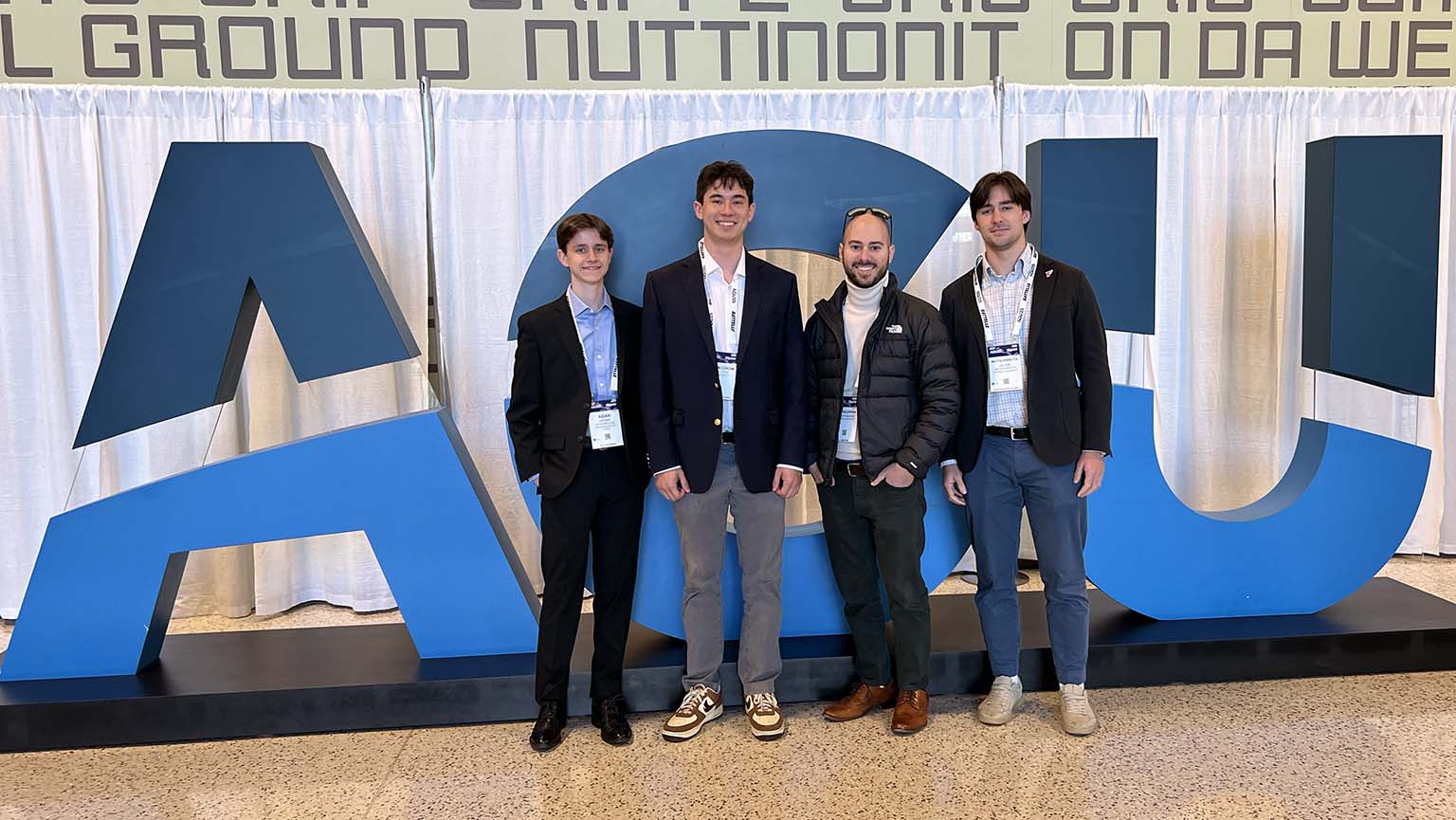
Alongside Rob Nazarian, PhD, faculty mentor and founding director of the Center for Climate, Coastal, and Marine Studies, three Fairfield Meditz students showcased their climate research at the 2025 American Geophysical Union (AGU) Annual Meeting.
The AGU conference—the largest international gathering of geoscientists—took place Dec. 15-19 in New Orleans, La. The event brought together tens of thousands of researchers, policymakers, and educators from around the globe to share the latest advances in earth and space science.
Extreme Snowfall
Researchers Ethan Chow ’27, Mattia Speretta ’27, and visiting student Aidan McClure presented their extreme snowfall research, conducted under the guidance of Dr. Nazarian, titled “Climate Change-Induced Trends in Extreme Snowfall Over Mountain Regions.”
Led by McClure, the students showed how a warming climate is altering patterns of extreme snowfall in mountainous areas—an issue of major global importance, as approximately 26 percent of the world’s population lives in mountain regions or their foothills, and nearly half of the global population depends on mountains for freshwater resources. Changes in extreme snowfall can lead to flooding, dangerous travel conditions, and disruptions to freshwater runoff, with significant societal and environmental consequences.
“Understanding how and why extreme snowfall is changing over mountain regions is critically important to resilience and adaptation planning efforts,” the students’ abstract states, “and presents an important avenue for bridging the gap from climate to extreme weather.”
Community Coasts
Another project presented at AGU and led by Dr. Nazarian, “Preferences for Coastal Management: A Discrete Choice Experiment from Uruguay,” explores how communities value different coastal management strategies in response to sea-level rise and the growing risk of coastline damage.
After analyzing public preferences, Dr. Nazarian and his student research team compiled insights to help policymakers design coastal management approaches that balance environmental protection, economic development, and community priorities. William Vasquez, PhD, professor and chair of economics also advised students on this sea-level rise research.
A third presentation, “Community Preferences for Sea Level Rise Mitigation and Adaptation at Connecticut Beaches,” focused on how residents and beach users perceive and prioritize responses to sea level rise along Connecticut’s coastline. The study emphasizes the importance of incorporating community input into climate adaptation planning, particularly as coastal regions face increasing risks from erosion, flooding, and storm surge, according to the abstract.