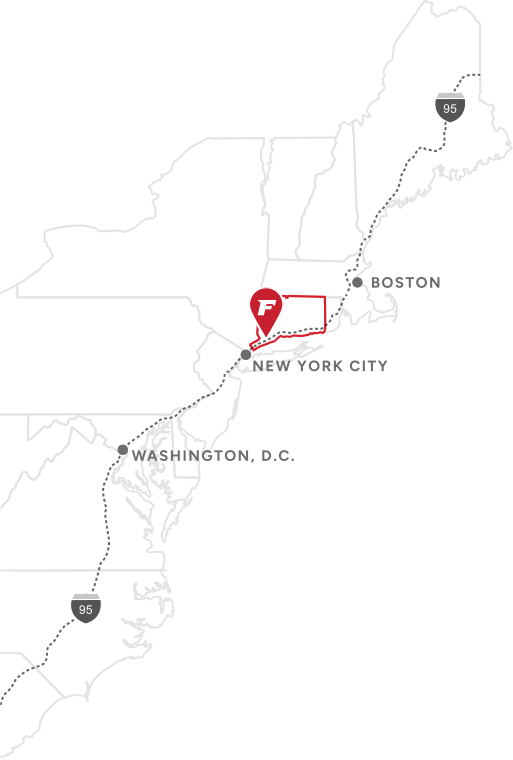
Inside the Bellarmine Hall Galleries, the labels begin underneath the exhibition lettering, and continue clockwise around the front gallery, ending with the stairs.
The labels continue in the back gallery, moving counterclockwise. Labels marked with a star were contributed by Fairfield University faculty members.
Childe Hassam (American, 1859–1935)
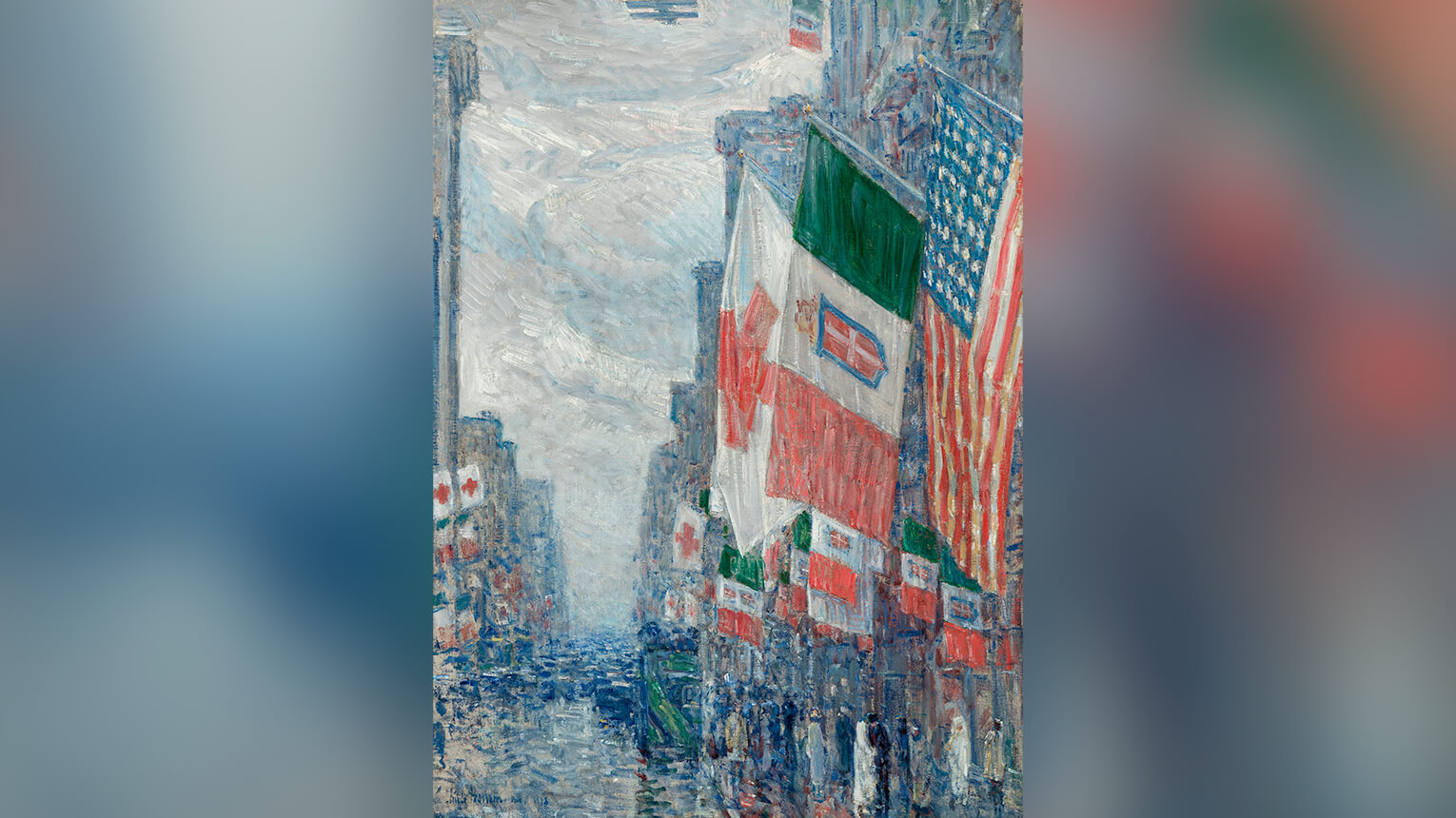
Italian Day, May 1918, 1918
Oil on canvas
Art Bridges
This painting depicts Manhattan’s 5th Avenue decor∗ated with the flags of the Kingdom of Italy, the Red Cross, and the United States, celebrating the 3rd anniversary of Italy’s declaration of war against the Austro-Hungarian empire. These displays increased in number and patriotic fervor after the United States entered the Great War in 1917. The painting formed part of a series begun in 1916 that drew inspiration from Claude Monet’s depictions of Bastille Day celebrations, which the artist had studied in Paris in the 1880s.
With the single-engine Curtiss JN “Jenny” biplane buzzing above, American master Childe Hassam captures the zeitgeist of old New York. His distinctively rhythmic brushwork recalls the en plein air modality of French Impressionism contrasted with the bustling noises of honking taxis along Manhattan’s Fifth Avenue. Using his characteristic staccato of short, flat, nib-of-the-brush gestures, he measures the heartbeats of the city.
Hassam is a Gotham-inspired observer playing the role of a gentleman dandy, a Yankee version of a loafing, Parisian flaneur. Rather than painting horse-drawn carriages along the Champs-Élysées, he celebrates Allied unity against Austro-Hungarian/German adversaries during the world’s first mechanized international conflict, one that would create over 40 million casualties.
With its radically oblique views plunging towards an open vanishing point across from the Plaza Hotel, the canvas explodes in a flurry of patriotic flags from the United States, Italy and the Red Cross. From his salon-like studio/residence at 130 West 57th Street—next to the legendary Art Students League—Hassam had easy access to the daily spectacle of midtown’s throbbing metropolis, awaiting peace.
Philip I. Eliasoph, PhD
Professor of Art History & Visual Culture
Special Assistant to the President for Arts & Culture
Florine Stettheimer (American, 1871–1944)
George Washington in New York, ca. 1932-1933
Oil and mixed media on canvas
Art Properties, Avery Architectural & Fine Arts Library, Columbia University in the
City of New York, Gift of the Estate of Ettie Stettheimer
Paintings by feminist modernist artist Florine Stettheimer often include American symbols such as the flag. Stettheimer was raised and lived in Europe after spending her early childhood in the U.S. Upon returning permanently to New York City after the start of World War I, she became a strong supporter of the Democratic Party.
In this unfinished work, two women, only their braceleted arms visible, look out a window onto an imagined view which combines buildings from Manhattan and the New York World’s Fair. One hand waves a flag which is in the composition’s center, above a gilded eagle with a shield (as in the national seal) and a large bust of George Washington that sits on the windowsill and meets the viewer’s gaze. Stettheimer began this painting during the World’s Fair, which coincided with the city’s celebration of the 150th anniversary of Washington’s inauguration. In her studio, Stettheimer had a “patriotic room” that included her collection of Washington-themed souvenirs.
Marice Rose, PhD
Professor of Art History & Visual Culture
N. C. Wyeth (American, 1882–1945)
The Victorious Allies, 1918
Oil on canvas
Published as the cover of The Red Cross Magazine, May 1919
Delaware Museum of Art, Gift of the Bank of Delaware, 1989
The quiet dignity of the “doughboy” carrying the unfurled American flag contrasts with the exuberance of his French, British, and Italian allies. The Belgian soldier, exhausted and kneeling, grips a tattered banner.
Ernest Lawson (American, 1873–1939)
Washington Bridge, New York City, ca. 1915-1925
Oil on canvas
Delaware Museum of Art, Gift of the Friends of Art, 1964
Unifying, unity, universality. Eyes roam freely and evenly around the scene. Large rocks in front anchor atop a hill looking toward melting snow. Geometric planes of houses, a bridge, and a curving road weave through winter’s terrain. A bridge that connects Bronx to Manhattan over the Harlem River. Dashes of green in the sky, in the distance, softer light colors. Equal proportion of shapes throughout, equality. Close tonal values and subtle shifts in color temperature harmonize to create the illusion of weather. Lawson’s color choices create a unifying light capturing a specific time of day for the viewer to contemplate. A collective human experience, the universality of weather, invites memory and feeling through our senses. Despite hints of blue and stripes, the composition is un-hierarchical, the flag at half-mast painted in unity within the democracy of the scene.
Suzanne Chamlin
Associate Professor of Studio Art
George L. K. Morris (American, 1905–1975)
Invasion Barge, 1943
Oil on canvas
Yale University Art Gallery, purchased with The Iola S. Haverstick Fund for American Art in honor of Professor Alexander Nemerov, Ph.D. 1992
An artist who worked primarily with abstraction, Morris returned some measure of representational content to his work during the height of American involvement in World War II. The fragmented appearance of this composition suggests the anxiety
of the soldiers themselves as they prepare to enter enemy territory.
John Gutmann (American, born Germany, 1905–1998)
The News Photographer, San Francisco City Hall, 1935
Gelatin silver print
Private Collection, New York
Gutmann was a German-born Jew who fled his native country in 1933. Settling in the United States, he set about documenting all aspects of his new homeland, including this shot of a reception for Nazi officials organized by the German Consulate in San Francisco. Uniformed American sailors sit politely before the podium, as the American flag is joined by the flag of the German Empire and that of Nazi Germany.
The idea that a flag “stands for” something is misleading—at least if one assumes its meaning is permanent. While a flag’s original inspiration can usually be identified, its significance can change dramatically “in the course of human events.” This is even more the case for an assemblage of flags. When officials in the German consulate in San Francisco displayed the flag of the Nazi party (far right) together with the flag of German Reich (middle) and the flag of the United States in 1935, they did not seek to generate meaning through direct representation but rather through strategic juxtaposition. While it is common practice for consular missions to fly both their own country’s flag with that of the host nation, German officials in San Francisco were surely also seeking to illustrate Hitler’s claim—advanced in Mein Kampf—that the Nazi party was pioneering a new form of “Germanic democracy” not entirely unrelated to that of the United States. This claim eventually proved to be more rhetorical than substantive. But it reflected Hitler’s foreign policy agenda at the time, which was to reassure the liberal democratic states of the west—the U. S. included—that the Nazis were more moderate than they really were. The assemblage of flags was thus an act of deception.
Gavriel D. Rosenfeld, PhD
Professor of History
President of the Center for Jewish History, New York City
Lower Left
Gordon Parks (American, 1912–2006)
American Gothic, Washington, D.C., 1942
Gelatin silver print
Collection of the Gordon Parks Foundation
Gordon Parks captured this portrait of janitor Ella Watson as part of a documentary project focused on Black lives in the nation’s capital, where he encountered “a kind of bigotry and discrimination…I never expected to experience.” Watson’s own life had been shaped by racial violence and poverty. While Parks’ image of her evokes Grant Wood’s iconic 1930 painting American Gothic, the substitution of the flag for the farmhouse suggests the divide between her circumstances and the implicit promise of the American dream.
Above
Herman Maril (American, 1908–1986)
Old Glory, 1943
Watercolor on paper
The Herman Maril Foundation, Courtesy of Debra Force Fine Art, New York
An American modernist painter, Maril served in the U.S. Army from 1942 to 1945. Because he was already in his 30s and an artist, he did not get sent overseas; rather, he spent these years in military training camps throughout the rural Southeast, rising to the rank of sergeant. He worked on camouflage designs and was part of an early project utilizing art therapy for combatants who had serious physical and mental impairments from their time on battle duty.
Upper Right
Joe Rosenthal (American, 1911–2006)
Raising the Flag on Iwo Jima, 1945
Gelatin silver print
Lent by the Estate of Hanns & Patricia Kohl
Joe Rosenthal captured this photograph of battle-worn Marines raising the American flag on Mount Suribachi atop the small Japanese island of Iwo Jima on February 23, 1945. The image was transmitted to U.S. newspapers less than 24 hours later, and it appeared on front pages from coast to coast as well as on war-bond posters. For a country increasingly exhausted by over four years of war, Rosenthal’s image became a powerful symbol of American resilience. It was later used as a model by Felix de Weldon for the U.S. Marine Corps War Memorial in Arlington, VA.
Three of the men you’re looking at are about to die. For this moment did not mark the end of the Battle of Iwo Jima. The men moved north; the fighting continued. Michael Strank died by friendly artillery fire, Harlan Block by a Japanese mortar. “They killed me!” he shouted, before going forever silent. Franklin Sousey would fall to a Japanese sniper weeks later. Of the survivors, two never publicly mentioned they were in the photo, while a third, Ira Hayes, famously battled alcoholism and post-traumatic stress, ultimately dying drunk, his body found outside an abandoned adobe hut in Arizona. But the photograph is immortal. We don’t see their faces. We don’t see them as men.
They’re Marines, and the important thing is their triumph. The important thing is the flag. It makes you feel proud to be an American. An image of war that causes no discomfort whatsoever. Though, perhaps, it should.
Phil Klay
Associate Professor of the Practice of English
Lower Right
Barnaby Furnas (American, born 1973)
Untitled (Iwo Jima), 2000
Watercolor on paper
Richard and Monica Segal
Furnas’ watercolor purposely punctures the mythology of Rosenthal’s Raising the Flag on Iwo Jima, which (as professor Phil Klay notes) lacks reference to the bloody battle that surrounded it. Here, the artist transforms the moment of wartime triumph into a scene of exaggerated carnage, suggesting the human cost behind the symbol.
Robert Lynn Lambdin (American, 1886–1981)
[Heroes of World War II], 1958
Oil on canvas
Bridgeport Public Library Collections
A local Westport, CT artist, Lambdin had produced murals for the Federal Arts Program and WPA during the Great Depression, including murals for the Post Office in Bridgeport. Nothing is known of the circumstances of this work’s origin, though its grand scale suggests a similar public setting.
The depiction of integrated armed services suggests a time after 1949, though it is likely a generic military tableau, rather than a realistic portrayal of any specific moment. While the USMC insignia on the helmet of the Marine at the far left and an Air Force pilot’s patch of the 370th suggest the Korean War, for example, the man in the center wears WWII-era Navy pants, and the airman in the leather jacket has a canvas or leather helmet (hard helmets were standard issue in 1949, prior to Korea).
Al Hirschfeld (American, 1903–2003)
Eisenhower’s Inauguration, After Covarrubias, 1953
Gouache on board
Published in Vogue, February 1, 1953
Collection of the Al Hirschfeld Foundation
Hirschfeld’s unsparing illustration of the inauguration of Dwight D. Eisenhower as a coronation—complete with a crown of laurel leaves—was inspired by his friend Miguel Covarrubias, a Mexican artist whose pointed caricatures of celebrities and politicians
profoundly influenced his own work. Dissatisfied with the new president’s conservative politics, Hirschfeld reduces the American flag to mere window dressing as curtains and bunting, hardly symbolic of American ideals.
Faith Ringgold (American, 1930–2024)
The People’s Flag Show Poster, 1970
Offset lithograph
Courtesy of ACA Galleries, New York
By 1970, the flag had taken on a newly charged status amid the culture of anti-war and Civil Rights protests, even as laws against desecrating the flag were being increasingly enforced. Ringgold, who had actively participated in protests, co-organized an exhibition to test the boundaries of these laws to which over 150 artists submitted their work. This piece, created as a promotional poster, was sold for a few dollars at the event.
Faith Ringgold designed this poster for a 1970 exhibition of art protesting laws against desecration of the American flag as well as the war in Vietnam. The call for submissions urged artists not to remain silent “in times such as these,” continuing with the powerful statement, “Your voice is your sole defense against repression.”
The exhibition, in Judson Memorial Church on Washington Square in NYC, was sponsored by the Independent Artists’ Flag Show Committee, led by Ringgold and two others (Jon Hendricks and Jean Toche). The three were arrested on the final evening of the show for denouncing the war and for burning the flag in the church’s courtyard.
The words on Ringgold’s poster form the stars and stripes, in red on black and black on red: “only the American people can interpret the flag, and a flag that does not belong to the people is the one to be burned.” She urges the oppressed—students, Third World Peoples, women, workers, and artists—to consider what the flag means to them, just as this exhibition invites viewers to engage anew with what the American flag stands for and how they interpret it in the present moment.
In an interview in 2012, Ringgold stated, “We thought of the American flag as our symbol of freedom, but we were losing our freedoms in the 60s. It is difficult to paint blood because you feel like you are bleeding. The flag was bleeding and may still be.”
Johanna X. K. Garvey, PhD
Associate Professor of English
Jasper Johns (American, born 1930)
Flag I, 1960
Lithograph
Printed and published by ULAE, West Islip, New York
Edition: 23, plus proofs
Susan Sheehan Gallery, New York
Perhaps no American artist has been so intrinsically tied to the image of the flag as Jasper Johns, who began to explore it in 1954–55 through a now-iconic series of paintings. This work from 1960—a single flag, richly inked in black and white—represents his first extension of this theme into printmaking and the medium of lithography. At the time, Johns’ treatment of the flag in his paintings and prints was quite subversive; no other artist had flattened and distorted the national symbol like this before.
James Rosenquist (American, 1933–2017)
Mirrored Flag, from the Cold Light Suite (G.37), 1971
Color lithograph with mirrored-Mylar foil
Printed and published by Graphicstudio/University of South Florida
Edition: 70, plus artist’s proofs
Fairfield University Art Museum, Museum Purchase, 2024, 2024.29.01
Jane Hammond (American, born 1950)
Untitled (28, 157, 272, 179, 64, 95, 45, 244, 247, 109, 146, 185, 9, 234, 207), 1993
Oil on canvas with metal leaf
Collection of the Orlando Museum of Art. Purchased with funds provided by the Acquisition Trust. © Jane Hammond
An elaborately coiffed figure lifted from Japanese ukiyo-e bobs in the lower-left corner of Hammond’s painting. Its bright skin and graphic handling pulls in the eye, providing an entry point into a blood-red sea that teems with characters yet denies them interaction, each inhabiting their own world.
Hammond’s work of this period draws on a personal iconography of 276 discrete images gathered from sources spanning myriad cultures and eras. This motley cast, each image assigned a number cited in the title, reappears across her paintings in a process she likens to DNA recombination. The Connecticut-born artists says she likes “the collision of otherness, of the voices behind my voice…I see it as a bit of collaboration.”
What is the ukiyo-e figure signaling with his raised hand? And is the clown-headed bather, who meets our gaze before a pinned-up flag, a stand-in for the artist herself, adrift in a boat with paint cans?
Ive E. Covaci, PhD
Adjunct professor of Art History & Visual Culture
Keith Mayerson (American, born 1966)
First Men on the Moon, 2012
Oil on linen
Fairfield University Art Museum, Gift of Avo Samuelian and Hector Manuel Gonzalez, 2023, 2023.25.10
The moon landing in 1969 was an opportunity for renewed American patriotism amid global competition with the USSR. Rosenquist’s print, however (on view at left), transforms it into a personal and poetic meditation; rather than depicting Buzz Aldrin and Neil Armstrong’s spacewalk, he focuses on the loneliness of the American flag left behind on the moon. In contrast, Mayerson’s painting captures the two astronauts as they prepare to plant the American flag. Created over 40 years after Apollo 11’s successful mission, it is colored by the artist’s nostalgic memories of watching the live broadcast as a young child.
I share Mayerson’s memories of this moment of patriotism. I awoke early in the morning of July 16 on my ninth birthday to witness the launch of the Apollo 11 spacecraft. On July 20, I sat enthralled as Neil and Buzz walked on the moon. As with many a young person of my generation the Apollo missions were instrumental in sparking my interest in space and science!
There are few actions as fraught with political and national significance as planting a flag. Most don’t know that the original idea was to plant a United Nations flag. Also not well known is that the flag was a “last minute” addition to the mission. The flag, flagpole apparatus, and hardware to transport it were designed, built, and installed with only 3 months to go (an extraordinarily short time in government project planning!) Flags were planted during all the successful Apollo missions (Apollo 13’s flag burnt up in earth’s atmosphere when the lunar module “lifeboat” was abandoned) and some are likely still standing although probably very worn due to exposure to ultra-violet radiation and lunar regolith (sand).
This painting depicts a particularly dramatic moment because the moon’s sharp angular regolith made it rather hard to drive the flagpole stake into the ground. The pole is estimated to have only gone in about 8 inches, which may have been why Buzz Aldrin reported the flag blew down as the upper part of the lunar module departed the moon. The flag was an off-the-shelf nylon flag modified to slip onto the pole cross bar so the flag would hang as if in the wind. The much-discussed (at least by conspiracy nuts) rippling effect seen in the video of the flag raising is caused by the movement of the poles and the flag being wrinkled from being stowed away for the trip.
L. Kraig Steffen, PhD
Associate Professor of Chemistry and Biochemistry
Ming Smith (American, born 1947)
America Seen Through Stars and Stripes (New York), 1976
Archival pigment print
Edition: 5, 1 artist’s proof
© Ming Smith. Courtesy of the artist and Nicola Vassell Gallery
Audrey Flack (American, 1931–2024)
Fourth of July Still Life, from the Kent Bicentennial Portfolio: Spirit of Independence, 1975
16-color screenprint with stencil, die-cutting, and lamination
Printed by Lorillard Co., published by Styria Studio
Edition: 125, plus 10 artist’s proofs
Fairfield University Art Museum, Gift of Audrey Flack, 2023, 2023.29.01
Flack created this print for a portfolio commemorating the Bicentennial of American Independence in 1976, in response to the question “What does independence mean to you?” Her work draws upon childhood memories of the Fourth of July in New York. “These objects,” Flack explained, “evoke memories, feelings, sounds, and colors of America. The brash sound of a trumpet, the tinsel of a shiny firecracker, the kitsch appeal of a dime store liberty bell. I have tried to create an absolutely American still life.”
Fritz Scholder (Luiseño and American, 1937–2005)
Bicentennial Indian, from the Kent Bicentennial Portfolio: Spirit of Independence, 1974
Color lithograph
Printed by Lorillard Co., published by Styria Studio
Edition: 125
Yale University Art Gallery, Gift of the Lorillard Company
Often calling himself a “non-Indian Indian,” Scholder—who was one quarter Luiseño and three quarters European—challenged expectations of what Native American art should look like and who is allowed to make it. In this Bicentennial print, created during the 200th anniversary of the United States, he depicts a Native figure wrapped in the American flag, seated in a nineteenth-century chair and holding a fan of eagle feathers, a symbol of Indigenous strength and endurance. Drawing on historical photographs yet refusing romanticized imagery, Scholder confronts the fraught relationship between Indigenous peoples and the nation whose emblem envelops the figure. The work reflects both his complicated personal identity and his determination to disrupt stereotypical representations of Native life in American art.
Andrew Farinholt Ward, PhD
Assistant Professor of Art History & Visual Culture
Upper Left
Larry Fink (American, 1941–2023)
Vietnam Demonstrations, photographed April 1967, printed 2019
Archival pigment print
Art Properties, Avery Architectural & Fine Arts Library, Columbia University in the City of New York, Gift of Ron Sadi
Lower Left
Danny Lyon (American, born 1942)
SNCC workers stand outside the funeral: Emma Bell, Dorie Ladner, Dona Richards, Sam Shirah, and Doris Derby, Birmingham, 1963
Gelatin silver print, printed later
Private Collection, New York
In 1963, Danny Lyon photographed members of the Student Nonviolent Coordinating Committee (SNCC) gathered outside the funeral for the four girls—Denise McNair, Cynthia Wesley, Carole Robertson, and Addie Mae Collins—who were killed in the bombing of the 16th Street Baptist Church in Birmingham, AL. A member of SNCC carries the American flag, challenging the nation to honor its promises of freedom and equality.
Center
William N. Copley (American, 1919–1996)
Untitled (Think/flag), part of the series Artists and Writers Protest Against the War in Viet Nam, 1967
Screenprint
Printed by Chiron Press Inc., published by Artists and Writers Protest, Inc.
Edition: 100
Courtesy of David Nolan Gallery
Upper Right
Leonard Freed (American, 1929–2006)
Support America’s Policy in Vietnam. Hard Hat Rally in Downtown Manhattan, 1970
Gelatin silver print
Fairfield University Art Museum, Gift of anonymous benefactors, 2025, 2025.35.80
After the United States’ controversial decision to enter the Vietnam War, supporters of the war and members of the peace movement took to the streets, each side using the flag as the symbol of their cause. Antiwar demonstrators burned the flag at Richard Nixon’s inauguration in 1973, flew the flag upside down to denounce the government’s policies, and brought coffins draped in flags to protests. Leonard Freed’s photograph captures a scene from the Hard Hat Riot, a bloody confrontation between construction workers and a crowd of student activists. Labor leader Peter J. Brennan would later assert that the construction workers “did it because they were fed up with violence by antiwar demonstrators, by those who spat at the American flag and desecrated it.”
Below Right
Artist unknown
Gather for Victory March: Marchers gather near the Capitol today for a demonstration calling for a military victory in Vietnam, Washington, D.C.,
October 3, 1970, 1970
Associated Press wire photo
Private Collection, New York
Adger Cowans (American, born 1936)
Mississippi, 1963
Gelatin silver print
Courtesy of the artist
LIFE Magazine sent Cowans to Greenwood, MS to cover the sing-in and voter registration rally that took place on July 6, 1963, less than a month after civil rights activist Medgar Evers’ murder.
Adger Cowans’ photograph is a visual expression of democratic contradictions and tensions. The U.S. Constitution was deliberately inegalitarian in its design, structuring citizenship, rights, and participation along racial lines. At the same time, its aspirational language, the promise of becoming a “more perfect union,” has served as a call to recognize those originally excluded and to become a nation where “all men are created equal.” The flag exposed over the Black child wearing a NAACP T-shirt highlights this exclusion while demanding that the nation live up to its promise and ideals. Inclusion and equality are not given; they are achieved and defended through political mobilization. This child is not confined to the past; he could be a child today, as full equality and citizenship remain unfinished. Over sixty years later, debates over voting rights and citizenship suggest that the promise of a “more perfect union” remains aspirational rather than fulfilled.
Gayle A. Alberda, PhD
Associate Professor of Politics
This image is defiant and powerful, yet also deeply optimistic. Produced prior to the advent of digital image manipulation, it is a double exposure—a photographic process in which an image is exposed over previously exposed film, allowing only partial control over the final result. The result is an image that seems to capture the “unseen”—the space between. Which exposure came first, and which followed? This sequencing fundamentally shapes the image’s clarity and force: whether the portrait asserts visual authority or the flag does.
Here, the subject’s eyes penetrate the flag’s surface, as does the text on the T-shirt reading “NAACP—National Association for the Advancement of Colored People.” Viewed through a contemporary lens shaped by the tragedies, events, and names that now occupy the cultural and historical space between these exposures, it becomes difficult to comprehend how Cowans could have created such an image. In a 2014 conversation with artist Carrie Mae Weems, Cowans cites the influence of his mentor Gordon Parks, whose “big lesson was taking anger and transforming it into work.” This philosophy is evident in the photograph’s restrained intensity.
Cheryl Yun Edwards
Adjunct professor of Studio Art
Upper Left
Leonard Freed (American, 1929–2006)
A baby sits in a stroller adorned with American flags, 1989
Gelatin silver print
Private Collection, New York
Upper Right
Leonard Freed (American, 1929–2006)
God Bless America—sign in private garden in South Carolina, 1964
Gelatin silver print
Fairfield University Art Museum, Gift of anonymous benefactors, 2025, 2025.35.95
Leonard Freed’s photograph marks an inflection point in American discourse about the First Amendment and the intentions of its framers. Taken at the height of the Cold War and ten years after the words “under God” had been added to the Pledge of Allegiance, Freed’s photograph reveals the burgeoning ideology known as Christian republicanism, or the belief that the founding documents of the United States were Christian in origin and that the founding fathers had never intended a “wall of separation” between church and state. Here, the symbolic becomes real: the flag appears to grow directly out of the image of Jesus Christ being cradled in the arms of the Virgin Mary. And so, in this particular understanding of the United States, not only does God Bless America, but God created America and baptized it Christian.
Lydia Willsky-Ciollo, PhD
Associate Professor of Religious Studies
Below
Bruce Davidson (American, born 1933)
Untitled, from the series East 100th Street, photographed 1966-1968, printed 2014
Archival pigment print
Art Properties, Avery Architectural & Fine Arts Library, Columbia University in the City of New York, Gift of Hugh and Sandra Lawson
From 1966 to 1968, Davidson photographed the residents of a single block of East Harlem. He later described the project’s motivation: “‘What you call a ghetto, I call my home.’ This was said to me when I first came to East Harlem, and … it stayed with me. Home became an old man who grows grass between broken slabs of concrete in a tenement backyard, children behind windows covered by chicken wire, walls with pictures of Christ, Kennedy, and the American flag … I like the people who live on the block, I love and hate it and I keep going back.”
Leonard Freed (American, 1929–2006)
Drug dealers advertising acid for $1 at the Powder Ridge Rock Festival, Connecticut, 1970
Gelatin silver print
Private Collection, New York
The Powder Ridge Rock Festival was scheduled for July 31–August 2, 1970 at Powder Ridge Ski Area in Middlefield, CT. Although a legal challenge forced the event to be cancelled, 30,000 attendees showed up anyway. There were no performers, no vendors, and no facilities, but plenty of drug dealers, leading one volunteer doctor to declare a hallucinogenic “crisis” on August 1.
Stanley Joseph Forman (American, born 1945)
The Soiling of Old Glory, photographed 1976, printed 1982
Gelatin silver print
Fairfield University Art Museum, Museum purchase, 2024, 2024.32.21
At the start of the semester I often ask my Intro to American Politics students which words come to mind when they see the U.S flag. “Justice,” they say, or “freedom.” “Equality.” Those are valid interpretations, but they aren’t the only ones. Next, I show them Stanley Forman’s Pulitzer Prize-winning The Soiling of Old Glory. The picture is visceral, violent. Every fiber of our being rejects this depiction of the flag: a symbol of hatred, not love; of racial bigotry instead of human equality. Yet there it is, in black and white. How can it represent both of these things? Émile Durkheim would say the U.S. flag is a “totem,” a physical representation of the nation. What it represents depends upon who we are. Lincoln exhorted us to embrace the “better angels of our nature.” Forman’s photograph reminds us that this battle is ongoing, and victory is far from guaranteed.
Aaron Q. Weinstein, PhD
Assistant Professor of Politics
Leandro Joo (Cuban, born 1957)
Y lo que nos une sellama estrella Selladora (And what unites us is called Star Sealing Machine), 1998
Gelatin silver print
Courtesy of Benjamin Ortiz and Victor Torchia, Jr.
Philip Trager (American, born 1935)
Times Square at Duffy Square, from 7th Avenue between West Forty-sixth and West Forty-seventh, 1977-1979
Archival pigment print
Fairfield University Art Museum, 2024, Gift of Philip and Ina Trager, 2024, 2024.28.03
One of the foremost photographers of architecture, this work by Philip Trager depicts Duffy Square and the TKTS booth. Operated by the Theatre Development Fund (TDF), it opened on June 25, 1973, in an abandoned trailer. Trager captures the daily grind and grit of Times Square in the ’70s and the long line of people waiting for discounted tickets under the billboards, which dwarf two American flags waving from atop staggered poles.
Robert Longo (American, born 1953)
Black Flag, 1990
Lithograph in black ink on wove paper
Published by Bill Bradley for U.S. Senate
Edition: 50, plus 14 artist’s proofs
Lent by Adam Reich and Clare Walker
This work forms part of a series in which Longo explored the flag in monochromatic sculptures and works on paper. In this example, he draws our attention to the topographical outlines of a shifting flag, its familiar stripes and canton nearly submerged in darkness.
Paul Camacho (Puerto Rican, 1929–1989)
American Beauty, 1966
Oil on canvas
Westport Public Art Collections
Paul Camacho was a Puerto Rican artist who lived in Westport, CT during the 1960s and 1970s.
Adger Cowans (American, born 1936)
South Ferry, Coenties Slip, ca. 1980
Gelatin silver print
Courtesy of the artist
Robert Rauschenberg (American, 1925–2008)
Kennedy Campaign Print, 1994
Color offset lithograph
Printed by ULAE, West Islip, New York
Edition: 100
Lent by Heather and David Joinnides
Rauschenberg created this print in support of Ted Kennedy’s 1994 U.S. Senate campaign, using the flag to create his signature collage aesthetic.
At the Top of the Stairs
Fred Otnes (American, 1925–2015)
America: A Nostalgic View, 1975
Mixed media on wood
Fairfield University Art Museum, Gift of the Robert K. Otnes Trust, in Memory of
Fred Otnes, 2021, 2021.07.01