Behind the Broadcast

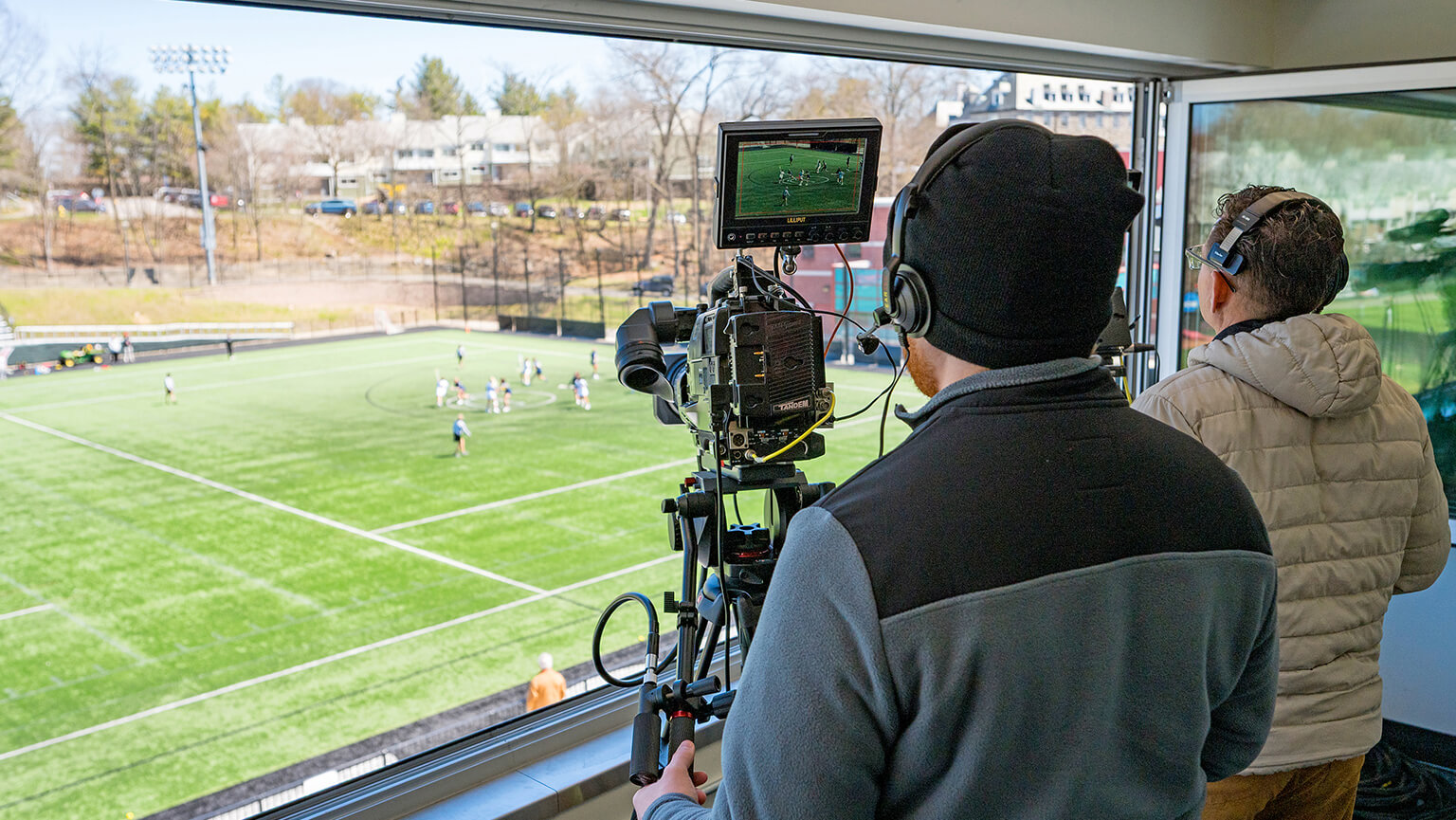
Two cameramen film a soccer game from a press box overlooking a green field. One operates a camera with a monitor, capturing the action below.
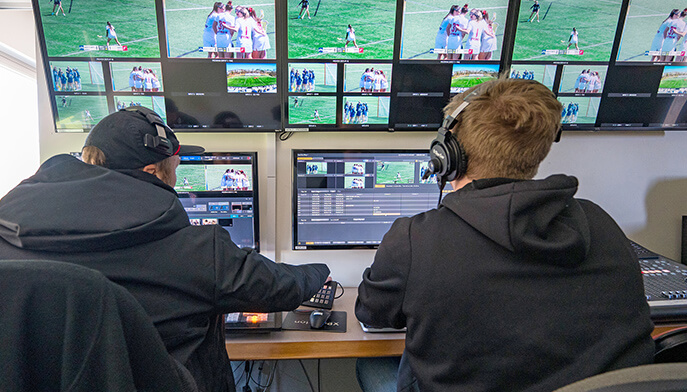
Students work the cameras in the Rafferty Stadium broadcast booth at an early spring women’s lacrosse game.
By Sara Colabella ’08, MA’11, EdD’26

Inside Fairfield’s Sports Media program, where students produce live games and prepare for careers in the industry.

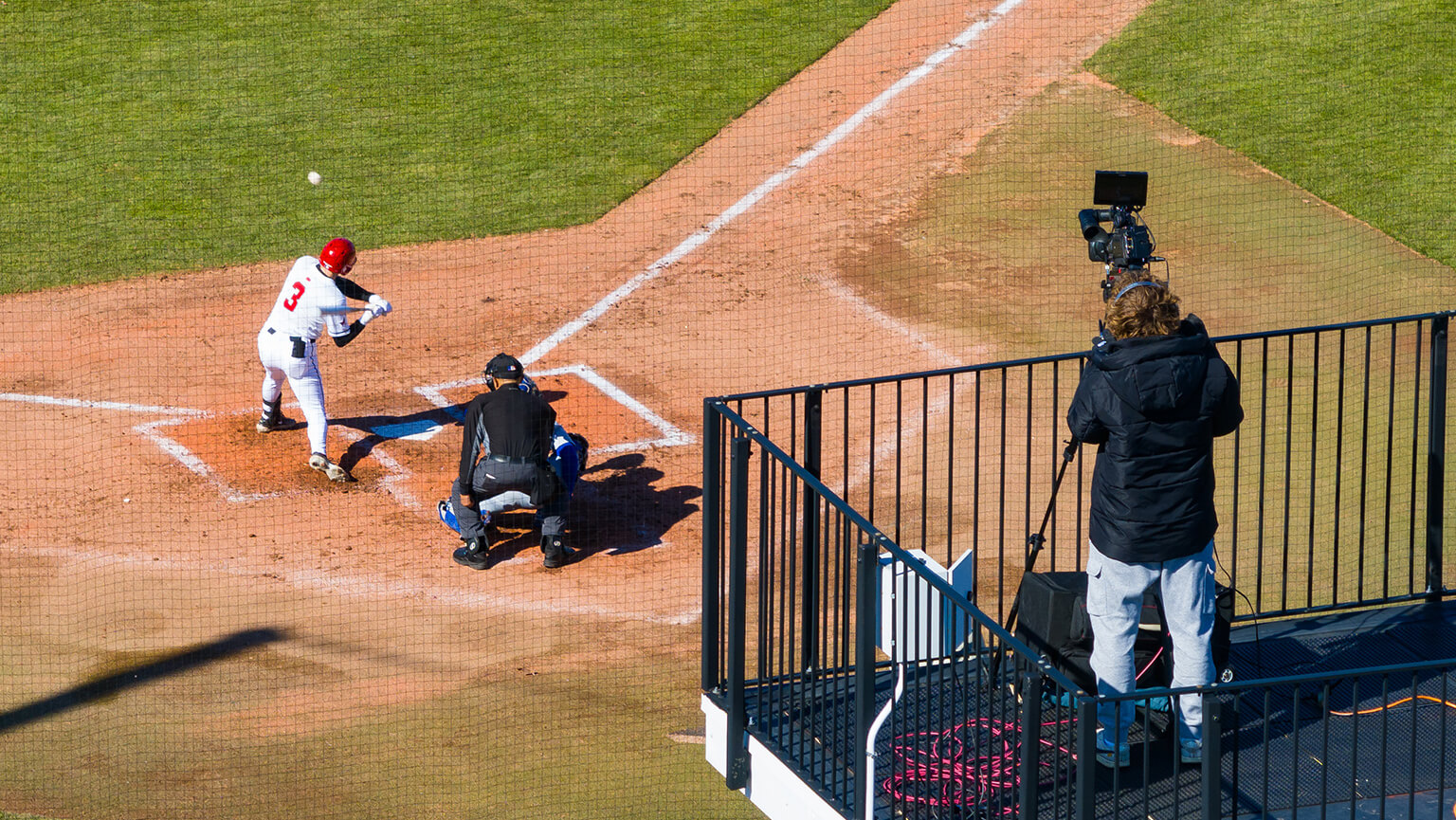
It’s a crisp, sunlit spring afternoon on Don ’63 and Chris ’88 Cook Field. A pitcher settles on the mound, the batter digs in, and anticipation hangs in the air as the crowd leans forward, waiting for the crack of the bat.

Beyond the baseline, a second team is in action—one most fans never notice. High above the field in the press box, students who work for the Stags Sports Network, Fairfield Athletics’ in-house broadcast operation, are producing the game. A cameraman tracks the action, a designer updates graphics in the moment, and a broadcaster calls the game. For these students, this isn’t an extracurricular—it’s an extension of their undergraduate Sports Media program.

Sports media and communication double major Christopher Bocchieri ’26 said his first visit to the press box at Cook Field clarified where he wanted to be.

“I had to shadow a live broadcast as an assignment for my ‘Intro to Sports Broadcasting’ class,” he said. “As a sports media major, I originally had interest in being an on-air talent. However, watching the production team in the booth really got me interested and I loved every second of it.”

Soon after, Bocchieri began volunteering for baseball broadcasts. He eventually landed an internship with the Stags Sports Network, working as a student production associate.
The Sports Media program launched in the fall of 2020 under program director Adam Rugg, PhD, and the late professor Matt Tullis. Housed in the John Charles Meditz College of Arts and Sciences, its curriculum has a uniquely singular focus—every course directly ties to athletics.

“All our required classes are sports-related, from sports broadcasting and sports journalism to sports media culture,” Rugg said. “There aren’t many programs out there where that’s the case.”

In a curriculum designed to develop both technical skills and critical thinking, sports media majors study journalism, video production, and broadcasting, alongside classes that explore broader social and cultural issues in sports.

“It was important to me that the program is not just skills-based, but rooted in the Jesuit Catholic mission,” Rugg said. “We address issues like gender inequity in sports, race, and nationalism—significant topics that are really important to explore at the university level.”

Another defining strength of Fairfield’s program is its emphasis on experiential learning. On-campus professional opportunities abound at the Stags Sports Network and WVOF, the student-operated campus radio station. “We’re one of the rare schools where you can start interning as a freshman,” noted Rugg. “If you’re committed, you can start taking opportunities right away.”

Students in sports journalism courses attend games and write features on Fairfield student-athletes. In the introductory broadcasting class, they shadow production teams and assist with live event coverage. “If you go to work at a place like ESPN now, they’re expecting you to write, film video, take pictures, edit video, post on social media, and talk in front of the camera,” continued Rugg. “You’re expected to have a wide variety of media-based skills.”

Sports media student Andrew Jamieson ’26 joined WVOF Sports as a first-year student, contributing to broadcasts across multiple sports. Looking to expand his skill set, he and classmate Bocchieri co-created a podcast called The Sports Den during their sophomore year.

Jamieson later helped develop Stags in the Studio, a WVOF podcast series featuring behind-the-scenes interviews with Fairfield Athletics staff and leadership. Along the way, he has also worked at the MAAC Basketball Championships, during the women’s basketball NCAA tournament run, and in an internship with Sports Illustrated.

“Taking advantage of those opportunities helped shape my work ethic,” Jamieson said.

The Stag Sports Network functions as a training ground where students put coursework into professional practice on live broadcasts. “It’s really about growing opportunities for students, to get them ready to find jobs in this space, while also putting on a good show,” said Carlton Best, assistant director of athletics for broadcast operations and digital, who oversees the network.

Each year, the Stags Sports Network produces more than 140 varsity events across digital platforms, including ESPN+. Students rotate through nearly every production role—from camera operator and graphics producer to replay technician and on-air talent—building experience that reflects industry expectations.

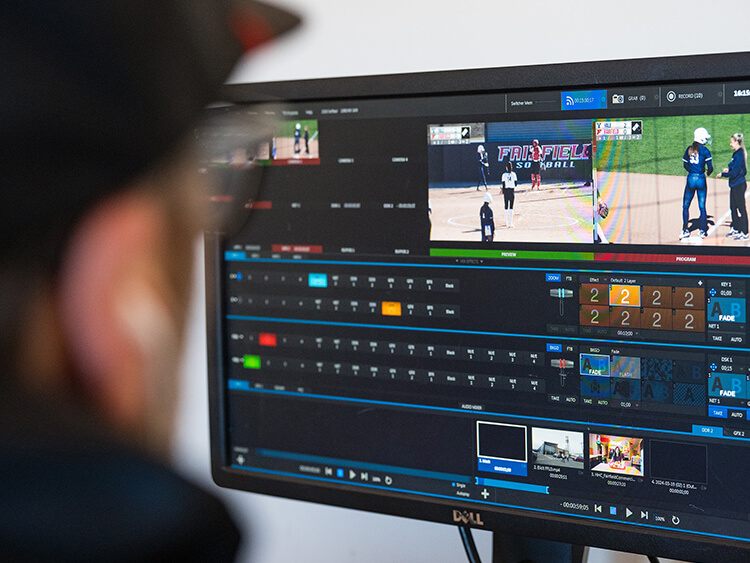
For Bocchieri, that experience proved transformative. Interning as a student production assistant, he learned to set up and operate cameras, create and use graphics, run a 3Play replay system, and even direct broadcasts using a TriCaster.

“Working on a live broadcast with a group of people shows the need for a specific type of communication: one that is quick, concise, and adaptable,” he said. “While it can be tense at times, clear and quick communication ensures things run smoothly—I think that type of experience is extremely hard to get in a classroom setting.”

The Stags Sports Network has grown, expanding from 10 students to more than 20 in just the past year. Students first shadow broadcasts for class and observe the behind-the-scenes production before stepping into entry-level roles and gradually taking on more responsibility. During high-profile broadcasts like men’s and women’s basketball, they gain exposure by working alongside experienced industry freelancers.

As on-air broadcasters, students are encouraged to develop their own voice by identifying the stories unfolding during games. “When they’re ready, we give them that responsibility,” Best said. “Sometimes there’s a little hesitation at first, but confidence grows quickly.”

Recently, an all-student crew produced an entire baseball broadcast, including play-by-play commentary.

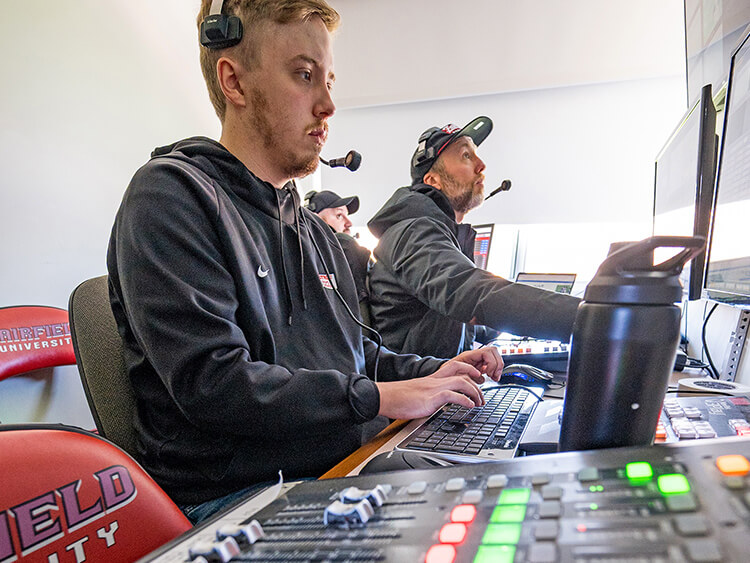
Two people in a control room manage a live sports broadcast. Multiple screens display a soccer match. The atmosphere is focused and professional.
Launched in 2020, a key strength of the Sports Media program is its emphasis on experiential learning.

“That was really a proud moment for me,” Best said.

Beyond the Stags Sports Network and WVOF, the Sports Media program also benefits from Fairfield’s proximity to major sports media hubs. Students have earned internships with NBC Sports and CBS Sports, including work connected to Olympics coverage. Graduates have gone on to careers with ESPN, NBC Sports, MLB Network, and Fox Sports.

“Every year we get a couple more out there,” Rugg said. “Then they come back to visit and talk through the process.”

Sometimes, alumni even return to campus to teach. The introductory broadcasting course is taught by Fairfield alumnus Ryan Cassella MA’14, a senior producer at WWE.

“When he’s teaching students, he’s saying, ‘This is literally what I did today,’” Rugg said. “It’s invaluable to have access to people who are actively working in the industry.”

Best and Rugg both credit the program’s momentum to the students themselves. “The majority of students have an attitude of ‘I want to learn more. I want to do more,’” Best said.

For Bocchieri, the Sports Media program has helped shape what comes next. He hopes to work in live broadcasting for WWE or the NBA.

“Fairfield developed me for that path by first allowing me to join Stags Sports Network and obtain and polish all the technical skills I need,” he said. “It also connected me with people throughout my four years who have given me advice and who continue to be connections I can always reach out to.”

Related Stories

More In