Fairfield researchers are exploring how stories of struggle and success can help underrepresented children see themselves in STEM fields.
When Amanda Haber, PhD, arrived at Fairfield University in 2023 as an assistant professor in the Department of Psychological and Brain Sciences, she brought with her a passion for early childhood education and storytelling.
“I’m interested in how language—what children hear from caregivers at home, from teachers at the day care center or school, or from peers on the playground—shapes early learning,” said Dr. Haber, director of Fairfield’s Child Development and Learning Laboratory. “I want to find out how we can develop new pedagogical approaches to early education and evidence-based interventions that foster the skills that children need to engage with the world today.”
One way to find out, Dr. Haber hopes, is a research project she and her students have been conducting in collaboration with Hall Neighborhood House in Bridgeport, Conn., a nonprofit community services provider with an early childhood program that Fairfield University has long supported through the Adrienne Kirby Family Literacy Project. The study is titled, “Exploring the Longitudinal Effects of Scientific Storybooks on Children’s Persistence in STEM.”
“Our partnership with Hall Neighborhood House has expanded from a literacy program to having a research component,” said Dr. Haber, who focused the project on STEM (science, technology, engineering, mathematics) for two important reasons.
“Not only are the skills associated with STEM needed for success in the 21st century, but we want to create a sense of belonging for the children,” she said. “Children of racial and ethnic minoritized groups and girls are underrepresented in STEM studies. By kindergarten, they are already falling behind in STEM achievement, which is why we’re developing interventions during the preschool years. Many children from underrepresented groups do not see themselves belonging to the STEM community or even the conversation.”
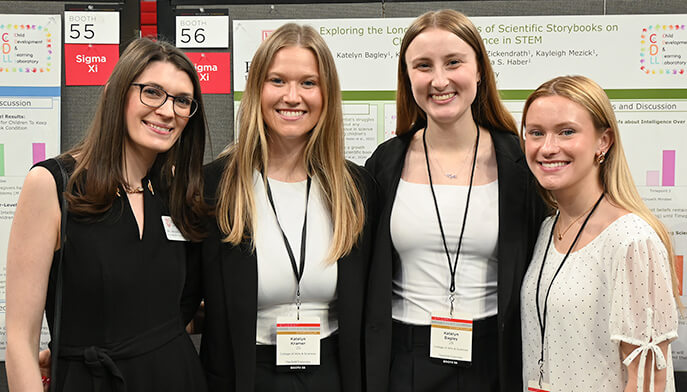
Despite the project’s scientific approach—data collecting, Excel spreadsheets, coding, and statistical analysis—at the heart of it is the simple act of telling a story to a child. In this case, the story takes the form of STEM-themed storybooks created and monitored by four student lab assistants—Katelyn Bagley ’26, Katelyn Kramer ’25, Kayleigh Mezick ’26, and Morgan Zickendrath ’27.
The “books” are short, eight-page biographies of two accomplished women scientists from diverse backgrounds: astronaut Mae Jemison, the first African American woman in space, and biologist Lydia Villa-Komaroff, a Mexican American with a PhD from MIT.
The target audience for the 130-word stories are 36 children, ages three to five, from Hall House’s Early Childhood program, whose parents have consented to their taking part. There’s a plot twist to this story, though. “We use three different versions of each biography,” explained lab assistant Bagley, a senior psychology major who spent an entire semester developing the storybooks.