For the fifth consecutive summer, Fairfield University's School of Engineering and Computing welcomed university and high school students to campus for a summer research residency. The eight-week program immersed students in faculty-mentored research, with more than 30 innovative projects taking place in laboratories across campus.
Working alongside faculty mentors, students gained valuable hands-on research experience while exploring real-world engineering and computing challenges. Research topics ranged from developing a web-based framework titled “360-degree Lidar Mapping for Autonomous Vehicles” to a project called “Producing Novel Quantum Circuits with a Graph Convolutional Network Trained Diffusion Model.” Through these projects, participants gained valuable hands-on research experience while exploring real-world engineering and computing challenges.
New This Year
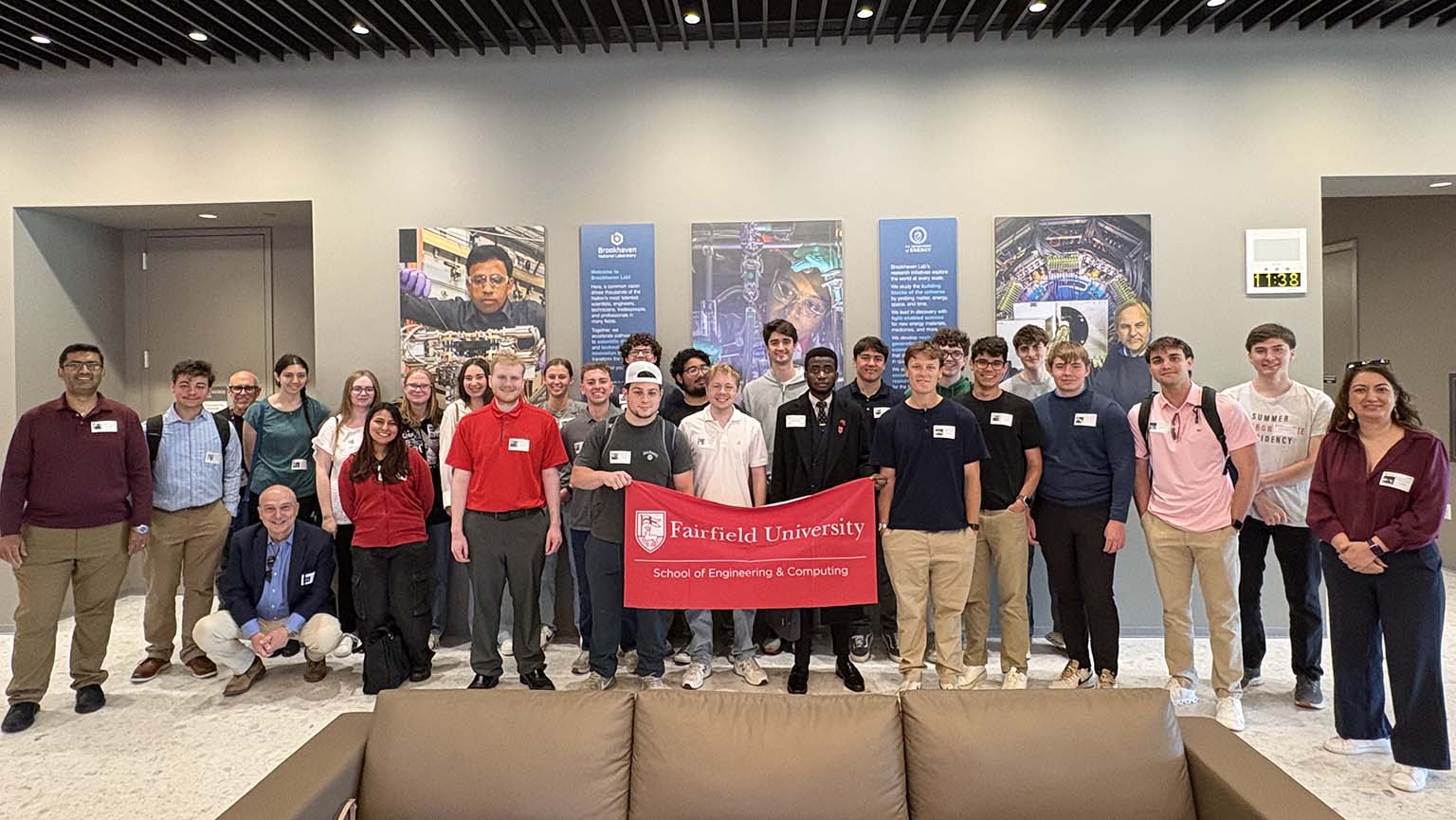
The residency expanded this year to feature a series of off-campus workshops and industry research visits to Brookhaven National Laboratory and UConn Tech Park. Additionally, five employees from Sikorsky and Vertical Flight Society came to campus to meet with program participants. These experiences gave students the opportunity to tour cutting-edge facilities, connect with industry professionals, and gain insight into research careers.
“Also new this year, the program welcomed nine graduate students, expanding the research community to include both undergraduate and graduate researchers,” said associate dean and professor Zahra Shahbazi, PhD. “Graduate students were invited to participate in the workshops and visits to research facilities offered throughout the program, while also taking part in a dedicated workshop series on artificial intelligence, covering AI fundamentals and its applications in engineering and computing research.”
Faculty Mentorship
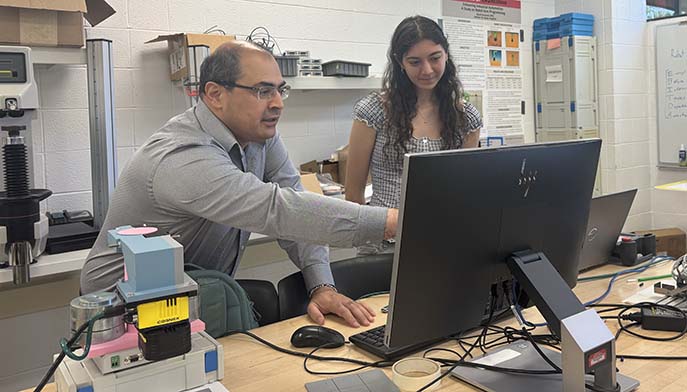
Under the mentorship of Isaac Macwan, PhD, associate professor of electrical and biomedical engineering, biomedical engineering major Ella Paturzo '29 and mechanical engineering major Jude Peterson '29 explored PVA-magnetite (Fe₃O₄) nanofibers for potential electrochemical sensing applications.
“Working with Ella and Jude this summer has been especially rewarding because they were able to take a research question from the initial fabrication and optimization stages through experimental characterization,” said Dr. Macwan.
“Seeing them troubleshoot the electrospinning process, analyze their results, and develop an understanding of how the scaffold structure can contribute to future electrochemical sensing applications has been a great example of hands-on, student-driven research.”