Dr. James Geisler MA'14 Expands Suicide Prevention Training Across Connecticut

By Sara Colabella EdD’26
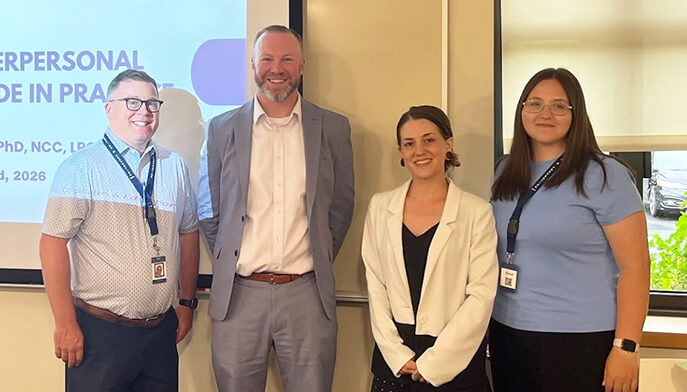
Four smiling people pose together at a professional event, with a presentation screen behind them, conveying a warm, collaborative atmosphere.
Dr. James Geisler MA'14 (second from the left) provided trainings to 135 mental health professionals in Connecticut.

James Geisler, MA’14, PhD, NCC, LPC, a School of Education and Human Development clinical mental health counseling alumnus, is advancing suicide prevention education across Connecticut through a statewide training initiative designed to strengthen mental health professionals’ confidence and skills in assessing and responding to suicide risk.

In partnership with the Connecticut Department of Mental Health and Addiction Services (DMHAS) and United Way/211, Dr. James Geisler MA'14 delivered a training series to 135 mental health professionals across the state. The initiative emerged after DMHAS learned about Dr. Geisler’s work in suicide prevention and connected him with a funding opportunity, with support from Andrea Duarte. The training series included sessions in each region of Connecticut, addressing gaps in clinical education and equipping professionals with tools to better respond to suicide risk.

“What made this opportunity so impactful wasn’t just how many counselors I reached or even the breadth of regions across the state that were covered; it was the beginning of a systems-wide effort to respond to what mental health providers are lacking,” Dr. Geisler said. “That effort translates to hundreds of clients who are likely to be impacted when it comes to suicide prevention.”

Dr. Geisler received his master's degree in clinical mental health counseling from Fairfield's School of Education and Human Development and earned his PhD in counseling from Oregon State University. He currently serves as executive director of wellness services at Sacred Heart University in Fairfield. He also developed and teaches the "Interpersonal Theory of Suicide" course offered through Fairfield University's Clinical Mental Health Counseling program.

Strengthening Clinical Confidence

Dr. Geisler said the strong participation in his statewide training series demonstrated the need for continued education in suicide assessment and intervention. "It demonstrates the gap in training that begins at the educational level and leaves many providers to ‘figure it out’ once they enter the field,” he said.

His goal is to create impact across multiple systems and contribute to suicide prevention efforts throughout Connecticut. By helping professionals build their skills and confidence, Dr. Geisler hopes to improve treatment outcomes and therapeutic relationships while fostering greater trust between clients and providers.


“If more mental health professionals have the tools, skills, and confidence to better respond to suicide, we can have more successful treatment outcomes, stronger connections, greater trust in helping professionals, less overwhelmed hospitals and behavioral health departments, and most of all, saved lives,” he said.

Dr. Geisler noted that many providers experience anxiety when assessing clients for suicide risk, making confidence essential to creating a safe, nonjudgmental environment.

“Confidence is important because it communicates to the client that they have a place to explore this safely and without judgment,” he said. “And you are not alone in this. We can figure it out together.”

Connecting Education to Prevention

Dr. Geisler has taught his suicide prevention course at Fairfield for six years. Over the years, students and professionals have shared experiences that demonstrate the impact of training on clinical practice and personal lives.

He recalled a parent training to become a clinician who said the course gave them the courage to ask their own child about suicidal thoughts. During the recent statewide training series, another participant shared that their brother had died by suicide just days before the training. 

Dr. Geisler has also heard from clinicians who assessed suicide risk with clients immediately after completing his training, reporting greater confidence and productive conversations.

“The stories keep this work going, and their value is priceless,” he said.

Dr. Geisler credits Fairfield’s Clinical Mental Health Counseling program with providing the foundation for his clinical career. “This education taught me, very early on, the power of advocacy as a counselor,” he said.

His Fairfield experience also established relationships that continue to influence his work. Jocelyn Novella, PhD, served as Dr. Geisler’s first practicum supervisor in the counseling field. He also credits Paul Maloney, professor of the practice of applied psychology, with helping him develop confidence in public speaking—a skill that has supported his teaching and professional presentations.

At the heart of Dr. Geisler’s approach is a message he shares with students: “Every client is somebody’s someone.”

"Because suicide is such a tragic phenomenon, we all like to think it is distant from us," he said. "And yet, suicide likely impacts our coworkers, our friends, our families, and so many more people around us.”

Through his teaching and statewide training efforts, Dr. Geisler hopes to encourage professionals and community members to recognize their role in suicide prevention.

“I did not just teach you about why people die by suicide,” he tells his students. “I taught you what we, as humans, fundamentally need to live.”

Related Stories