For centuries, scholars have debated whether one of the earliest historical accounts of Jesus outside of the New Testament was written by a first-century Jewish historian—or forged by later Christian writers.
New Testament and early Christianity scholar Thomas Schmidt, PhD, associate professor of religious studies at Fairfield University, believes he has found evidence that the passage written by Flavius Josephus is authentic.

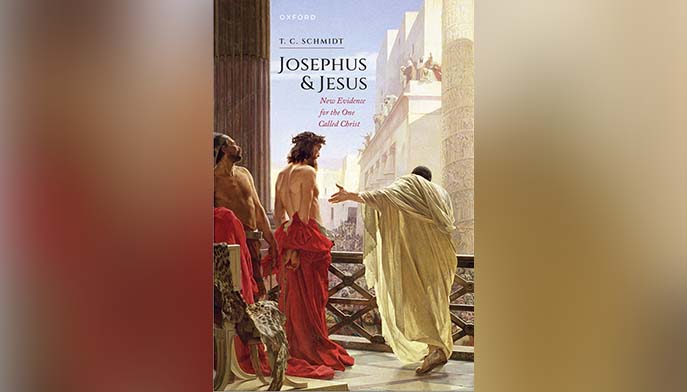
In his book, Josephus and Jesus: New Evidence for the One Called Christ, Dr. Schmidt examines a passage in Josephus’ Antiquities of the Jews that describes Jesus, his followers, his execution under Pontius Pilate, and the belief among his disciples that he had risen from the dead. If authentic, it would be considered the earliest testimony of Jesus by a non-Christian author, according to Dr. Schmidt.
“I think this passage is authentic,” Dr. Schmidt said. “It looks like Josephus. It sounds like Josephus.”
To test his theory, Dr. Schmidt conducted a forensic authorship analysis, comparing the passage’s language, vocabulary, grammar, and word frequency patterns with nearly half a million words of Josephus’ surviving writings. Using digital databases, he identified linguistic patterns consistent with Josephus’ authorship.
He also examined 18 instances in which ancient and medieval Christian writers quoted the passage, finding that they did not necessarily interpret it as the overtly pro-Christian statement that many modern scholars had assumed it to be.
One example is Josephus’ description of Jesus’ miraculous works. The Greek word paradoxa suggests extraordinary or unusual deeds without necessarily communicating approval, leaving open questions about the nature and origin of Jesus’ supernatural abilities.
“That does not sound like what a Christian would say,” Dr. Schmidt said. “A Christian would not want to leave the door open that Jesus was using sorcery.”
Another key detail is Josephus’ description of Jesus as the Christ. Dr. Schmidt argues that the original wording was likely “thought to be the Christ” rather than a direct affirmation that Jesus was the Messiah.
Although those words are absent from surviving Greek manuscripts, ancient Latin and Syriac translations that preserve the distinction. Dr. Schmidt believes the qualifying language was inadvertently dropped from the Greek manuscript tradition, changing the meaning of the passage. The original phrasing would be consistent with a Jewish historian acknowledging that some believed Jesus was the Messiah without endorsing that belief himself.
A Historical Window into the First Century
Josephus is considered one of the most important historical sources on the ancient Jewish world and the Roman Empire. His writings provide extensive context for people, places, and religious groups described in the New Testament, including Pontius Pilate, John the Baptist, James, the brother of Jesus, the Pharisees, and the Sadducees.
Although Josephus wasn’t an eyewitness to Jesus’ ministry, he had close connections to individuals involved in the events surrounding Jesus and his followers. Writing around 94 A.D., he was documenting events that had occurred only decades earlier, making him a valuable historical source.
“If we lost him and never had him, we would lose so much of our information about the New Testament,” Dr. Schmidt said.
Dr. Schmidt believes the passage independently corroborates several details described in the Gospels, including Jesus’ ministry during the governorship of Pontius Pilate, his many disciples, his crucifixion, and his followers’ belief that he had been raised from the dead three days later. Importantly, Dr. Schmidt doesn’t argue that Josephus affirmed Jesus was the Messiah or that the resurrection occurred, but rather provides evidence that Jesus’ followers held those beliefs immediately following his crucifixion.
“He corroborates the life and ministry of Jesus as outlined in the four Gospels in the New Testament,” Dr. Schmidt said. “He's anchoring Jesus in the exact historical context that the New Testament does.”
For Dr. Schmidt, the key takeaway is the historical significance of an account written outside the Christian tradition, by someone who did not share the beliefs of Jesus’ followers.
“Sometimes the greatest testimony you can hear about someone is from someone's enemies,” he said.