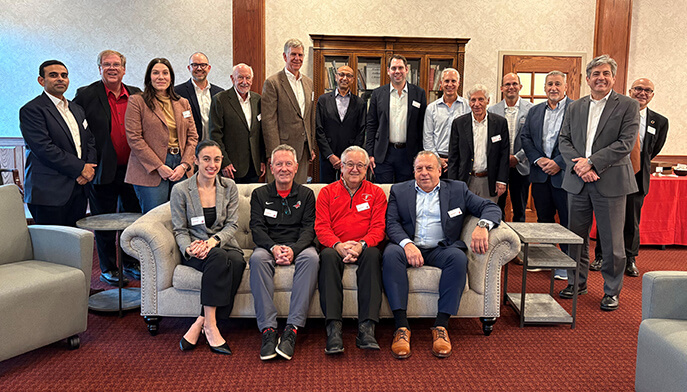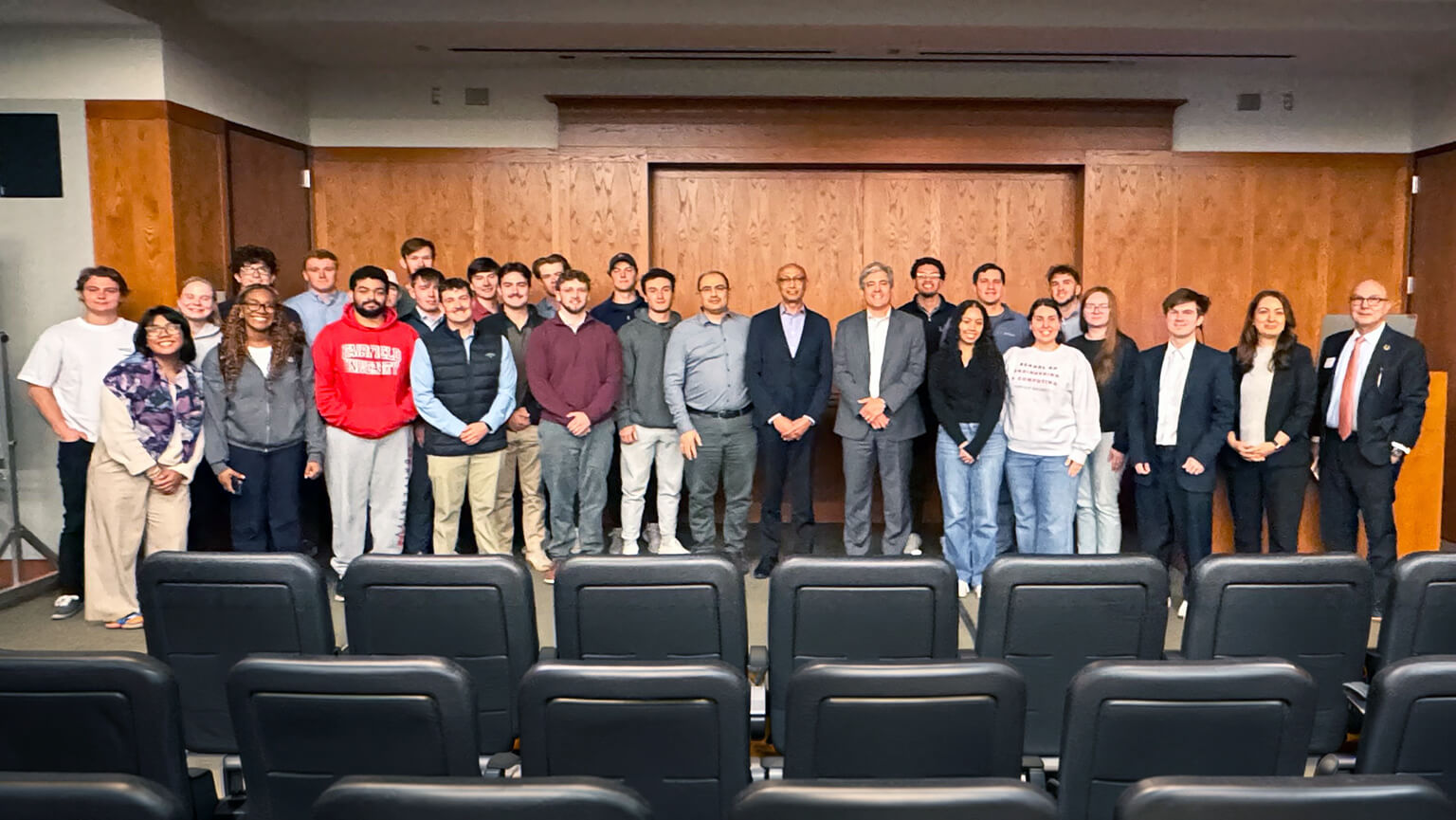
On Oct. 22, Kirti Patel, Connecticut’s deputy commissioner for economic development and chief manufacturing officer, met with School of Engineering and Computing students as they begin their senior design projects.
Patel, who has more than 25 years of experience in manufacturing, discussed the state’s engineering and manufacturing landscape and offered advice for turning classroom learning into real-world innovation.
He shared his personal experience as an engineering student and spoke of how one course in semiconductor fabrication helped shape his career and lead to his first job at Intel. Emphasizing the breadth of opportunities in the field, he stressed the importance of learning how to develop solutions through experiences like the senior design project.
“An idea is just an idea until you start figuring out how to make it into a reality,” Patel told students.
A Growing Engineering Landscape
Connecticut’s diverse manufacturing and engineering sector includes aerospace, defense, medical devices, semiconductors, biotechnology, robotics, automation, and advanced materials. These industries, Patel said, rely on the technical expertise, precision, and problem-solving skills that engineering students develop through their academic experiences.
He gave examples of how Connecticut is investing in emerging technologies, including Quantum CT, a consortium that secured a $160 million regional innovation engine award from the National Science Foundation, and a $20 million initiative to establish an applied artificial intelligence learning center in Hartford.
For graduating engineers, Patel said this evolving landscape presents myriad opportunities to contribute to meaningful work across a range of sectors and organizations. “You are graduating into an industry that's innovative and needs people who can accelerate that pace of innovation,” he told the students.
While technical expertise is still essential, Patel encouraged students to recognize the importance of understanding the broader context of their work. Effective engineering solutions require consideration of design constraints, stakeholder needs, customer expectations, and the practical realities of bringing a product to market.