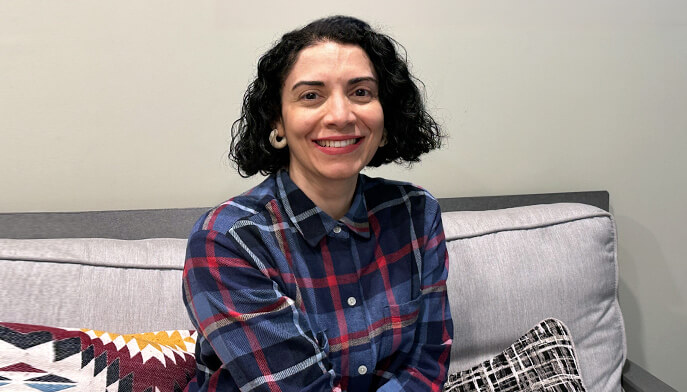
When master of social work alumna Claudia Atehortua speaks about her work with bilingual children and families, she speaks from own experience.
After moving to the United States, she navigated a new language, unfamiliar systems, and the challenge of not always being able to express herself fully. That feeling of not having a voice now drives her work as a clinician.
Atehortua began her career in Colombia, where she graduated in 2010 from Universidad Pontificia Bolivariana. Following graduation, she moved to Spain to start a family. In 2019, she relocated to the United States, where she made the decision to return to her career after building confidence in her English.
“I explored different paths, including school psychology and social work, and ultimately chose social work because of its broader scope and stronger clinical focus,” she said.
That decision was personal. As she navigated unfamiliar systems and language barriers, Atehortua experienced firsthand the importance of support. She explained, “What drew me most to this field was the opportunity to support individuals in a meaningful way, especially those facing barriers similar to the ones I experienced.”
Her past experiences shape her work today. While she worked in human resources in Colombia, it is her clinical training that has had the greatest impact. It reinforced the importance of empathy, trust, and active listening. This perspective is evident in her work with bilingual children and families. “I know what it feels like to not have a voice and to face language barriers,” she says. “For me, being bilingual is not just about language, it is about connecting with culture, building trust, and reducing barriers to care.
At Fairfield and the master of social work program, Atehortua found a strong sense of community. “What has made this experience especially meaningful is the sense of inclusion and support I have felt from the very beginning,” she said. “My professors and peers created an environment where I felt safe to grow, learn, and express myself without fear of judgment. It has truly felt like a community where I belong.”