Temple Grandin, PhD – author, scientist, and professor of animal sciences at Colorado State University – has perhaps done more than anyone to broaden the conversation around autism, a spectrum of neurodiversity in persons that can be profoundly disabling for some but may also manifest in some persons as a remarkable range of unique talents and abilities.
In Dr. Grandin’s case, among her many capacities – she describes herself as a visual thinker – is a capacity for empathy with animals and their anxieties. This empathy and her visual thinking style associated with her autism has been channeled into a profound understanding of livestock animals, and how to handle them. In particular, Dr. Grandin has designed and consulted on developing squeeze chutes and other humane restraints for cows and other animals when taken for processing, so that the animals are less frightened and alarmed during the process.
In 2010, Dr. Grandin was named in the TIME100 list as one of the most influential people in the world, and her life was fictionalized in a semi-biographical HBO film entitled Temple Grandin, starring Claire Danes. In 2025, Dr. Grandin was honored with the National Portrait Gallery’s Portrait of a Nation Award, which recognizes the honoree “for their transformative contributions to American history and culture,” and Grandin’s portrait was included in the gallery’s collection. Her books include Emergence: Labeled Autistic (1986), and Navigating Autism: 9 Mindsets for Helping Kids on the Spectrum (with Debra Moore, PhD, 2021).
For many, Dr. Grandin would have first come to their attention through a 1993 profile of her in the New Yorker by the late neurologist, Oliver Saks, who called her “one of the most remarkable autistic people of all.”
Born in 1947 in Boston, Dr. Grandin was initially diagnosed as being brain damaged and experienced her early childhood as one of heightened sensation, according to her autobiography, stiffening in her mother’s arms, and “subject to sudden impulses and, when these were frustrated, violent rage” Saks writes. At three, unable to speak, she was diagnosed with autism, with an expectation that this would require lifelong institutionalization. But through a series of teachers and mentors she was able to develop her intense capacity for concentration. One of her mentors encouraged her to develop a “hug box” to provide her with some physical comfort, based on squeeze chutes used to hold cattle. Her continued scientific study of the “hug box” and its applications for livestock management led her to degrees in animal science from Arizona State University in 1975, and a doctoral degree in animal science from the University of Illinois, in 1989.
As an advocate for people with autism, Dr. Grandin has expressed criticism of standard diagnostic assumptions of a “spectrum” of autism, saying: “The spectrum is so broad it doesn’t make much sense. Are we really going to put people with severe autism who cannot dress themselves in the same category as people with mild autism who work in Silicon Valley?”
Describing herself as a “visual thinker,” and at other times as feeling like “an anthropologist on Mars,” Dr. Grandin – in her many books and articles – has sought to articulate her world view and understanding, and how it differs from what is “normal,” saying: “When I was younger, I believed that everybody thought in photo-realistic pictures the same way I did, with images clicking through my mind a little bit like PowerPoint slides or TikTok videos.”
“I had no idea that most people are more word centric than I am… We call most of these people neurotypical – they develop along predictable lines and communicate, for the most part, verbally.”
She has argued, as recently as in a 2023 essay in the New York Times, that “many aspects of our society are not set up to allow visual thinkers – which many of our neurodivergent folks are – to thrive…. This must change not only because neurodivergent people, and all visual thinkers, deserve better but also because without a major shift in how we think about how we learn, American innovation will be stifled.” She pointed out that trains, factories, silicon chips, and most specialized mechanical equipment that the country uses are manufactured outside the United States, which can be traced in part to a greater appreciation of vocational skills in other countries. The “skill sets of visual thinkers are essential to finding real-world solutions to society’s many problems.”
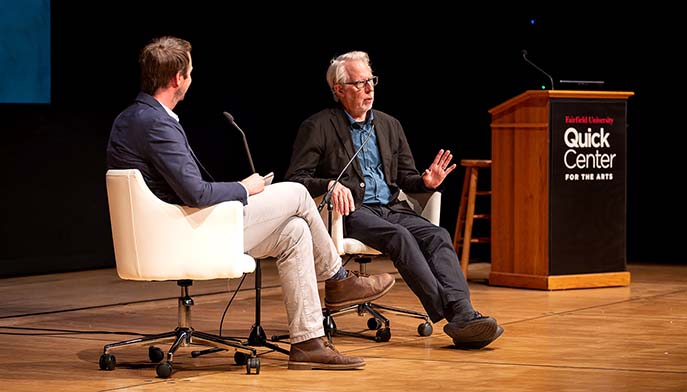
Dr. Grandin’s lecture at the Regina A. Quick Center for the Arts is part of the University’s School of Education and Human Development Diversity Lecture Series.
Temple Grandin, PhD, will be live at the Quick Center for the Arts on Wednesday, March 25 at 6 p.m. She’ll offer “The Way I See It: A Personal Look at Autism,” sharing powerful insights from her life as a scientist, author, and autism advocate. Reserve your tickets today.