For more than three decades, professor of visual & performing arts Jo Yarrington has taught studio art at the John Charles Meditz College of Arts and Sciences, guiding students through printmaking, book arts, drawing, and capstone seminars.
Alongside her teaching, her work as a professional artist has focused on these media as well as mixed-media installations. In Dec. 2025, her creative work took on a new scale, the culmination of a yearlong sabbatical in India.
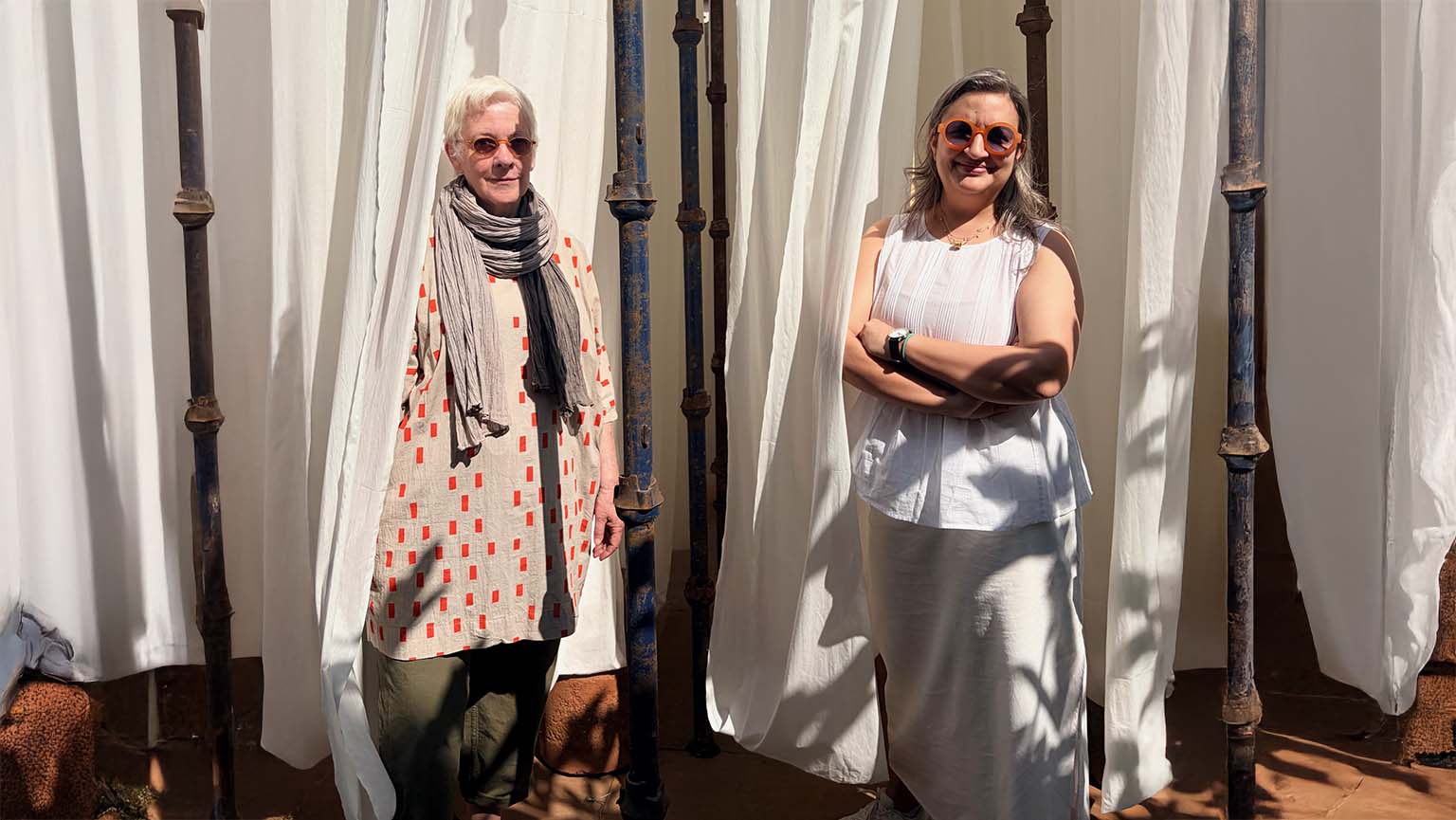
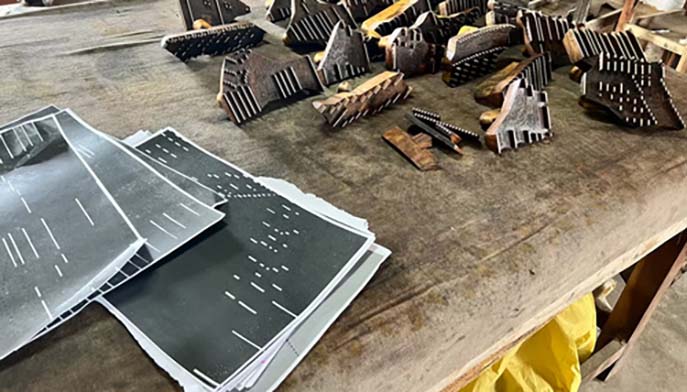
As an invited artist at the Serendipity Arts Festival in Goa, India, Yarrington created the site-referential installation PAUSE, an immersive, walk-through meditation of light, sound, and textile. Visitors moved through yards of white muslin suspended from scaffold-like frames, sunlight filtering through hand-printed patterns inspired by a century-old piano roll. Four sound boxes—doubling as seating—played interwoven compositions by sound artist and U.S. composer John Morton.
“Creating this work changed the way I experience time and space,” said Yarrington. “You’re not just making the piece—you’re in it. You’re going through it alongside the viewer.”
Her work in India grew out of a fascination with “outmoded informational systems”—piano rolls, microfiche, and textile punch cards—and a long-standing interest in light and time as artistic media. During her sabbatical, she spent five weeks as an invited visiting artist at Shiv Nadar University in Greater Noida, just outside Delhi. There, she created three large-scale installations and several performances on campus, while engaging with MFA students from across India.
A workshop in Bagru, outside Jaipur, introduced her to centuries-old block printing techniques and natural dyes. Observing fabrics stretched high on drying racks near the studio sparked the idea for her own installation.
“It was a seemingly endless looping of fabric suspended 30 feet in the air. The wind and the sun interacting with blindingly white textile,” Yarrington said. “It was just this really beautiful, mesmerizing, very Zen-like structure. And I thought, I could just see this being an art piece.”
Working with architect Anjali Mangalgiri and her team from the Goa-based firm Grounded, Yarrington translated these ideas into 12 printed panels incorporated into lengths of white muslin commissioned from Bagru.