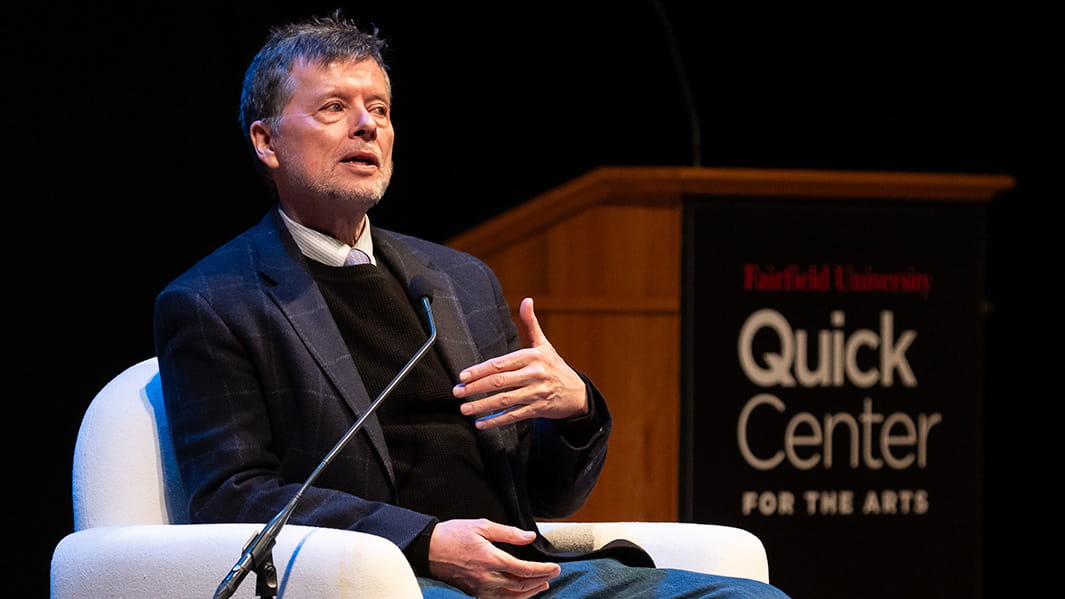
A sold-out evening at the Quick Center explores the promise, paradox, and enduring complexity of America’s founding story.
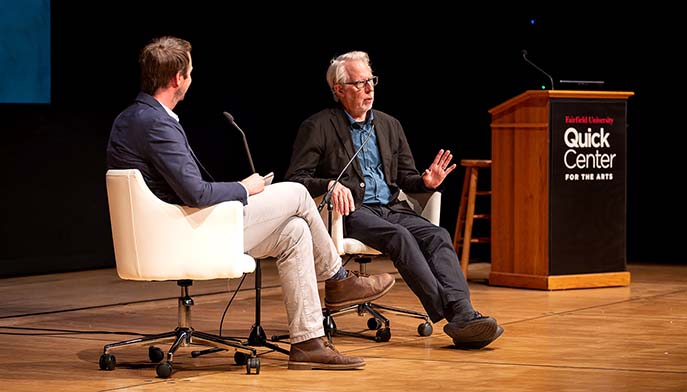
Ken Burns, America’s pre-eminent documentary filmmaker known for his longform films and series about American culture and history, such as The American Revolution (2025), The Civil War (1990), and The Vietnam War (2017), received an honorary Doctor of Arts degree from Fairfield University prior to a conversation about the art of filmmaking and the complexity of the American experience on Feb. 3, 2026.
The degree was conferred by University President Mark R. Nemec, PhD, alongside University Provost Christine Siegel, PhD, and President of the University’s Board of Trustees, Sheila Kearney Davidson ’83.
Burns was appearing at the University’s Regina A. Quick Center for the Arts before a conversation with CNN’s John Berman, and Philip I. Eliasoph, PhD, Special Assistant to the President for Arts and Culture and Professor of Art History and Visual Culture, as part of the University’s Philip I. Eliasoph Open VISIONS Forum series of public lectures.
The sold-out event, which was also simulcast to guests at the University’s Charles F. Dolan School of Business event space, was attended by more than 900 guests – the largest audience to have attended a single event in the history of the performing arts center.
The evening was part of the University’s yearlong America250: The Promise and Paradox series of events and performances, through which the University is exploring and celebrating the country’s complex history and identity in light of the 250th anniversary of the signing of the Declaration of Independence, to be marked on July fourth of this year.
The event was sponsored by Bank of America and by Anne Harris P’18.
In conferring the degree, President Nemec acknowledged Burns’ “extraordinary achievements in documentary filmmaking, his enduring contributions to historical understanding, and his profound influence on American culture and civic life,” and said that Burns’ work “extends beyond chronicling events: it fosters empathy, civic engagement, and a deeper appreciation of the ideals and struggles that shape the American experience.”
While the conversation ranged widely over Burns’ many films, including The Brooklyn Bridge (1981), Baseball (1994), and Prohibition (2011), most of the evening was spent discussing The American Revolution, a six-part, 12-hour documentary that aired on PBS in November 2025 about the founding the nation, the origins of the conflict, and the war’s profound global impact on the political character of the age.
In saying that his role as a historian and filmmaker was to “be aware of calling balls and strikes” when it comes to the historical record, and to avoid falling into simple binaries or sweeping generalizations to explain events, Burns noted that the origin story of the United States is “complicated.” As many as one-third of inhabitants of the colonies at the time of the revolution were loyal to the British crown, so the war was as much a civil war – brothers fighting brothers – as it was a war with Britain. At the same time, the future of the indigenous nations and enslaved and free Black Americans were also implicated in the struggle.
“Whoever looks upon the Americans as an irregular mob will find himself much mistaken,” British General Hugh Percy said at the height of the conflict, as George Washington’s irregular forces and Continental Army continued to exceed British expectations. Burns, in his remarks, continued to refer to the “14 and 15-year-old boys” – often ragtag and ill-equipped – who fought for the revolution despite the hardships, like Joseph Plumb Martin of Connecticut, who joined the revolution’s forces as a 15-year-old. “They fought the revolution for us,” Burns said. “They [were] thinking about posterity.”
Speaking of George Washington himself, Burns spoke of his contradictions: a slaveholder, who would be enriched by the revolution, and who lost many important battles, such as the Battle of Long Island in 1776 and Brandywine in 1777, Washington also had the ability to “inspire people to fight,” and to encourage men and women to follow the highest ideals. Washington could have pressed his position to be a Commander-in-Chief for life, but declined a third term in the presidency in 1796, saying “the highest office in the land is citizenship,” Burns pointed out. “We don’t have a country without him,” Burns said.
“We want to protect the big ideas,” Burns continued, explaining the temptation to obscure the historical messiness and human contradictions of the Revolution with oversimplified historical accounts. But, he added that however dark and complex the history, the emergence of a republic and democracy out of the events of 1776 has had an enduring impact on how the world has developed: “It is the most important event of world history since the birth of Christ. Period.”
The Philip I. Eliasoph Open VISIONS Forum continues to serve as Fairfield University’s premier public lecture series, welcoming leading voices in the arts, journalism, politics, and culture for dynamic conversations that extend learning beyond the classroom. Founded in 1997 and recently renamed in honor of its longtime director, the series remains a cornerstone of civic dialogue on campus and in the region.
Learn more about upcoming Philip I. Eliasoph Open VISIONS Forum events and reserve tickets at fairfield.edu/artsminds.