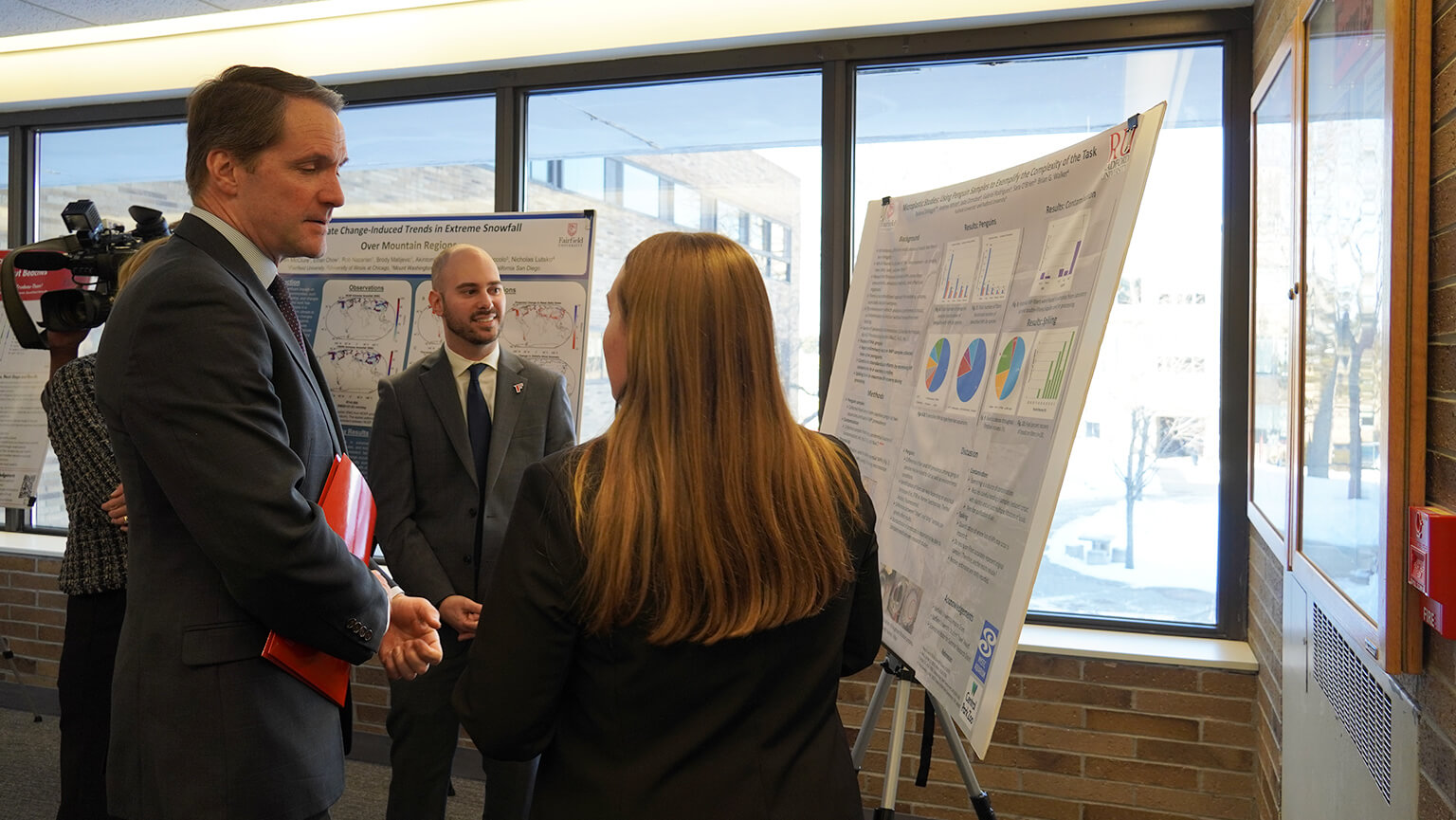
On Jan. 29, U.S. Representative Jim Himes, D-Conn., visited Fairfield University’s Center for Climate, Coastal, and Marine Studies and met with students and faculty to discuss the University’s expanding work in climate science.
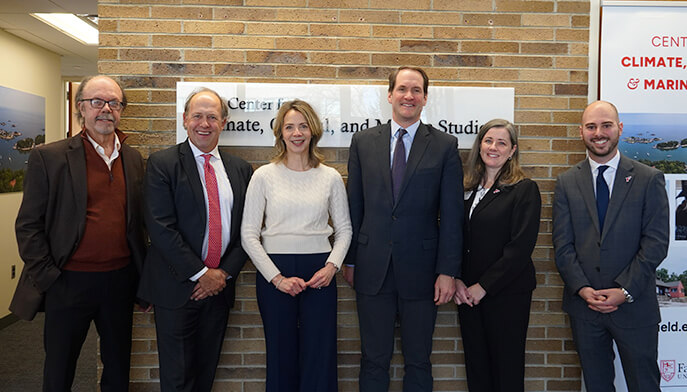
Rep. Himes was welcomed at Donnarumma Hall by Fairfield University President Mark R. Nemec, PhD, and Provost Christine Siegel, PhD.
Rob Nazarian, PhD, associate professor of physics in the John Charles Meditz College of Arts and Sciences and founding director of the Center for Climate, Coastal, and Marine Studies, joined Margaret McClure, PhD, associate vice provost for research and scholarship and professor of psychological and brain sciences, to outline the Center’s mission and its interdisciplinary approach to climate resilience, marine ecosystems, and coastal sustainability.
“We are so fortunate to have student scholarship that intersects with the research of more than 30 faculty across a range of disciplines,” Dr. Nazarian said. “Over the past five years, more than 120 students have participated in research focused on climate, coastal, and marine studies. Our students are excited to be at an institution like Fairfield, where care for our common home and care for one another resonate in their coursework and in their research.”
The visit featured one-on-one conversations between Rep. Himes and the following student researchers who presented their work:
- Mattia Speretta ’27, co-advised by Dr. Nazarian and Charles F. Dolan School of Business economics professor William Vasquez-Mazariegos, PhD, shared research on public perceptions of sea level rise mitigation. His work explores whether Fairfield residents understand increasing flood risks and their willingness to support investments in adaptation strategies.
- Hannah Snayd ’26, advised by Shannon Gerry, PhD, biology professor in Meditz College, presented findings on how rising water temperatures affect the behavior of cunner, a local fish species. As Long Island Sound continues to warm, her research tracks behavioral shifts that signal broader ecosystem change.
- Brianna DiMaggio ’26, advised by Brian Walker, PhD, biology professor in Meditz College, discussed research on microplastic exposure and the need for standardized study methods. Her preliminary findings identified microplastics in captive penguins and revealed contamination risks in current testing approaches.
- Ethan Chow ’27, advised by Dr. Nazarian, presented an analysis of projected extreme snowfall trends in mountain regions using global climate models. His findings suggest increasing extreme snowfall at higher latitudes and declining totals further south, alongside a northward shift in major storm tracks.