Fairfield Bellarmine Students Explore Art, Culture, and Identity at MoMA

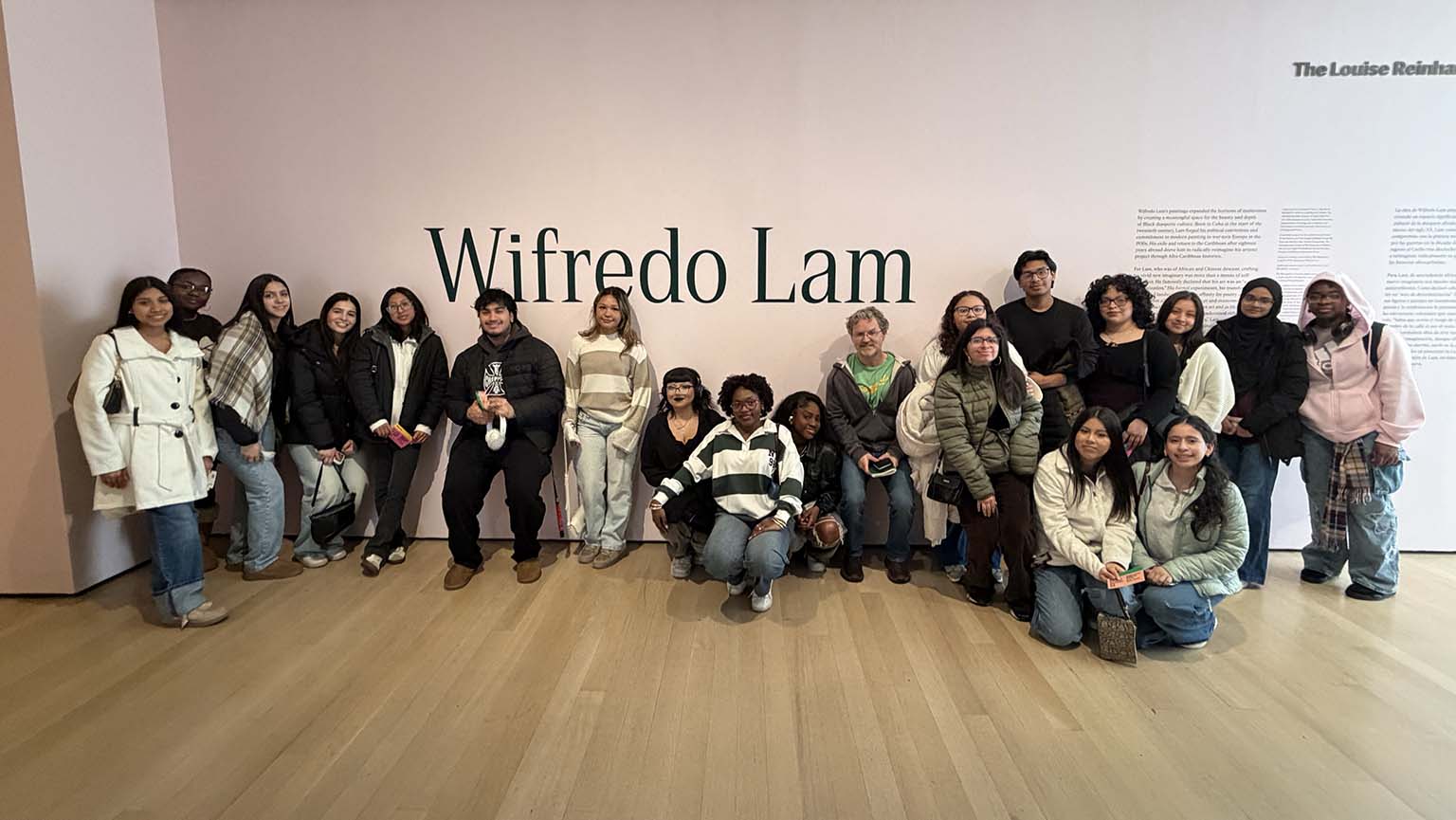
A group of smiling people posing together in front of a colorful wall.
Fairfield Bellarmine students visited MoMA as part of the Fairfield Meditz Art Institute’s grant-funded Fairfield Arts Excursions program.
By Sara Colabella

This March, Fairfield Bellarmine students explored the Museum of Modern Art in New York City. The trip was made possible through Fairfield Arts Excursions, an Arts Institute grant-funded program in the John Charles Meditz College of Arts and Sciences.

Led by Ryan Harper, PhD, assistant professor of the practice in religious studies, Ivelisse Maldonado, Fairfield Bellarmine librarian, and Khalila Brown, PhD, visiting professor of English, the trip was designed to deepen students’ engagement with course material, particularly the work of Cuban-born artist Wifredo Lam, whose large-scale paintings are imbued with Afro-Cuban spiritual imagery.

Dr. Harper, who teaches the work of Lam in his course on art and Afro-Caribbean religions, said the exhibition presented a timely opportunity for students. “Many of our students have connections to the Caribbean,” he said, “and it felt like we needed to take advantage of this opportunity while it lasted.”

At the museum, students encountered works they had previously studied in class. For Dr. Harper, the impact of the experience was clear: seeing art in person is different than on lecture slides. “On one hand, one gets to experience the sheer massive scale, or the texture, of the pieces,” he noted. “On another hand, one gets to experience the accumulation of the pieces in one place; one is awash in them. On still another hand, one gets to wander a large exhibit with one's fellow students and with other museum-goers, and one can measure one's reactions alongside a larger viewing community.”
For D’Adrea Roberts FB’27, the trip connected to coursework in her “Religion and the Critical Mind” class. “I saw how different ideas, beliefs, and perspectives can be expressed through art,” she said. “Some of the artwork reflected deeper meanings about society, identity, and belief systems, which connects directly to what we discuss in class. It helped me understand that religion and personal beliefs don’t just stay in books—they show up in culture, creativity, and everyday life.”

Roberts found the African exhibit particularly meaningful. “It really stood out to me because of the representation of Black people in the artwork,” she said. “Seeing someone who looked like me in such a powerful and confident way made the experience more personal and meaningful. It reminded me how important representation is, especially in spaces like museums, where not everyone always feels included.”

For Chanel Rocha FB’27, the show-stopper was Wifredo Lam’s large-scale, gouache-on-paper painting, The Jungle (ca 1943). “I always believed seeing art in person has a much different feeling that a simple picture,” she said, “and the display of high walls with the art really elevated that feeling of amazement.”

Considering the broader significance of the trip, Dr. Harper underscored the value of sustained engagement with creative work. “The prevailing culture in the United States can feel as though it de-incentives both imaginative practice and long attention, which is its own species of imaginative practice. I hope our students’ immersion in a concrete physical space, filled with past and present wondrous acts of creation—filled with citizens from across the world and across generations who, like them, decided to spend a day attending to such creations—gives them a sense that the imagination has a great cloud of witnesses testifying on its behalf.”

Related Stories