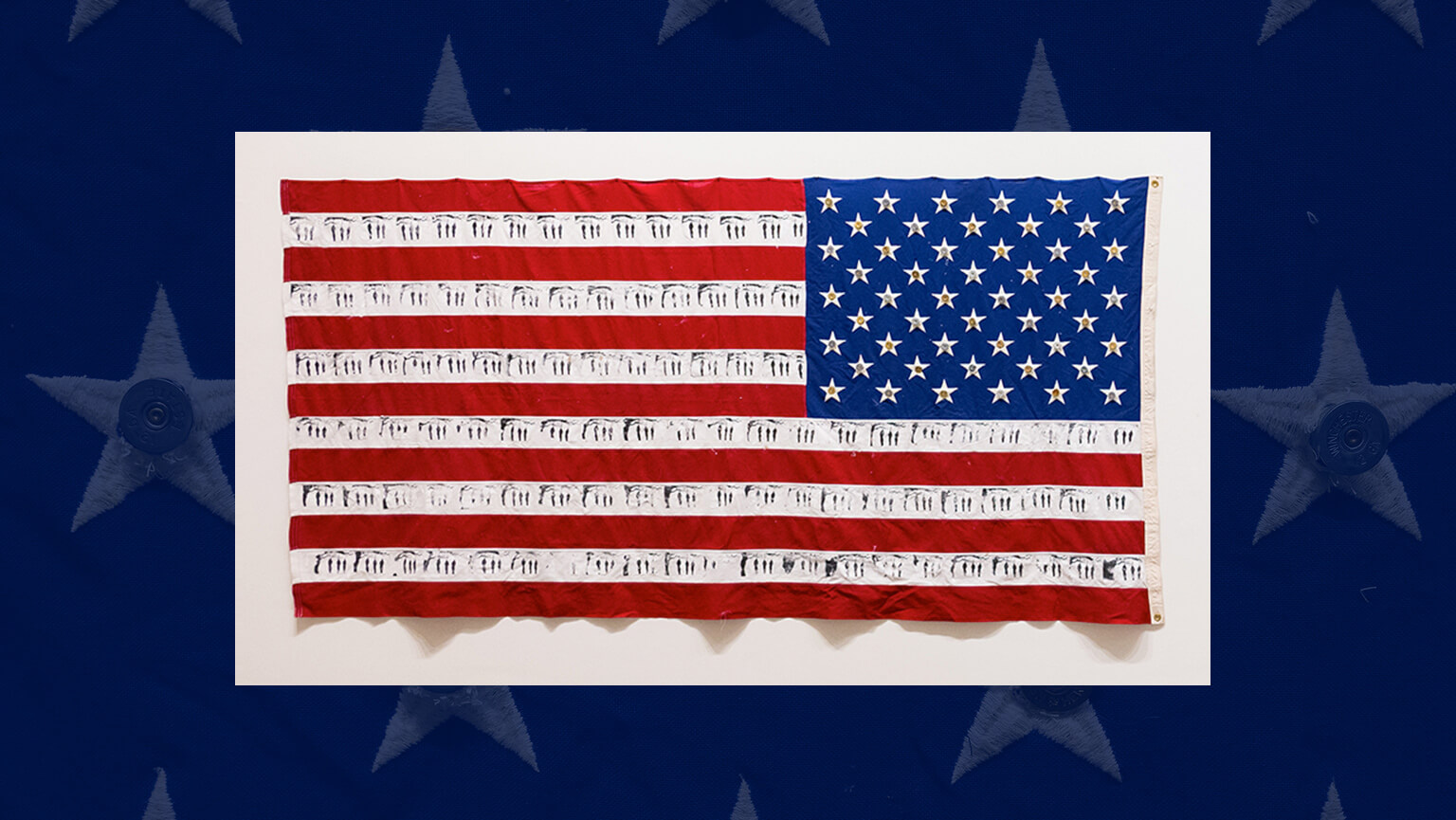
For Which It Stands...

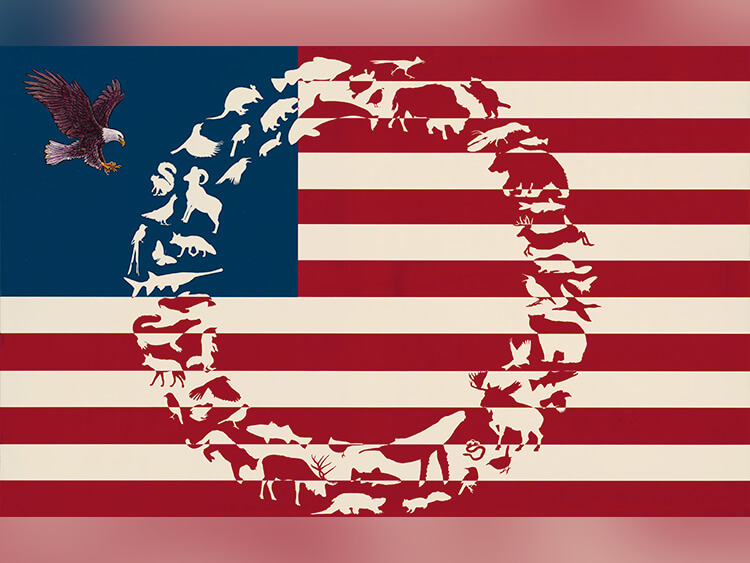
The image shows a U.S. flag with alternating red and white stripes; the white stripes feature small, black stitched figures. The blue field contains stars. The artwork conveys a sense of commentary or questioning, merging traditional patriotism with subtle messages.
On view in the Walsh Gallery: Danielle Scott, False Flag, 2020, Photo transfer and found objects (shotgun shells) on US flag. Courtesy of the artist. © Danielle Scott.
By Kiersten Bjork ’21

The Fairfield University Art Museum is marking the 250th anniversary of the signing of the Declaration of Independence with a major loan exhibition centered on the American flag.

When you think of the American flag, what comes to mind? What does it mean to you? Who does it represent—and who does it not?

These questions and more are posed through an impressive range of artistic voices in the Fairfield University Art Museum’s nationally sourced, landmark exhibition—For Which It Stands…

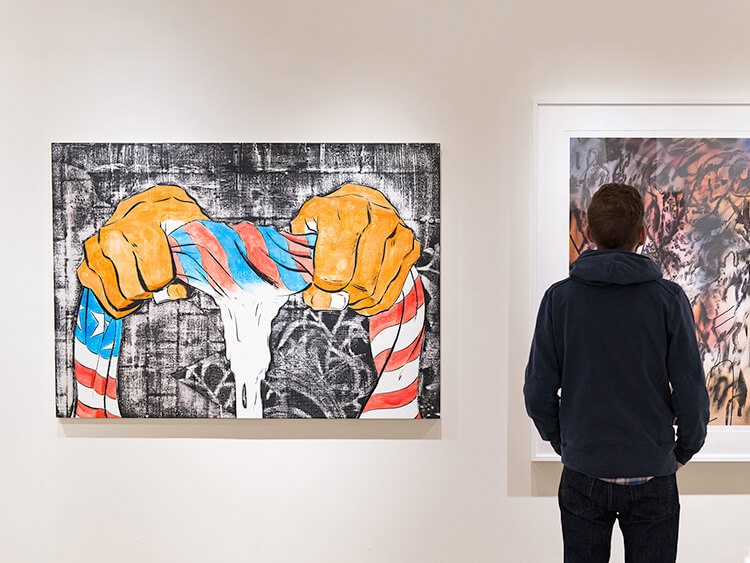
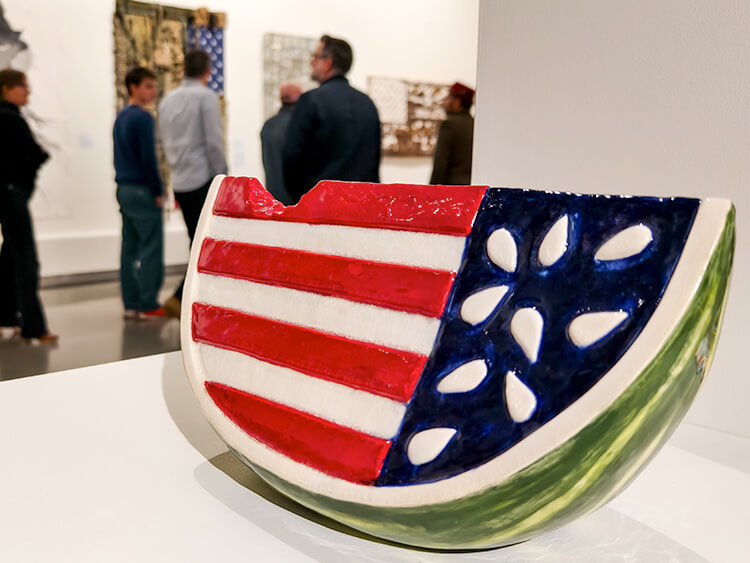
For Which It Stands… examines depictions of the American flag through more than 70 artworks created over more than a century, from World War I-era pieces to contemporary works. Featuring art in a variety of media by artists including Jasper Johns, Faith Ringgold, Robert Rauschenberg, Shepard Fairey, and Julie Mehretu, the collected works challenge viewers to consider who the American flag truly represents and whether justice is available to all.

The exhibition runs Jan. 23 through July 25, 2026, in both the Bellarmine Hall Galleries in Bellarmine Hall and the Walsh Gallery in the Regina A. Quick Center for the Arts. It is positioned as a powerful centerpiece of Fairfield’s America250 programming in celebration of the 250th birthday—the semiquincentennial—of the United States.

“As we approach the 250th anniversary of the United States, Fairfield University is proud to serve as one of the central convening forces for America250 programming in our region— bringing together scholarship, the arts, and public dialogue in ways that are both rigorous and inclusive,” said Fairfield University Provost Christine Siegel, PhD. “The exhibition affirms our belief that universities play a vital civic role: creating space for thoughtful engagement, complex inquiry, and shared conversation as we consider where we have been as a nation and where we are called to go next.”
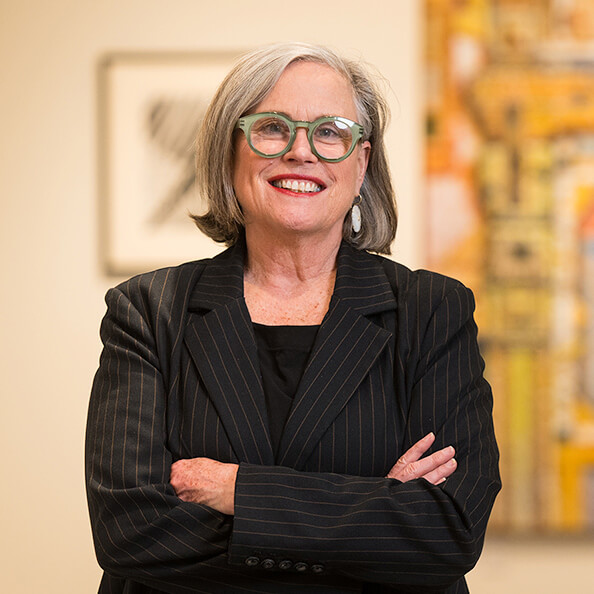
Carey Mack Weber, the museum’s Frank and Clara Meditz Executive Director, is the curator of the exhibition and has been working on assembling the collection of artworks on display for more than five years.

“This project is personal,” said Weber. “I grew up in Concord, Mass., where each April the ‘shot heard round the world’ is commemorated on Patriots’ Day. As a teenager in 1975, I witnessed the bicentennial celebrations that began there, experiences that shaped my sense of history and civic identity.

“With For Which It Stands…, I wanted to mark the semiquincentennial in a meaningful way for both the museum and the University: by presenting artworks that use our most enduring national symbol to question, to commemorate, and to engage.”

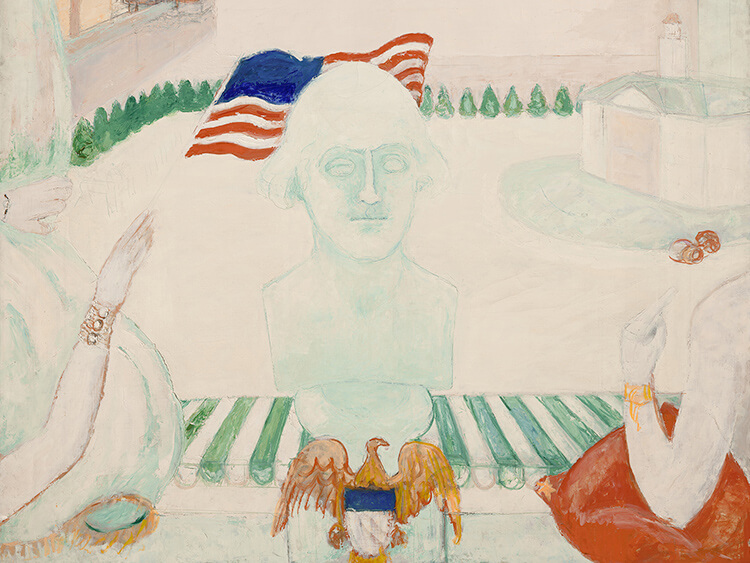
Inspiration for the exhibition began with Childe Hassam’s Italian Day, May 1918, which Weber discovered in the Art Bridges database in 2020.

“I knew I wanted to start with the Hassam painting from 1918, and from there I wanted to cover World Wars I and II, and then all major historical events—from the moon landing, civil rights, integration, Vietnam, the bicentennial, and flag law, to the wars in the Middle East, AIDs crisis, 9/11, Black Lives Matter, eco rights, immigration, and Indigenous rights. As I started finding artwork, it began to organically fill in the timeline, and after that it was a matter of filling in the remaining gaps.”

Weber was drawn to artists whose work embodied the depth and complexity she hoped to showcase—but she could never have predicted how timely those pieces would feel today. “When I began developing this exhibition five years ago, I could not have anticipated the turbulence of our current moment,” Weber reflected. “My goal, however, has remained constant: to create an exhibition that fosters civic engagement through art—highlighting artists whose work invites us to confront the complexity of our past, acknowledge present challenges, and imagine future possibilities. As the artists here reimagine the flag, they reveal not only our shared victories but also the injustices that demand reckoning.”

True to that vision, For Which It Stands… showcases a range of points of view on the flag and its role and representation over time.

“Hopefully people will take the time to look at the art through the lens of the artists who created it and try to imagine the place that they’re coming from,” said Weber. “Every piece is telling a different story—from patriotism to protest, beautifully poignant paintings to works with no historical meaning whatsoever. The intent is to showcase a thought-provoking mixture that will get people thinking and talking—a way to mark this historic moment in time in a thoughtful way.”

The exhibition features nationally recognized and local contemporary artists—many of whom will visit campus for talks and programs—inviting a multidisciplinary conversation about the ideals and contradictions embedded in the American story. Artists such as Maria de Los Angeles—whose textile sculpture, Freedom Is Not Free?, was commissioned specially for this exhibition—will give gallery talks about their work, shining a light on the creative process and meaning behind the artworks.

The For Which It Stands… exhibition has garnered widespread national attention—including coverage in The New York Times—inviting broader audiences into Fairfield’s America250 arts and humanities programming and affirming the University’s role in shaping cultural dialogue through art.

In the For Which It Stands… exhibition catalog, Fairfield University President Mark R. Nemec, PhD, wrote:

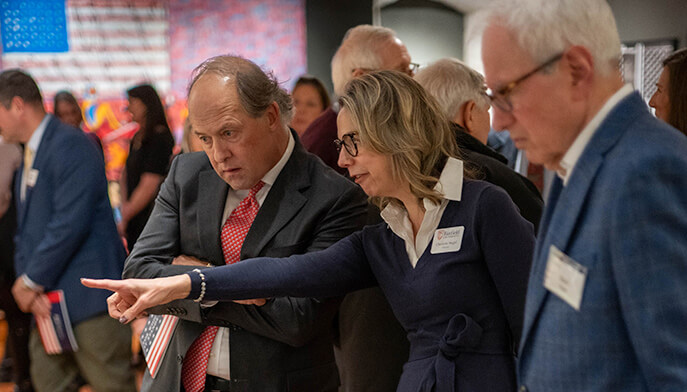
Provost Christine Siegel, PhD points ahead while talking to President Mark R.Nemec, PhD in a crowded event. They appear engaged and serious. Attendees in formal attire are visible in the background.
Fairfield University President Mark R. Nemec, PhD, and Provost Christine Siegel, PhD, toured the exhibition in the Bellarmine Hall Galleries following the opening night lecture.

“American higher education is the embodiment of American exceptionalism. From the founding of Harvard College in 1635 to the founding of Fairfield University in 1942 to today, our higher education institutions have been central to the American project. Our nation’s extraordinary history and example is in no small part a product of the breadth and depth of our remarkable model for higher education. It is with this Tocquevillian ethos in mind that we are most excited about the exhibition For Which It Stands…, which examines depictions of the American flag over the past century—from patriotic to politically charged.

“We host this exhibition as not simply a museum, but as a university—a university whose societal role in our American context is to ensure public ideas and public discourse are essential. For as I have written previously, ‘if the university comes to be broadly perceived as simply a vested interest inhibiting the consideration of reform, rather than as an agenda-setting institution, its unique societal position—its relevance—is lost.’

“Fairfield University’s relevance stems not just from our commitment to free inquiry, but from our over 500-year Jesuit, Catholic educational tradition which embraces the centrality of the arts in our shared endeavor of advancing human flourishing and seeking wisdom in support of the dignity of every individual and the greater good—or as our motto states, Per Fidem ad Plenam Veritatem—Through Faith to the Fullness of Truth.”

To learn more about the exhibition, including visiting hours and the full schedule of programs, visit fairfield.edu/museum.

Related Stories