The Art of Counting

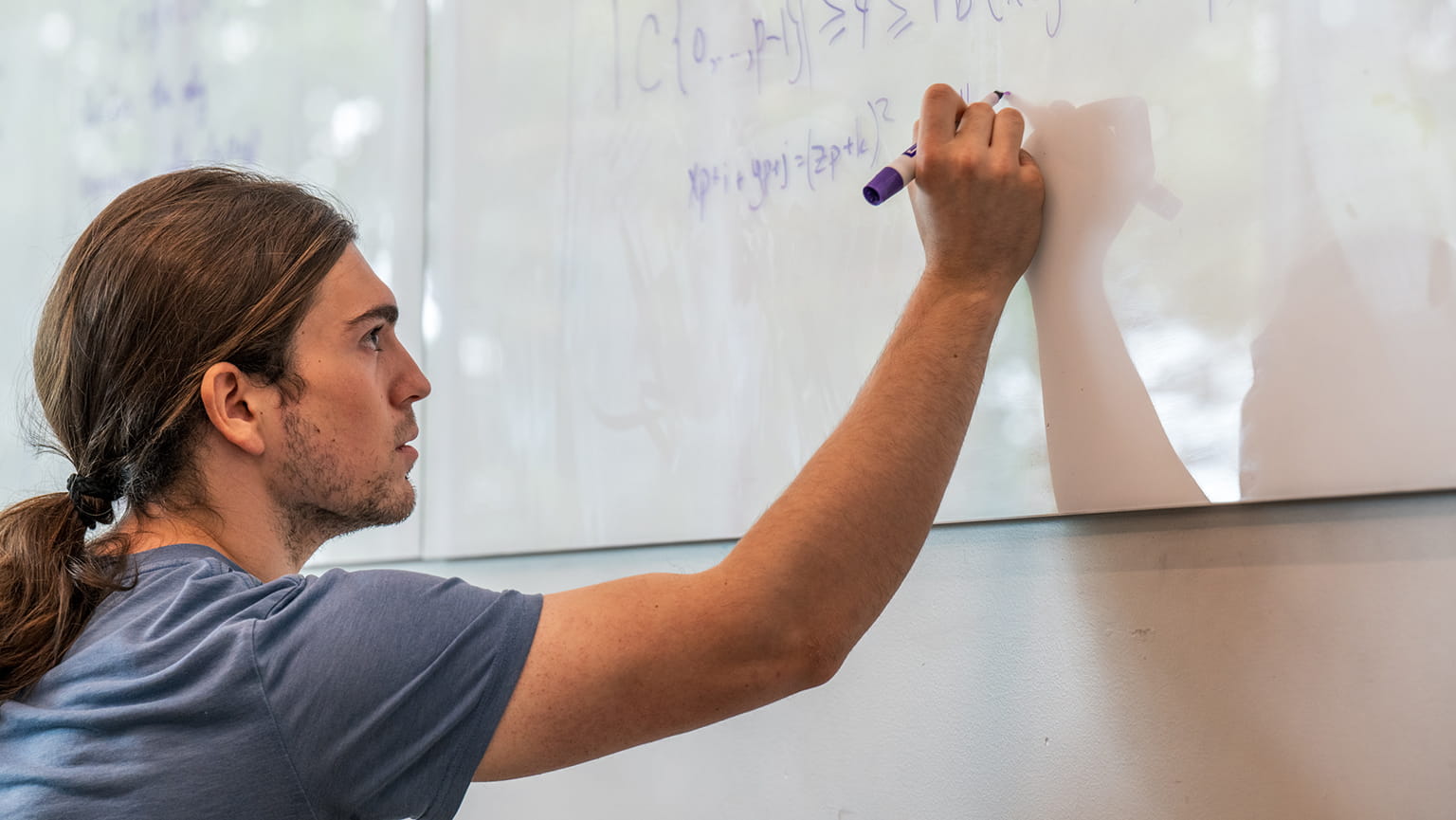
A focused young man with long hair writes equations on a glass whiteboard with a purple marker in a bright classroom, conveying concentration.
During the summer research program, mathematics students worked with Zhanar Berikkyzy, PhD, on anti-Ramsey theory.
By Sara Colabella ’08, MA’11, EdD’26

Some mathematical questions are surprisingly easy to ask—and remarkably difficult to answer.

That tension is what first drew Zhanar Berikkyzy, PhD, associate professor of mathematics at Fairfield Meditz, to combinatorics—a field that examines counting, patterns, and structure.

“Counting is often considered easy, even boring; we learn to count before we start school. But I would argue that counting is one of the most profound and humbling activities in mathematics,” said Dr. Berikkyzy.

Her research focuses on anti-Ramsey theory, an area that explores colorful mathematical rainbow structures. While traditional Ramsey theory investigates when order must appear in large systems, Dr. Berikkyzy examines the conditions under which differently colored elements are guaranteed to exist.

Supported by a National Science Foundation grant, her work investigates rainbow substructures in graphs and equations. Recent research conducted with students was presented at the Joint Mathematics Meetings in Washington, D.C., one of the nation’s largest mathematics conferences. This year, Dr. Berikkyzy and her collaborators will also host a workshop on anti-Ramsey theory at Carnegie Mellon University, bringing together researchers from across the country.

At the center of her scholarly work is a commitment to involving students in authentic research experiences. “I work with undergraduates on open research problems, meaning nobody knows the answer. Not me, not anyone,” she said.

This summer, Dr. Berikkyzy’s students looked at a challenging problem in anti-Ramsey theory. They are researching how many colors are needed to guarantee a rainbow solution to the nonlinear equation x+y=z^k in Z_n, where n is a positive integer. The students have already established part of the result and are now working toward proving a matching upper bound. The problem is advanced enough that researchers at other universities are currently studying a related nonlinear equation x-y=z^k, highlighting the level of mathematical research Fairfield students are conducting. In June, the group traveled to Jane Street Math Day in New York City to give a poster presentation and to the Yale Research Experiences for Undergraduates Conference to give a talk on their results. Students will be giving a talk at a joint math meeting in Chicago in January 2027 and are currently writing a paper that they hope to submit to a journal.

“This is what typical summer research with students looks like to me,” Dr. Berikkyzy said. “Two months wrestling with a problem nobody has solved: some days the whiteboard is covered in ideas, other days it is stuck on a single step. That is exactly the point—students get a real experience of what it means to do mathematics. We are navigating unexplored territory together.”

Over the years, Dr. Berikkyzy has watched students transform through their involvement in research. Many have gone on to graduate programs at institutions including Michigan, Pittsburgh, Colorado Boulder, Nebraska Lincoln, University of Connecticut, Notre Dame, Indiana University, and Rutgers. Students have also co-authored peer-reviewed publications and won presentation awards at national conferences.

For Dr. Berikkyzy, however, the greatest reward is witnessing students grow in confidence and discover their own potential. “The moment something clicks—that particular smile—it never gets old.”

Related Stories