Flagship University Centers Mark 20 Years

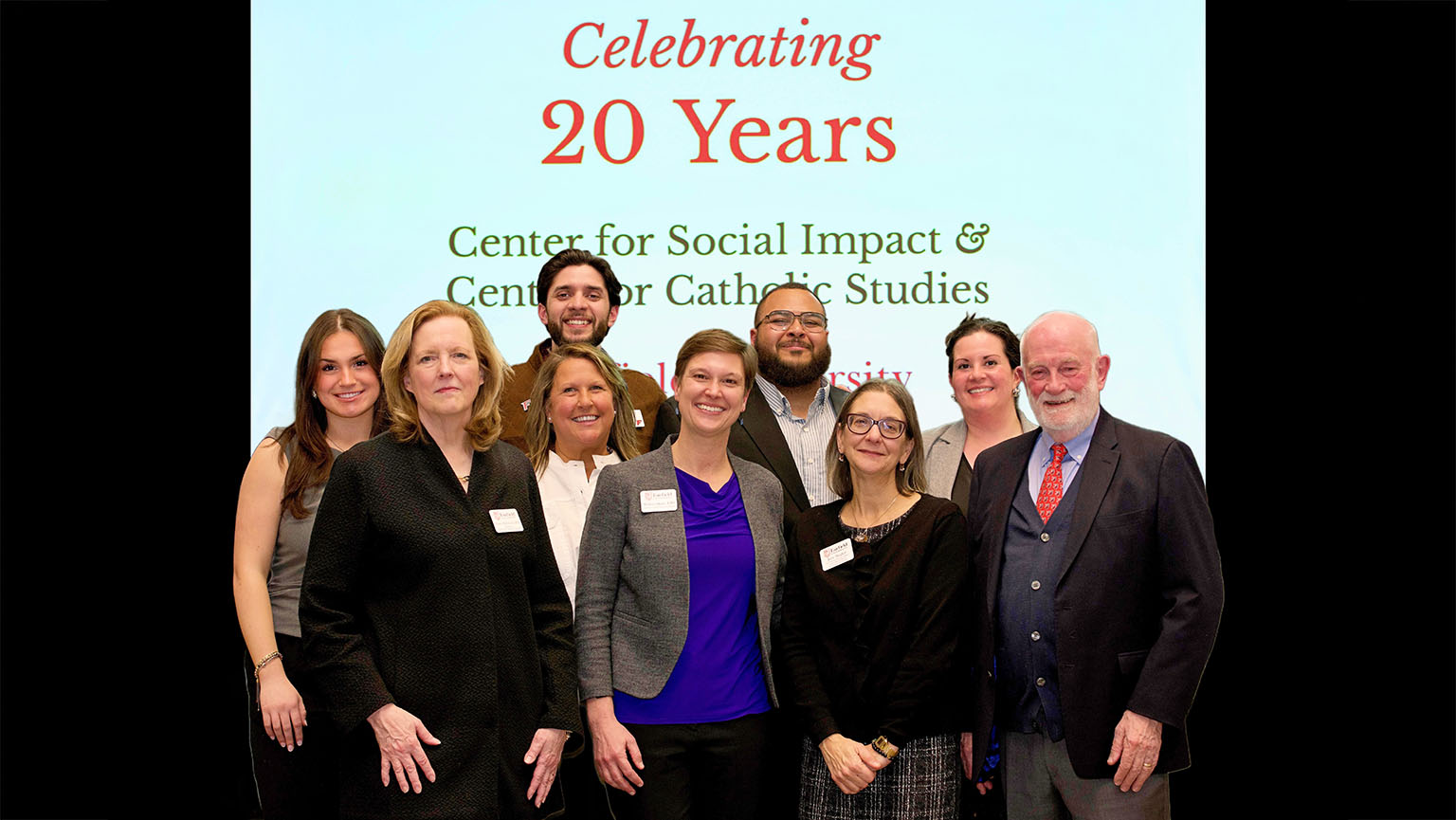
A group of people celebrating 20 years of social impact and care studies, smiling and standing together.
Professor Emeritus Paul Lakeland, PhD (far right), posed with Center for Catholic Studies and Center for Social Impact faculty and staff members.
By Jeannine Graf

Invited guests gathered on March 3 to celebrate the 20th anniversary of Fairfield University’s Center for Catholic Studies and Center for Social Impact.

The evening included a dinner and lecture by Kim Daniels, PhD, presented by the John Charles Meditz College of Arts and Sciences in partnership with America Media.

Professor Emeritus Paul Lakeland, PhD, founding director of the Center for Catholic Studies in 2005, and Fairfield University President Emeritus Rev. Jeffrey P. von Arx, S.J., (2004-2017) joined University President Mark R. Nemec, PhD, in offering remarks at the event.

The Center for Catholic Studies

For two decades, the Center for Catholic Studies has promoted understanding of the Catholic Intellectual Tradition through scholarly programming that connects Fairfield’s mission to its academic life. The center sponsors seminars, conferences, and an annual lecture series exploring Catholic and Jesuit themes.

Welcoming guests, Nancy Dallavalle, PhD, associate professor of religious studies and center’s current director, highlighted two recent initiatives.

The first, a new fall program called Faith and Fairfield, invites first-year students “to unpack the story of lived faith in action.” The second, the Canisius Faculty Fellows program, brings faculty members from across departments of the John Charles Meditz College of Arts and Sciences together to discuss projects that engage the Catholic Intellectual Tradition.

From the Catholic roots of the call for social justice to the Catholic understanding of what it means to be human, Dr. Dallavalle said the fellows program aims to “thicken the conversation about ‘Catholic’ that our faculty bring to their teaching and research.”

In his remarks, Dr. Lakeland noted that both the Center for Catholic Studies and what was then known as the Center for Faith and Public Life were established in response to the declining number of Jesuits on campus. The centers filled a void and cemented the relationship between Fairfield’s academic work and its Jesuit mission. They are, he said, “bonded to the University in those places where all that they do is done because—and only because—it serves the mission.”

Looking ahead, Dr. Lakeland proposed that the centers continue adapting to the ever-evolving University by adding a new, explicitly Jesuit dimension to the discussion of mission, taken from Pope Francis’s call in the encyclical letter Laudato Si’. Drawing on the concept of buen vivir—a Spanish phrase meaning “living well”—he described a vision in which every dimension of Fairfield’s work includes a calling “to be apostles of a better humanity in a better world.”

“The centers will be here,” he said, “to be sacraments, or living signs, of the call to embody buen vivir.”
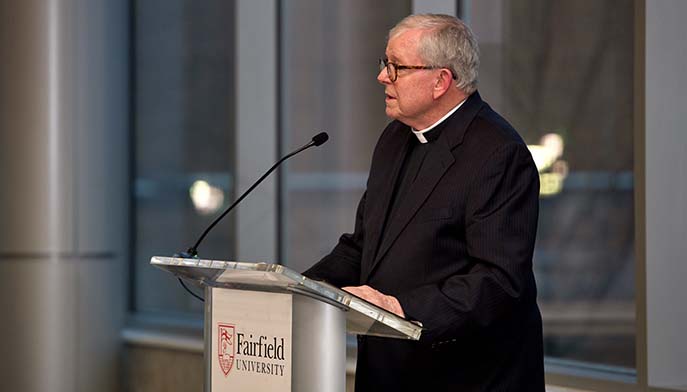
Image of President Emeritus Rev. Jeffrey P. von Arx, S.J.
The Center for Catholic Studies and the Center for Social Impact were founded in 2005, during the tenure of President Emeritus Rev. Jeffrey P. von Arx, S.J.

The Jeffrey P. von Arx, S.J., Seminar in the Catholic Intellectual Tradition

Acknowledging Fr. von Arx’s support of the Center for Catholic Studies and his encouragement for its ongoing Presidential Seminar, Dr. Dallavalle announced that beginning in September 2026, the program will be renamed the Jeffrey P. von Arx, S.J., Seminar in the Catholic Intellectual Tradition.

Before offering the meal’s blessing, Fr. von Arx reflected on the creation of what he called “the two flagship centers of the mission of the University” in the early days of his presidency. He honored the founding directors and thanked the current leaders and supporters who have sustained the centers’ work over the years.

The Center for Social Impact

The Center for Social Impact—formerly called the Center for Faith and Public Life—was established in 2005 through an anonymous $2 million gift. Rev. Richard Ryscavage, S.J., former director of the Jesuit Refugee Services, served as its founding director.

Melissa Quan, EdD, the current director, noted that Fr. Ryscavage “imagined a center that would help the University live more fully in its social responsibilities.”

Twenty years later, she said, the center’s name has changed but its vision remains constant. More than 9,000 students have participated in community-engaged learning courses, and more than 2,000 in humanitarian action courses.

“These numbers matter,” said Dr. Quan, “but what matters more is who these students have become: educators, advocates, business and nonprofit leaders, healthcare professionals, and public servants.”

In recognition of Fr. Ryscavage’s enduring commitment to human dignity and the transformative power of a Jesuit education, Dr. Quan announced the establishment of the Richard Ryscavage, S.J., Fund for Student Success, which will support first-generation college students and help ensure that opportunities offered by the center are accessible to those facing financial barriers.

She also spoke of the center’s nationally recognized community-engaged research initiatives. Projects have helped shape national conversations on immigration and have brought students, faculty, and community partners together to address local challenges including food security, gun violence, and affordable housing.

The Center for Social Impact, she said, encourages students to learn “not just how to succeed in the world as it is, but how to participate in shaping the world as it could be.”

Carrying the Mission Forward

In closing remarks, Dr. Nemec described the work of the two centers as a living expression of Fairfield’s motto, Per Fidem ad Plenum Veritatum—Through Faith to the Fullness of Truth.

The Center for Catholic Studies, he noted, advances the University’s tradition of inquiry, while the Center for Social Impact embodies the Jesuit call to be contemplatives in action.

Both centers, he said, allow Fairfield "to be nimble, to be responsive, and to be sure that we are building an institution that can sustain itself well."

Related Stories