Temple Grandin, PhD, Offers Personal Look at Living With Autism

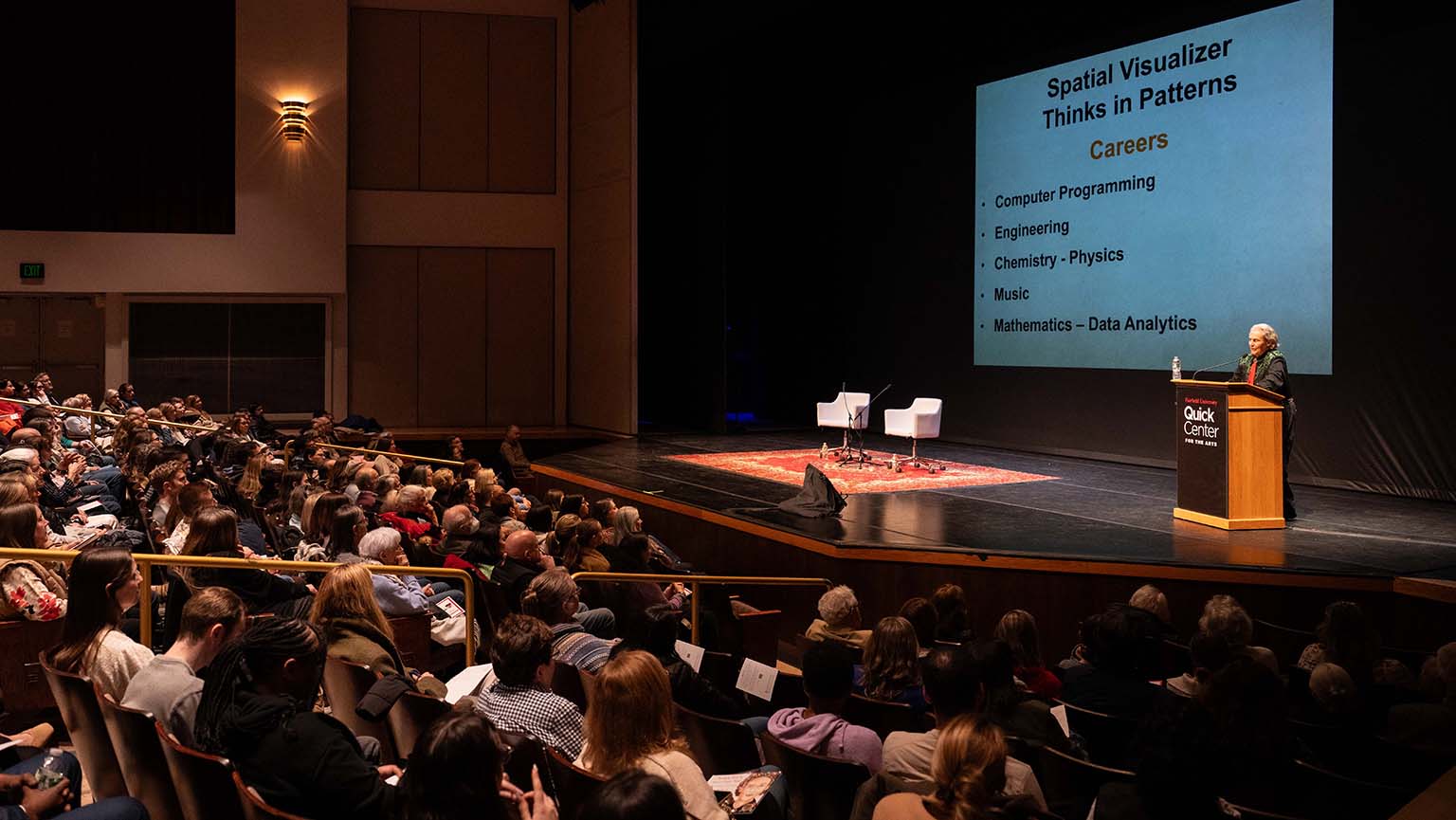
A speaker addresses a large crowd in an auditorium, engaging the audience with his presentation.
On March 25, a sold-out crowd filled the Quick Center for the Arts to see autism advocate Temple Grandin, PhD.
By Sara Colabella

Temple Grandin, PhD, is a professor of animal sciences at Colorado State University. In her lecture, “The Way I See It: A Personal Look at Autism,” on March 25, the author, scientist, and autism advocate shared insights from her life and offered her perspective on how to better educate and work with those with autism.

Dr. Grandin’s work has been covered by The New York Times, People, National Public Radio, and 20/20. In 2010, she was named one of Time magazine’s 100 most influential people of the year. That same year, Temple Grandin, an HBO movie based on her life, starred Claire Danes and received seven Emmy Awards. The author of more than a dozen books, Dr. Grandin engaged with Fairfield students and audience members at a reception and book signing after her lecture.

Life with Autism
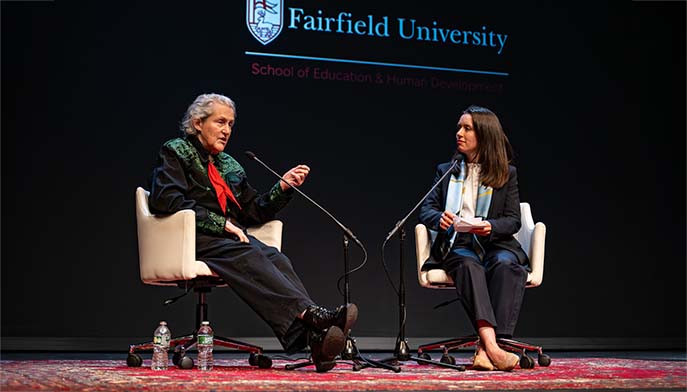
Two speakers in conversation on a stage at Fairfield University’s School of Education and Human Development event.
The lecture was part of the School of Education and Human’s Development’s diversity lecture series.

Addressing a full house at the Regina A. Quick Center for the Arts, Dr. Grandin spoke of her childhood, highlighting the role her mother played in ensuring she had access to education and opportunities to build social skills. She remembered selling candy for charity, working a sewing job at 13, cleaning horse stalls, helping on her aunt’s ranch, and starting a sign painting business at 17. These experiences, she said, were instrumental in developing both practical and social skills—things she believes are especially important for autistic youth.

Dr. Grandin also discussed the ongoing need for skilled labor, specifically in fields that involve building and fixing. She suggested expanding vocational education and hands-on training programs, because such pathways are especially well-suited for visual thinkers. “By putting trade schools back in the community colleges, we need to start kids a lot younger with [using] tools,” said Dr. Grandin.
 

Three Ways of Thinking

According to Dr. Grandin, people on the autism spectrum think in three different ways: visual thinking, pattern thinking, and verbal/logic thinking. She explained how each comes with its own strengths. A visual thinker like herself, for example, processes information through detailed, photo-realistic mental images. She credited this perspective with shaping her ability to observe the world in ways others might miss, which led to her groundbreaking work in livestock handling.

Pattern thinkers who excel in recognizing systems and spatial relationships thrive in fields like math, engineering, and computer science, Dr. Grandin said. Verbal/logic thinkers think in words and facts, with strengths in writing, teaching, and communication. Rather than viewing these approaches as limitations, she argued that each represents a valuable way of understanding and engaging with the world.

“It was an honor to host Dr. Temple Grandin as our Diversity Lecture Series speaker. As a pioneering scientist, autism advocate, and teacher, her life’s work has transformed how we understand animals, human difference, and the dignity inherent in every mind,” said Evelyn Bilias Lolis M'02, PhD, dean of the School of Education and Human Development. “Dr. Grandin’s innovations in animal welfare arose not only from technical expertise, but from a capacity to perceive stress, fear, and environment from another creature’s point of view. This integration of intellect and empathy offers a powerful model for our students and scholars—reminding us that knowledge reaches its highest purpose when guided by humane concern.”

Related Stories