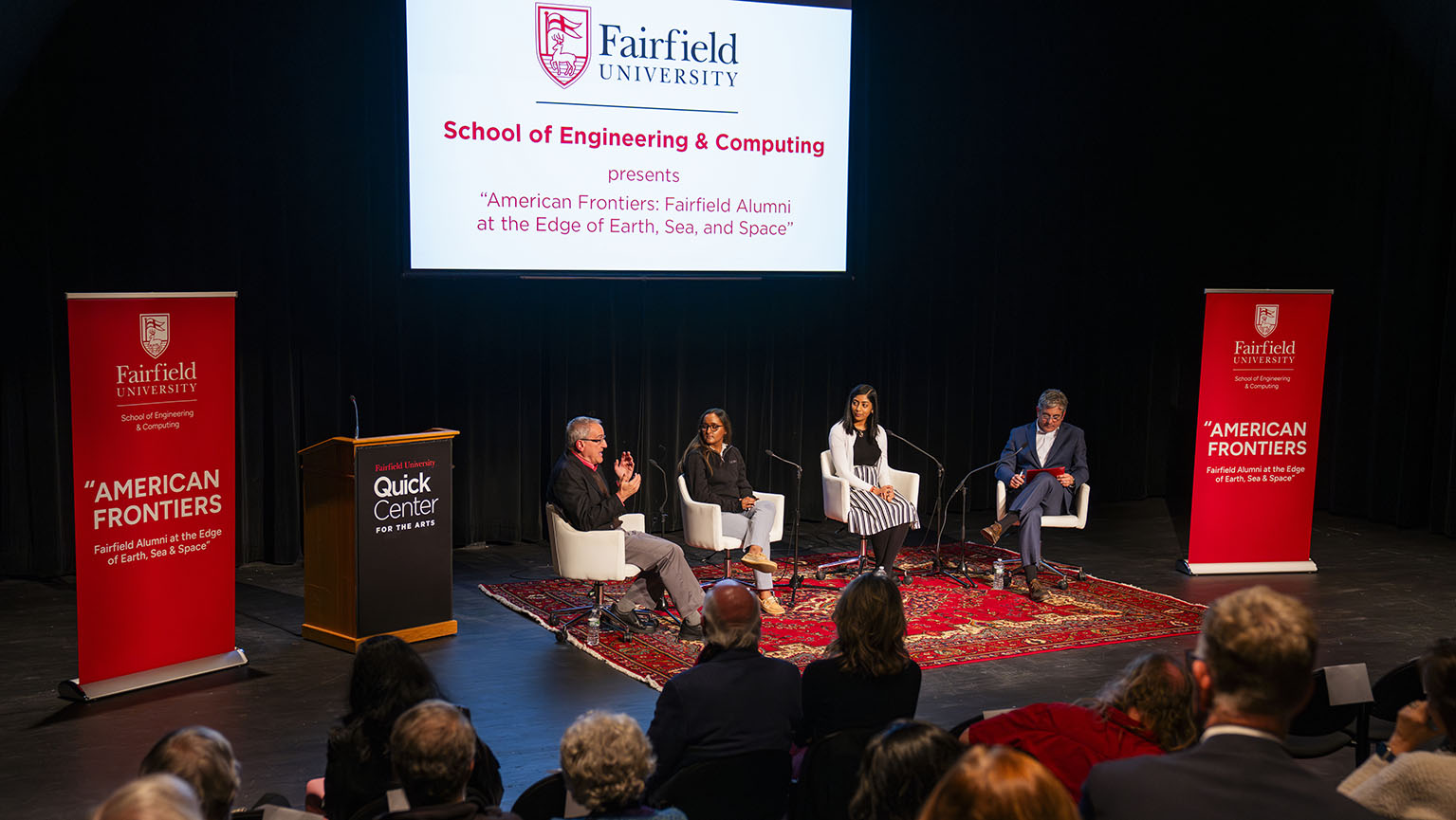
The School of Engineering & Computing presents The Bob Sobolewski ’70 Speaker Series: “American Frontiers: Fairfield Alumni at the Edge of Earth, Sea, and Space.”
Fairfield alumni of The School of Engineering and Computing are driving the next era of discovery—from missions to Mars and microgravity research, to deep-sea exploration and developing the military technologies of the future.
Part of Fairfield’s America250: The Promise and Paradox programming, an initiative through which the University explores 250 years of the American experiment, “American Frontiers” brought together three Fairfield alumni making their mark in their respective fields: NASA Jet Propulsion Lab’s (JPL) Joe Sauvageau ’79, PhD; Blue Origin’s Manjot Singh ’23; and Johns Hopkins University Applied Physics Lab’s (APL) Stephanie Brij-Raj ’21.
Andres Carrano, PhD, dean of the School of Engineering & Computing and former NASA faculty fellow at the Marshall Space Flight Center welcomed students, colleagues, community members, family, and friends to the Wein Black Box Theatre at the Regina A. Quick Center for the Arts on Monday, December 1. Following Dr. Carrano’s remarks that introduced the speakers and brought the audience up to speed on the differences between “old space” and “new space”, each of the alumni shared insights and practical applications from their current work.
Brij-Raj currently serves as an undersea warfare analyst at APL, following her time in the APL Discovery Program, which allowed her to explore a variety of roles within the research center as she was first entering the field—from space and exploration to asymmetric operations, force projection, and air and missile defense. Currently, Brij-Raj works at the intersection of cyber and submarines. As she explained, “many of our current submarines were designed and built in a time before modern cyber threats” and so there is a need to analyze and assess how our current submarines and respective technologies can be vulnerable to those threats, and how they can be upgraded to account for them. Her work also takes her directly to the source. “I have been on submarines, and talked directly with war fighters,” she shared, and that direct approach allows her and her team to best understand and serve the current needs of those on the ground.
Singh is a crew systems, payloads, and launch vehicle engineer, whose focus is on the systems inside the crew capsule. Specifically, Singh works on the New Shepard Program out of West Texas, which many may recognize as the facility responsible for launching Katy Perry and an all-female crew into space. “Reducing the cost of accessing space is one of the biggest goals right now,” Singh explained, highlighting how Blue Origin is one of the companies leading the charge on this front. Longterm, this goal is directly tied into increasing access to space overall. “Reusable systems play a huge role,” Singh shared, as it can greatly reduce the cost if new components aren’t being built for every launch.
Dr. Sauvageau is the Cal-Tech, JPL principal engineer, as well as supervisor of the imaging system architectures group. One of the highlights he shared from his work was that his group made the cameras that looked up and down at the parachutes on a Mars rover landing. During his time at Fairfield, Dr. Sauvageau recalled experiencing the launches of Voyager 1 and 2, and even though the cameras are no longer on, those two missions are still sending data back to JPL to this day.
Following their individual presentations, Dr. Carrano moderated a panel conversation with all three alumni. The conversation provided a deeper dive into the personal experiences, from Brij-Raj’s research on lunar dust as part of APL’s work toward having a sustainable presence on the moon, to Dr. Sauvageau’s perspective on the moon vs. Mars debate—“the current administration and Congress set our priorities,” he shared, but ultimately confirmed, “moon first, then Mars.”
“I believe that the strength and quality of any academic program is always best demonstrated through its alumni outcomes,” said Dr. Carrano. “This event showcased both recent and seasoned Fairfield graduates from our engineering, computing, and science programs, who have gone on to work on the NASA Ingenuity missions on Mars, and the pioneering all-female crew that flew the New Shepard mission, as well as in Lunar Dust mitigation and habitat construction projects on the moon.”
“American Frontiers” was part of the Bob Sobolewski ’70 Speaker Series, hosted by Fairfield University’s School of Engineering & Computing, which will continue to bring distinguished alumni and industry-leading innovators to campus for conversations that inspire, educate, and shape the future of the school’s mission, “engineering for a higher purpose.”