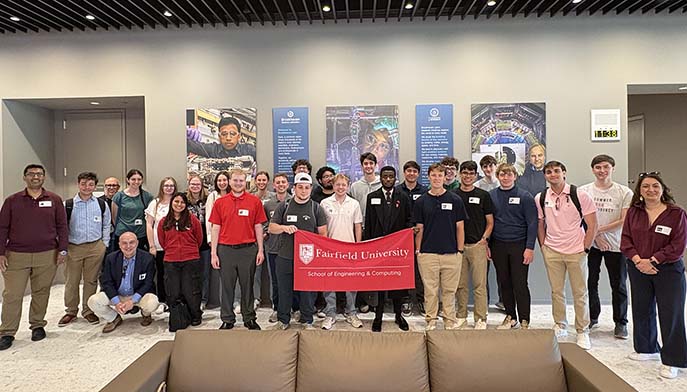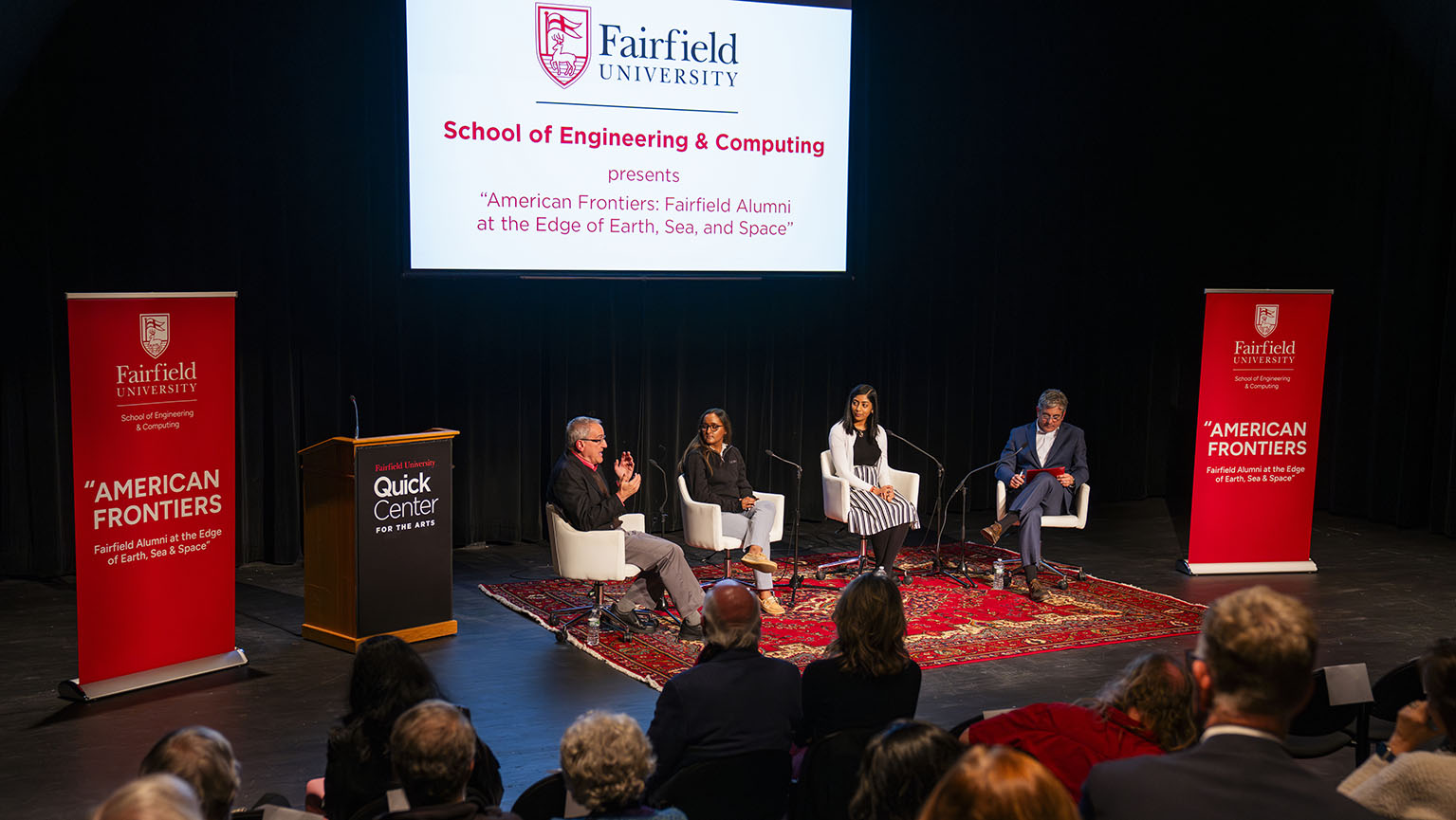
The School of Engineering and Computing presented “American Frontiers: Fairfield Alumni at the Edge of Earth, Sea, and Space” as part of the Robert "Bob" Sobolewski '70 Family Distinguished Speaker Series.
Fairfield alumni are driving the next era of discovery—from missions to Mars and microgravity research, to deep-sea exploration and development of military technologies.
Part of Fairfield’s America250: The Promise and Paradox programming—an initiative through which the University explores 250 years of the American experiment—“American Frontiers” showcased three Fairfield alumni making a mark in their respective fields: NASA Jet Propulsion Lab’s Joe Sauvageau ’79, PhD; Blue Origin’s Manjot Singh ’23; and Johns Hopkins University Applied Physics Lab’s Stephanie Brij-Raj ’21.
Andres Leonardo Carrano, PhD, dean of the School of Engineering & Computing and former NASA faculty fellow at the Marshall Space Flight Center, introduced the speakers and brought the audience up to speed on the differences between “old space” and “new space” before inviting the alumni to share insights and practical applications from their work.
Stephanie Brij-Raj graduated from Fairfield magna cum laude with a BS in electrical engineering. She currently serves as an undersea warfare analyst at Johns Hopkins’ Applied Physics Lab (APL), following her time in the APL Discovery Program, which allowed her to explore a variety of roles within the research center—from space and exploration to asymmetric operations, force projection, and air and missile defense. “Many of our current submarines were designed and built in a time before modern cyber threats,” she said. That’s why, she explained, her work focuses on identifying potential vulnerabilities and determining how current platforms can be upgraded. “I’ve been on submarines,” Brij-Raj said, “and I’ve spoken directly with the warfighters who depend on them.”
Manjot Singh earned her BS in mechanical engineering with a minor in mathematics. At Blue Origin, she is a crew systems, payloads, and launch vehicle engineer, whose focus is on the systems inside the crew capsule. She works on the New Shepard Program out of West Texas—the facility responsible for launching Katy Perry and an all-female crew into space. “Reducing the cost of accessing space is one of [the industry’s] biggest goals right now,” she said, noting that Blue Origin is one of the companies leading that effort. Ultimately, lowering costs is what will make space more accessible. “Reusable systems are a major part of that,” she added. “Not having to build new components for every launch dramatically reduces expenses.”